Applying in the UK, Ireland or New Zealand? Read the CV version of this guide.
Tailoring a resume does not require a tool. It requires twenty minutes, a printout of the job description, and a decision about what to cut. What it mostly requires is knowing which twenty minutes, because the version of this advice that tells you to "customise your resume for every role" is true and useless in the same breath.
This guide is published by JobShifu, which sells software that does this work. The method below needs none of it, and the numbers that shape it are sourced at the end.
What you are actually optimizing for
Most tailoring advice quietly assumes a robot is rejecting you, and sets the target accordingly: get your keyword match above some percentage and you will get through. That target is mostly fiction.
Jobscan is the largest vendor in the applicant-tracking-optimization category, which makes them the last people you would expect to say it, and their own 2026 guide says an ATS "rarely 'rejects' a candidate automatically" [1]. Enhancv interviewed 25 US recruiters in late 2025 and found 2 of them had configured any content-based automatic rejection [2].
What is actually in the way is arithmetic. Greenhouse analysed more than 640 million applications and found the average role drew 244 applications in 2025, up from 116 in 2022, while recruiters per organisation fell from 10.43 to 4.62 [3].
So you are not beating a filter. You are number 180 in a stack of 244, in front of a person with half the colleagues they had three years ago. That sets the whole brief:
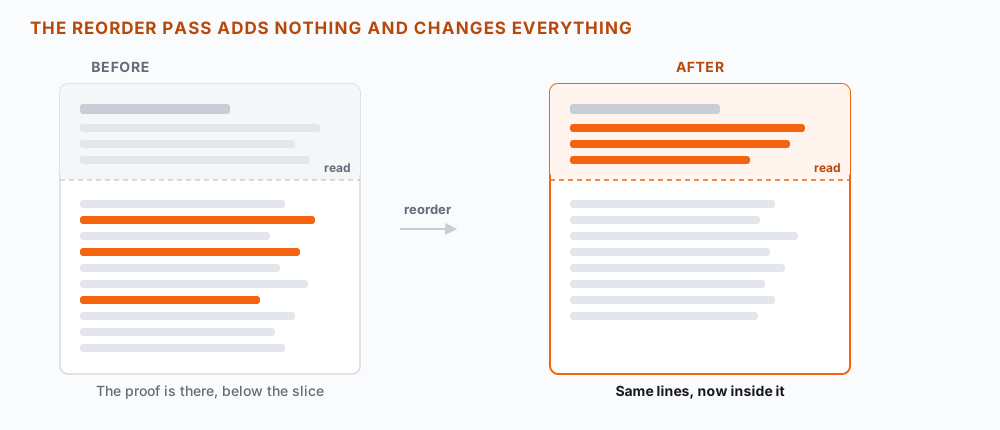
- The goal is that the top third of page one proves you fit this job, because in a stack that size, that is what gets read.
- Every line has to survive being asked about. A resume that wins the scan and falls apart in the screening call was never an advantage.
- Cutting is the main tool. Not adding.
Step 1: the document you will never send
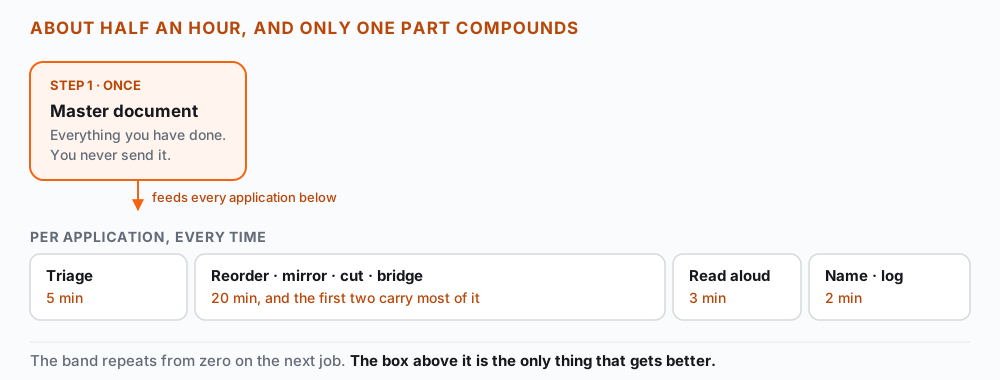
Before you tailor anything, you need one file holding everything you have done, because tailoring is selection, and you can only select from what is written down.
Yale's career office describes it well: the master version covers the past ten years of experience, education, skills, special training, awards, publications, related coursework, volunteer work, memberships and presentations, and you derive a one or two page resume from it for a specific application [4].
Length does not matter here, because nobody reads this document. Detail does: numbers, tool names, team sizes, timeframes, and the small projects you stopped mentioning because they felt minor. Add to it every few months. The reason is unglamorous. You finish something significant in March, do not write it down, and by November the specifics are gone.
Step 2: triage the posting, because the employer has not
Print the job description. Now the part that saves you the most time.
JobShifu read 500,000 live postings and counted what they ask for. The average posting names 15.75 requirements and presents 86.8% of them as mandatory rather than preferred, and about one posting in five marks every single requirement mandatory with nothing optional at all [5].
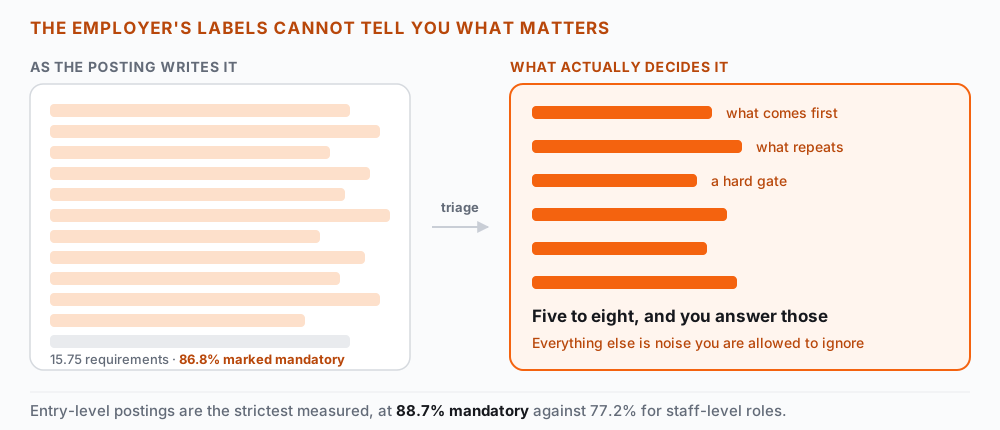
That number is the permission slip. If nearly nine requirements in ten are labelled mandatory, the label tells you nothing, and you cannot answer all fifteen in a one page resume anyway. So triage by something the employer did not control:
- What comes first. Requirements near the top of the list are usually the ones the hiring manager wrote. The ones near the bottom were often added by someone else.
- What repeats. If a phrase appears in the summary, the responsibilities and the requirements, it is the job.
- What is a hard gate. A licence, a clearance, work authorisation, a specific degree. These are pass or fail and no wording fixes them.
Highlight the five to eight that survive. That is your list. Everything else is noise you are allowed to ignore.
⚠️ One thing worth knowing before you talk yourself out of applying: entry-level postings are the strictest measured, at 88.7% of requirements marked mandatory against 77.2% for staff-level roles [5]. A long, rigid list is not evidence that a role is senior or that the employer means all of it.
Step 3: the twenty minute pass
Four passes over your resume, roughly five minutes each. In order, because the order is what keeps it short.
Reorder first. Take the five to eight requirements you highlighted and find where your evidence for each one currently sits. Anything below the fold moves up. Within each role, the bullet that proves the most important requirement goes first. You have not written a word yet and the resume is already more relevant.
Then mirror the wording. Where the posting and your resume describe the same thing in different words, use theirs. If they say "cross-functional collaboration" and you wrote "worked with other teams", change it. This is not keyword stuffing, which fails for a simple reason: a keyword sitting in a comma-separated skills list is a claim, and the same keyword inside a bullet with an outcome attached is evidence. A reader can tell the difference instantly.
Then cut. Everything that does not serve this application comes out: the role from twelve years ago, the bullet about a tool nobody here uses, the second line about a project that is not relevant. Cutting is what makes room for the reordering to matter, and it is the pass people skip.
Then bridge the title, if you need to. If the job is "Customer Success Manager" and your title is "Client Relations Specialist", do not change your title. Titles get checked in references and background screens. Add a headline at the top instead: "Client Relations Specialist with customer success experience". It connects the two for the reader in one line and stays true.
Step 4: read it aloud, once
This is the whole quality check and it takes three minutes.
Read the tailored resume out loud, slowly. Two things surface that reading silently will not catch. Any sentence you cannot say without wincing is a sentence you cannot defend in an interview, and any phrase that sounds like it came from a brochure ("spearheaded", "robust", "seamless", "best in class") is one you would never use about your own work in conversation.
For every bullet, ask one question: if someone asks me about this line, do I have a thirty second story with a specific number, a tool and an outcome? If not, the line is decoration. Decoration is what fills the space where evidence should be.
Step 5: name it, log it
Two minutes, and both save you later.
The filename. Name first, then the role: `Jane-Okafor-Data-Analyst-Resume.pdf`. Never `resume-final-v3.pdf`. A recruiter downloading forty attachments into one folder should be able to tell which job yours was for without opening it.
The log. A spreadsheet row: company, role, date, the exact file you sent, and the posting link. When someone calls three weeks later, you need to know which version of you they read.
How long it takes
The published estimates disagree wildly, which is worth knowing before you take a number from anyone. Huntr's 2026 guide says manually tailoring a resume properly takes one to three hours per application [6]. TailorForge's 2026 report says 30 to 90 minutes, with light tailoring at 10 to 20, and states plainly that it is not original primary research and its figures are indicative ranges rather than measurements [7].
An order of magnitude apart, and neither is measuring you. The method above adds up to about half an hour: five minutes to triage the posting, twenty for the four passes, three to read it aloud and two to name and log it. It fits in that because the reorder and the cut carry most of the value and neither requires writing. Time your first three applications and you will have a better number than either of those.
The real cost is not one application. It is that this resets completely on the next one, and the master document only gets better if you remember to update it, which is the step everybody drops around application six.
If you would rather not run the loop by hand every time, the same nine steps with a chat model are written out in how to tailor your resume with AI, for free, including the eight checks a generated draft needs before you trust it. JobShifu automates the same sequence and cites the confirmed experience behind every line it writes, which is described at resume tailoring.
Common questions
Do I have to tailor my resume for every single job?
No, and the triage in step 2 is what tells you. Read the posting, highlight the five to eight requirements that lead or repeat, and check them against your master document. If a hard gate is missing, skip the role entirely. If the fit is genuine, the twenty minute pass is worth it. The expensive mistake is spending the time on a job you were never going to get, and it is invisible because it feels like effort.
Is tailoring the same as lying?
No, and the distinction is what the read-aloud check protects. Choosing which true things to show a particular employer, and describing them in the words that employer uses, is what an application has always been. Adding things you did not do is different in kind, not in degree. If you can tell a thirty second story about every line, you are on the right side of it.
Should I match the job description word for word?
Mirror the wording where it describes something you actually did, and nowhere else. A keyword in a skills list is a claim; the same keyword inside a bullet with a result attached is evidence, and the second one is what survives a conversation.
Sources
- Jobscan, "What Is an Applicant Tracking System (ATS)? The Complete 2026 Guide", 10 April 2026. jobscan.co
- Enhancv, "Does the ATS Reject Your Resume? 25 Recruiters Explain What Really Happens". Interviews conducted September to October 2025. enhancv.com
- Greenhouse, Benchmark Report, March 2026, North America. Applications per open role and recruiting team size, 2022 to 2025, from more than 640 million applications across over 6,000 companies. greenhouse.com
- Yale Center for Business and the Environment, Career Planning and Development, "A note about resume writing from CPD", 1 August 2024. careers.environment.yale.edu
- JobShifu Posting Corpus, 500,000 live job postings measured 13 August 2026. Requirement counts and the mandatory share are JobShifu's own measurement; the method is in the skills that pay, from 500,000 jobs.
- Huntr, "How to Tailor a Resume to a Job Description in 2026", 11 March 2026. huntr.co
- TailorForge, "State of Resume Tailoring 2026", read 20 August 2026. tailorforge.com