You can tailor a resume to a job description with a free chat model, and it works. What no guide tells you is how many steps it really has, that eight of them are checking rather than writing, and that the whole thing resets to zero on the next job. This is the full loop, every prompt in it, and the arithmetic that decides whether you should be running it by hand.
This guide is published by JobShifu, which sells a tool that automates the loop below. The loop is given away complete and works without it. Every outside number is sourced and dated at the end.
The thing these guides optimize for is not what stops you
Almost every free tailoring guide sets the same target: get your keyword match above 80 percent so the applicant tracking system does not reject you. That target is mostly fiction, and aiming at it will cost you the thing that actually decides the outcome.
Jobscan is the largest vendor in the ATS optimization category, which makes them the last people you would expect to say this. Their own 2026 guide says that contrary to popular belief, an ATS rarely "rejects" a candidate automatically [1]. Enhancv interviewed 25 US recruiters in late 2025 and found 2 of them, 8 percent, had configured any content based automatic rejection. The other 92 percent had not [2]. The famous claim that 75 percent of resumes never reach a human traces to a 2012 sales pitch by a company that was out of business by 2013, and it has circulated without a published methodology ever since. That story is told in full on does an ATS reject your resume.
Here is what is actually in your way. Greenhouse analysed more than 640 million applications from over 6,000 companies. Applications per open role went from 116 in 2022 to 244 in 2025, up 111 percent. Over the same period, recruiters per organisation fell from 10.43 to 4.62 [3].
So you are not being filtered by a robot. You are number 180 in a stack of 244, in front of a person who has half the colleagues they had three years ago. That changes the brief completely:
- The goal is not a match score. It is that the top third of page one proves you fit this specific job, because that is what gets read.
- Every line has to survive being asked about. A resume that wins the scan and collapses in the screen call is worse than one that never got read.
- Keywords still matter, but as evidence you demonstrated something, not as tokens you listed. A skill in a comma separated Skills line and the same skill inside a bullet with a result attached are not the same claim, and the reader knows it.
Every prompt below is written for that brief rather than for a match score.
Can ChatGPT tailor my resume to a job description?
Yes, for the part of the job that is selection and wording. A chat model is good at reading a posting, finding which of your real achievements answer it, and restating them in the employer's vocabulary. That is most of what tailoring is, and the fourteen prompts below do it.
What it cannot do unprompted is stop. Six of the fourteen prompts get you a draft. The other eight check the draft, and they exist because a model asked to make a resume match a posting will close a gap rather than report one. JobShifu's own benchmark watched that happen on a control resume containing the word Kafka twice, Spark five times and Iceberg three times, and the word Flink zero times: a bullet generator asked for Apache Flink produced three bullets asserting Flink experience, and the match score on the same screen moved from 9 percent to 15 percent once one of them was saved [7].
So the answer has two halves. ChatGPT will tailor a resume to a job description, and whether the result is still yours depends entirely on whether you run the checking half.
The loop, in nine steps
Nine steps. Fourteen prompts. Six places where you have to make a judgement call that no model can make for you. Per job, every time.
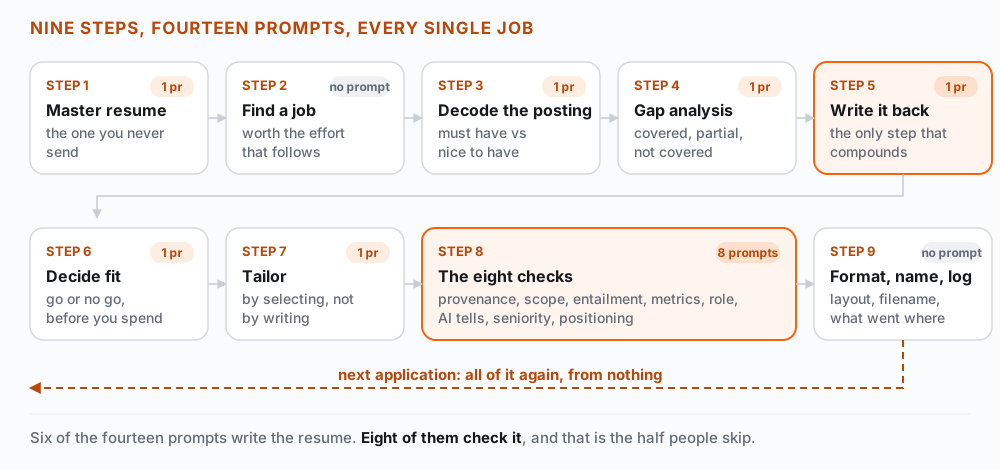
Step 1. Build the master resume you will never send
Before you tailor anything you need one document holding everything, because a model can only select from what you give it. Yale's career office describes the master version as the past ten years of experience, education, skills, special training, awards and honours, publications, related coursework, volunteer work, organisation memberships and presentations, from which you then derive a one or two page resume aimed at a specific application [4].
Length does not matter here. Nobody sees this document. What matters is detail: numbers, tool names, team sizes, timeframes, and the small projects you have stopped mentioning because they felt minor.
Most people write this from an existing one page resume and lose most of the detail in the process, because the one pager was already a summary. This prompt pulls the detail back out of you instead.
You are helping me build a MASTER resume. This is an internal document
I will never send to an employer, so length is not a constraint and
completeness is the only goal.

Below is my current resume. For each role in it:

1. List what the bullet points tell you I did.
2. List what a bullet like this usually leaves out: the scale, the
   tools, the people involved, the timeframe, the outcome, and what
   went wrong.
3. Ask me up to 5 specific questions per role whose answers would turn
   a vague bullet into a specific one. Ask about numbers I would know
   without looking them up.

Do not write any resume text yet. Do not invent anything. Ask the
questions and wait for my answers.

RESUME:
[paste your current resume as plain text]Answer the questions in plain language. Then paste your answers back and ask it to file each one under the right role, verbatim, without rewriting. The rewriting happens later, against a specific job. Save the result somewhere you can paste from repeatedly.
Set a reminder to add to this every few months. The reason is unglamorous: you finish something significant in March, do not write it down, and by the time you are job hunting in November the numbers are gone.
Step 2. Find a job worth the effort
No prompt here. Search, and pick one posting you would genuinely take. This step has no shortcut and it is worth being slow about, because everything after it costs you real time and it is spent whether or not the job was ever a fit.
One thing to check before you spend anything: how old the posting is. A role that has been open for six weeks has already collected most of its 244 applicants.
Step 3. Decode the posting before you touch your resume
The single most common failure is treating a job description as a bag of keywords. It is not. It has a structure: a few things that will get you rejected if you lack them, a longer list of things that are optional, and a house language the company uses about itself.
Read the job description below and produce four lists. Quote the
posting's own words. Do not paraphrase into generic skill names.

1. MUST HAVE. Requirements phrased as required, minimum, or essential,
   plus anything stated first or repeated more than once.
2. NICE TO HAVE. Requirements phrased as preferred, bonus, or a plus.
3. HOUSE LANGUAGE. The 5 to 8 phrases this company uses repeatedly to
   describe the work or itself. Include the exact phrasing, even where
   it is jargon.
4. HIDDEN REQUIREMENTS. What the posting implies but does not state:
   the seniority really being asked for, the size of team or system,
   and the problem they are most likely hiring to solve.

For each item in list 1, say whether it is a hard gate (a licence, a
clearance, work authorisation, a specific degree) or a soft gate
(years of experience, familiarity with a tool).

JOB DESCRIPTION:
[paste the full posting]Two additions that career coaches consistently recommend and that cost you almost nothing. Read the company's careers page and note the words it repeats about itself. Then look at two or three people currently doing this job on LinkedIn and note what they lead with. Postings describe the role as written; people in it describe the role as it is.
Step 4. Run the gap analysis, against the master
This is the step most people skip, and skipping it is why so many AI tailored resumes read as invented. If you go straight from posting to rewrite, the model has no way to distinguish "this candidate has done this and did not mention it" from "this candidate has not done this". It will paper over both the same way.
Compare my MASTER RESUME to the requirements list below. For every
requirement, output one row:

REQUIREMENT | VERDICT | EVIDENCE

VERDICT is exactly one of:
- COVERED. My master resume contains direct evidence. Quote the exact
  line.
- PARTIAL. There is adjacent or weaker evidence. Quote it and say
  precisely what is missing from it.
- NOT COVERED. There is nothing in my master resume that supports
  this.

Rules:
- Never mark something COVERED on the strength of a job title alone.
- Never mark something COVERED because a related tool appears. Name
  the gap.
- If you are unsure, use PARTIAL and say why.
- Do not suggest any rewrite yet.

Then, separately, list every requirement marked PARTIAL or NOT COVERED
that a person in my field plausibly HAS done but would not think to
write down. Phrase each as a question to me.

REQUIREMENTS:
[paste the must have and nice to have lists from Prompt 2]

MASTER RESUME:
[paste your master resume]That final list is the valuable part and it is the reason the gap analysis comes before the tailoring rather than after it.
Step 5. Write what you find back into the master, not into this application
Some of what the gap analysis surfaces you have genuinely done and simply never wrote down. Ten years of work does not fit in anyone's memory, and the one page resume you started from had already thrown most of it away.
The mistake is to add those things to the tailored copy for this job. Do that and the discovery dies with the application. It belongs in the master, where every future job can use it.
Below are my answers to the questions you asked about gaps. For each
answer, write ONE master resume entry:

- Which role or project it belongs under.
- One sentence in plain past tense, using my own words and numbers. No
  adjectives I did not use. No verbs stronger than what I described.
- The date or period, if I gave one.
- A note of what job description surfaced it, so I know where it came
  from.

If an answer is too vague to become a specific entry, say so and ask
me one follow up question instead of writing a weak entry.

Output only the entries. I will paste them into my master resume
myself.

MY ANSWERS:
[paste your answers]Paste the result into your master document. This is the only step in the loop that compounds, and it is the first one everybody drops around application number six.
Step 6. Decide whether to apply at all
This is a gate, not a formality, and it is where the largest saving on the whole loop lives. Tailoring properly costs you real time. Spending it on a role you were never going to get is the most expensive mistake in the process, and it is invisible because it feels like effort.
Using the gap analysis, give me a go or no go recommendation.
Structure it as:

1. HARD GATES. Any must have I marked NOT COVERED that is a hard gate
   (licence, clearance, work authorisation, specific degree). If there
   is even one, say so plainly and recommend no go.
2. COVERAGE. How many must haves are COVERED, PARTIAL, and NOT
   COVERED. Give the counts, not a percentage.
3. THE WEAKEST LINK. The single requirement most likely to end this
   application, and whether anything in my master resume can address
   it.
4. RECOMMENDATION. Go, go with reservations, or no go, in one
   sentence.

Do not be encouraging. I would rather skip a job than waste an hour on
it. Job descriptions are partly aspirational, so do not recommend no
go purely because some nice to haves are missing.The judgement is still yours. The prompt only makes the trade explicit before you have sunk the time.
Step 7. Tailor, by selecting rather than by writing
Now, and only now, the rewrite. The framing that matters: you are selecting and reordering true things, not generating new ones. A model asked to "make my resume fit this job" will fill gaps, because filling gaps is what it is for.
Produce a tailored version of my resume for the job below.

HARD RULES:
- Use ONLY content that exists in my master resume. If something would
  improve the fit but is not in my master resume, do not write it.
  List it separately under "NOT WRITTEN, NOT IN YOUR EVIDENCE".
- Do not add, change, or round any number that is not in my master
  resume.
- Do not upgrade a verb. If I wrote "supported", do not write "led",
  "owned", "drove", "spearheaded" or "architected".
- Keep every bullet under the employer it actually happened at.

WHAT TO DO:
- Select the most relevant content and cut the rest. Cutting is the
  main tool.
- Reorder so that the evidence for this job's must haves appears in
  the TOP THIRD of page one. Assume the reader stops there.
- Use the posting's own house language where it truthfully describes
  what I did. Where my wording and theirs differ for the same thing,
  use theirs.
- Put each keyword inside a bullet that shows the outcome, not only in
  the skills list. A listed skill is a claim; a demonstrated one is
  evidence.
- If my job title differs from the target title but the work overlaps,
  do not change my title. Add a headline at the top that bridges them,
  in the form "[My real title] with [target area] experience".
- Target [1 or 2] pages.

OUTPUT:
1. The tailored resume in plain text.
2. A CHANGE LOG: for every line you changed or added, the original
   line from my master resume it came from, quoted.
3. The "NOT WRITTEN" list.

MASTER RESUME:
[paste]

JOB DESCRIPTION AND REQUIREMENTS:
[paste]The change log is what makes step 8 possible. Without it you are checking prose against your memory, which is exactly the comparison that fails.
The eight checks, and why each one is its own prompt
Here is the part no free guide includes, and it is where the real work is.
A tailored draft fails in eight distinct ways, and they are not variations of one problem. They have different causes and different fixes. Ask a single prompt to find all eight and it will find the most obvious one, usually the buzzwords, announce the resume is now strong, and stop. One check per prompt is slower and it is the only version that works.
These eight are eight of the nine checks JobShifu's Calibration Engine runs on every resume it builds. The ninth, job-posting echo, fails a line carrying a term from the posting that appears nowhere in your evidence, and check 3 below covers the same ground by hand. They are written out here because they are useful without it.
| # | Check | What it catches |
|---|---|---|
| 1 | Provenance | A line with no basis anywhere in your master resume |
| 2 | Scope | Real work described at a size it was not |
| 3 | Entailment | A tool, outcome or responsibility that appears in the line but in none of your evidence |
| 4 | Jagged metrics | A number that exists nowhere in your source, or a timeframe that contradicts your dates |
| 5 | Role integrity | A true bullet filed under the wrong employer |
| 6 | AI tells | Language that reads as generated rather than as yours |
| 7 | Title seniority | A headline reading a level above what your evidence supports |
| 8 | Positioning | The right evidence, sitting below the part anyone reads |
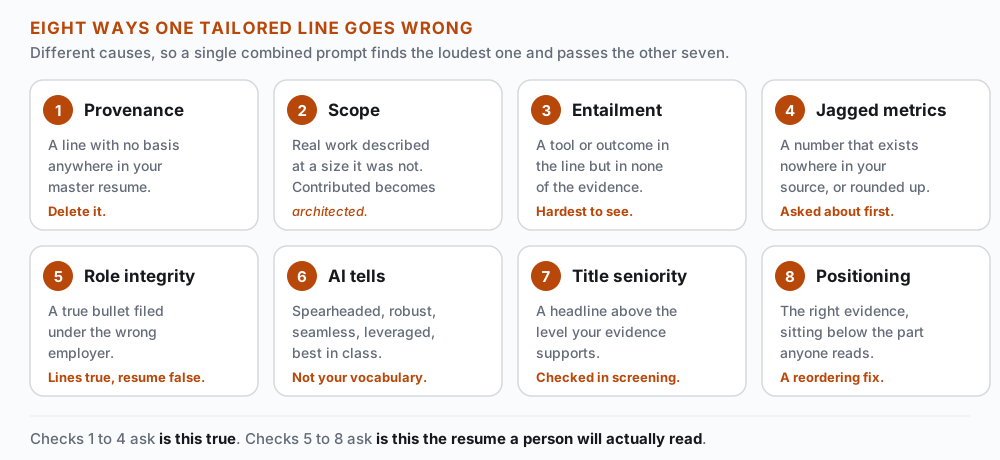
Run these against the tailored draft and the change log from Prompt 6.
For every line in the tailored resume, quote the text in my master
resume that supports it. If you cannot quote anything, mark the line
NO SOURCE.

Judge only whether the evidence is in the document. Do not reason
about whether the claim is plausible for someone in my field.

List the NO SOURCE lines at the end. Those are the lines to delete.For each tailored line, compare the size of the claim to the size in
the evidence it cites. Flag any line implying more ownership, more
reach, more duration or more authority than its source supports.
Show each flagged line beside its source. If nothing is flagged, say
so and stop. Do not find something to justify the exercise.For each tailored line, list the substantive elements in it: each tool
named, each outcome claimed, each responsibility described.
For each, say YES or NO on whether it appears in the cited source
evidence, quoting the source for every YES. Flag any line containing a
NO.List every number in the tailored resume and quote the master resume
text it comes from.
Flag any number with no source, any number that has been rounded or
scaled up, and any duration that contradicts the dates on the role it
sits under.For each bullet in the experience section, check that the work
described happened at the employer it is filed under.
Flag any bullet whose supporting evidence belongs to a different role,
naming both employers.Flag every phrase that reads as machine written rather than as mine:
inflated verbs, filler adjectives, and empty constructions like
"responsible for" or "played a key role in".
Propose a plain replacement for each, using my own vocabulary from the
master resume. If the plain version says nothing, say the line should
be cut.Compare the seniority implied by my headline, summary and job titles
to the evidence in my master resume.
Flag anything claiming a level the evidence does not support, and flag
any job title that has been altered from what my master resume says.
Bridging a title with a headline is fine. Changing a title is not.Assume the reader stops at the end of the top third of page one.
List which of this job's must have requirements have supporting
evidence inside that top third, and which have evidence only below it.
For the second group, say which weaker line above could be swapped
out.
Do not add anything. This is a reordering problem, not a writing
problem.Work through the flags in order and rebuild. Then, before you send it, read the whole thing aloud once. Every check above runs against the document. The read aloud is the only one that runs against you, and it catches the line you cannot actually defend.
Step 9. Format it, name it, log it
Three things, none of which a chat model does for you.
The document. Get the text into a real layout: single column, ordinary section headings like Experience and Education, no text boxes, no icons, no tables holding content, no material in headers or footers. This is not about a robot rejecting you. It is that parsers routinely mangle multi-column layouts, and a parser that garbles your job titles removes you from searches you should appear in, which is a quieter and more permanent problem than rejection.
The filename. Recruiters are handling a shared folder full of attachments, so use the name first convention: `Jane-Okafor-Data-Analyst-Resume.pdf`. Never `resume-final-v3.pdf`. Include the role, because a recruiter downloading forty files should be able to tell which job yours was for without opening it. One exception: if you are applying somewhere that anonymises applications, leave your name out.
The log. Record the company, the role, the date, the exact file you sent, and the posting URL. When someone calls three weeks later, you need to know which version of you they read. A spreadsheet is enough.
Where this loop breaks
Everything above works. The problem is not any single step. The problem is what happens on the sixth job, and the twentieth.
Start with the arithmetic. Fourteen prompts per application. Six judgement calls per application. Two steps with no prompt at all, both of them manual. None of it carries forward.
How long does that take? Nobody actually knows, and the published estimates are worth looking at for what they reveal. Huntr's 2026 guide says manually tailoring a resume properly takes one to three hours per application [5]. TailorForge's 2026 report says effective tailoring typically requires 30 to 90 minutes, with light tailoring at 10 to 20 [6]. That is a spread of roughly an order of magnitude between two guides published months apart, and TailorForge deserves credit for saying why: its report states plainly that it does not present original primary research and that its figures are indicative ranges rather than definitive measurements [6]. So do not take a number from anyone, including this page. Time your own first three applications and multiply.
Then there are four failures that are structural rather than slow.
The chat forgets, and then it improvises. Your master resume has to be in context for every prompt. Paste it fourteen times and you burn the window; paste it once and rely on the conversation, and by prompt nine the model is working from a summary of a summary. Worse, in a long session it starts carrying the last job's tailored language into this one. The drift is invisible because the output stays fluent.
Step 5 is the first casualty. Writing findings back to the master is the only step that makes the next application easier, and it produces no immediate reward, so it is the one that gets dropped. Drop it and every application starts from the same thin document it did on day one. Twenty applications in, you have done twenty gap analyses and learned nothing you kept.
Verification is eight of the fourteen prompts. It is the majority of the work, it produces no visible improvement when it passes, and it is the half people skip once the draft looks good. A draft looking good is precisely the condition in which these failures hide.
Nothing carries over. Job two starts from zero. So does job forty.
And one practical thing: free chat tiers rate limit exactly when you are batching applications on a Sunday afternoon, which is the only time most people have.
What are the downsides of using ChatGPT for resumes?
Four of them are structural rather than a matter of trying harder, and all four are described above: the chat window forgets your master resume and starts improvising from a summary of a summary; step 5, the write-back that is the only step which compounds, is the first one dropped; verification is eight of the fourteen prompts and produces nothing visible when it passes, so it is the half that gets skipped once a draft reads well; and nothing carries over, so job forty starts exactly where job two did.
The fifth is the one the benchmark measured. A generator writing from the posting and a scorer measuring against the posting share a ruler, so the score rewards an inserted keyword exactly as it rewards a real one. On that run the only term marked present after the edit was the one the resume never contained, while Kafka, Spark and Iceberg, all three genuinely in the document, stayed marked missing [7].
And one practical downside: free chat tiers rate limit on the afternoon you set aside for applications.
Will recruiters know I used ChatGPT?
Nobody reading your resume runs a detector over it. What a reader notices is texture, which is check 6 above: inflated verbs, filler adjectives, and empty constructions like "responsible for" or "played a key role in". Those are the tells, and Prompt 12 exists to strip them back into your own vocabulary.
The larger risk is not detection at all. It is the screening call. A line generated to cover a gap reads perfectly on the page and collapses the moment someone who does this work asks you to talk about it for two minutes. That is why the read-aloud pass at the end of the eight checks matters more than any of the prompts: it is the only check that runs against you rather than against the document.
Which turns the question into a better one. Not whether a reader can tell that a model helped, but whether every line on the page is one you could defend if asked.
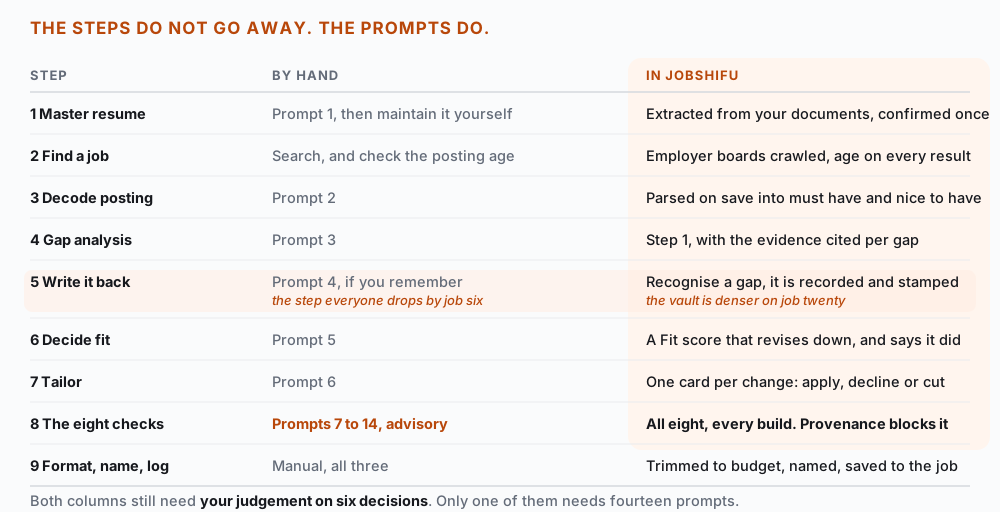
The same nine steps, run automatically
JobShifu was built around this loop, so the mapping is direct.
| Step | By hand | In JobShifu |
|---|---|---|
| 1. Master resume | Prompt 1, then maintain it yourself | Upload existing documents; each fact is extracted and you confirm it once |
| 2. Find a job | Search, then check the posting age | Employer boards crawled directly, with posting age on every result |
| 3. Decode the posting | Prompt 2 | Parsed on save into must haves, nice to haves, skills, seniority and work authorisation |
| 4. Gap analysis | Prompt 3 | Step 1 shows what the job asks against what your vault can evidence, citing the evidence |
| 5. Write back | Prompt 4, if you remember | Recognise a gap and it is recorded as a confirmed fact, stamped with the job that surfaced it |
| 6. Decide fit | Prompt 5 | A Fit score that revises down when the evidence does not support it, and says that it did |
| 7. Tailor | Prompt 6 | Each change arrives as a card you apply, decline or cut. Declining restores the original |
| 8. The eight checks | Prompts 7 to 14 | Nine checks run on every build. Two block it: a line citing nothing, or a line carrying a posting term found nowhere in your Vault or resume |
| 9. Format, name, log | Manual | Page budget trimmed against the real measure, exported name first, saved against the job |
Two of those rows are the ones that matter over a job search rather than over one application.
Row 5 is the compounding one. Reading a posting is not only how you find work, it is how the vault gets built, so the twentieth job starts from materially more evidence than the first. That is the opposite of what happens manually, where the twentieth starts from exactly what the first did.
Row 8 is the difference between advice and a mechanism. Everything in the eight prompts above is advisory: the model tells you a line has no source, and you decide. In JobShifu two of the nine checks are not advice. A resume line has to cite at least one confirmed fact from your vault, and a line carrying a posting term found nowhere in your vault or resume fails too; either way the document does not build. Those are the checks that cannot be skipped on a tired Sunday, which is the entire point of them. The other seven report and leave the call to you. The mechanism is described at the Calibration Engine.
What it does not do is make the judgement calls. You still pick the job, you still decide which gaps you genuinely have, and you still approve or reject each change. Those six decisions are the ones that need a person who was actually there, and they are the reason a tool that applies on your behalf without you is solving a different problem. Removing your judgement is not the goal. Removing the fourteen prompts is.
What the free tier covers
The loop above costs nothing but your time. So does running it in JobShifu, up to a point, and the point is worth stating exactly rather than in marketing terms.
Free includes two tailored resumes a day, every day, each one going through all nine checks. It also includes three cover letters a month, five screener answers a week, one interview prep a month, and unlimited job matching, job tracking and application autofill. Two a day is a real day of applying, indefinitely, and the vault built along the way is yours whether or not you ever pay.
Paid removes the tailoring cap and adds the alerts on newly posted roles. Full detail is on pricing. Nothing above requires it.
Common questions
Is it dishonest to tailor a resume?
No, and the distinction is the whole point of the eight checks. Selecting which true things to show a particular employer, and describing them in language they use, is what every application has always been. Adding things you did not do is different in kind, not in degree. The checks exist to keep the line visible when a model is generating fluent text on your behalf.
Can I just use one big prompt instead of fourteen?
You can, and the result will be a resume that passes the check you cared most about and fails the other seven silently. The eight failures have different causes. A single prompt asked to find all of them finds the buzzwords, declares the document strong, and stops. If you are going to shorten anything, shorten steps 1 to 7 and keep the checks.
Which model should I use?
Any current frontier model handles these prompts. Model choice matters far less than whether you actually run the verification half, and no model removes the need for it. All of them will fill a gap rather than report it, unless the prompt forbids it and something checks afterwards. If the model you use is Claude, using Claude to tailor a resume covers which Claude model to pick, how to set up a Claude Project for a job search, and where the loop breaks in a chat window.
Do I have to rewrite my resume for every single job?
No. Steps 3 to 6 are cheap and tell you whether step 7 is worth doing at all. For a role that is a weak fit, run the gap analysis, write anything new back into your master, and move on. The write back is worth doing even for jobs you decide against.
Sources
- Jobscan, "What Is an Applicant Tracking System (ATS)? The Complete 2026 Guide", 10 April 2026. jobscan.co
- Enhancv, "Does the ATS Reject Your Resume? 25 Recruiters Explain What Really Happens". Interviews conducted September to October 2025. enhancv.com
- Greenhouse, Benchmark Report, March 2026, North America. Applications per open role and recruiting team size, 2022 to 2025, from more than 640 million applications across over 6,000 companies. greenhouse.com
- Yale Center for Business and the Environment, Career Planning and Development, "A note about resume writing from CPD", 1 August 2024. careers.environment.yale.edu
- Huntr, "How to Tailor a Resume to a Job Description in 2026", 11 March 2026. huntr.co
- TailorForge, "State of Resume Tailoring 2026", read 20 August 2026. tailorforge.com
- JobShifu, Resume tailoring tools benchmark, August 2026: /blog/resume-tailoring-tools-benchmark, data file tailor-benchmark-2026-08-27.json, CC BY 4.0. Published 27 August 2026.