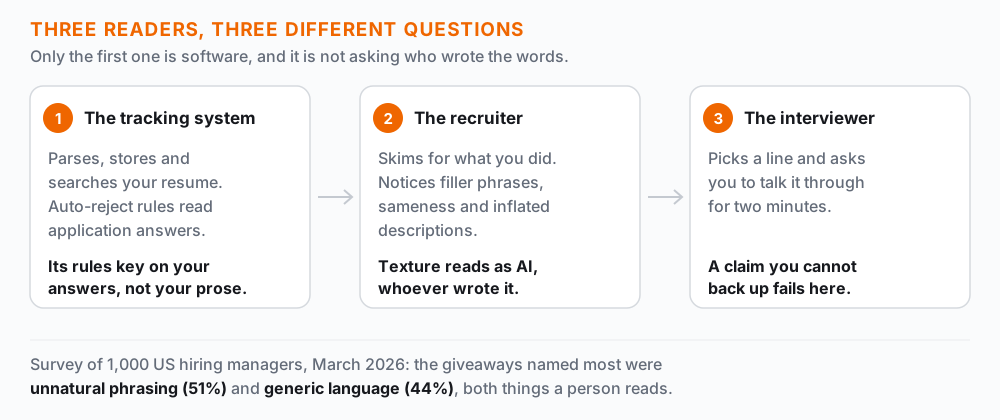
Not from the software. An applicant tracking system parses, stores and searches resumes, and the automatic rejection rules a vendor like Greenhouse documents read your answers to application questions, not who wrote your bullet points. What a recruiter does notice is texture: generic wording, filler phrases, and claims you could not talk through in an interview. Those read as AI whether a model wrote them or you did.
So the useful question is not whether anyone can prove a model helped. It is whether each line sounds like a specific person and holds up when somebody asks about it.
This guide is published by JobShifu, which sells a resume tailoring product that runs on Anthropic's Claude. Survey and vendor claims are linked and dated in the Sources section, and JobShifu's own numbers are labelled as its own measurement.
Can an ATS detect a ChatGPT resume?
Look at what an applicant tracking system is built to do. It turns your file into fields, stores it against the job, lets a recruiter search and sort the pile, and applies whatever rules the employer configured. Greenhouse's documentation describes its automatic rejection this way: "Auto-Reject uses custom application questions to screen and reject candidates based on their responses", and gives license and location requirements as the examples [1]. The rule reads a yes or no answer to a question the employer wrote. It does not read your prose for style.
That is also why the screening questions deserve more care than the bullets, a point covered in can application questions reject you.
Detecting AI writing is a separate problem, and it is a hard one. OpenAI built a classifier for exactly this and withdrew it: "As of July 20, 2023, the AI classifier is no longer available due to its low rate of accuracy" [2]. A 2023 study of GPT detectors by Liang and colleagues found they "consistently misclassify non-native English writing samples as AI-generated" while native writing was identified correctly, and that simple prompting bypassed them [3]. A detector bolted onto hiring would mostly penalize people who write plainly in a second language, and miss anyone who edited a draft.
Do employers check if a CV is AI?
They check by reading, and many say they can tell. In the UK, Ireland and New Zealand the question is asked about a CV rather than a resume, and the answer does not change with the word.
Resume Genius surveyed 1,000 US hiring managers for its 2026 Hiring Insights Report, published 24 March 2026. 80% said they can often tell when a resume has been written by AI, and 77% said many resumes appear completely or partially AI-generated [4]. Asked what gives it away, they named:
- Unnatural phrasing or tone (51%)
- Repetitive or overly generic language (44%)
- Vague or inflated descriptions (41%)
- Buzzword-heavy writing (41%)
- Perfect grammar with no variation (39%)
- Formatting habits such as em dashes (32%)
- Incorrect or irrelevant details (27%)
Read that list as a description of what a hiring manager reacts to, not as proof that they can identify a model. It is self-reported, and it comes from a company that sells resume writing. But every item on it is something you can see in your own document and fix, which no detector score offers.
Attitudes are not uniformly hostile. In a TopResume survey of 600 hiring managers in May 2025, 19.6% said they would reject a candidate with an AI-generated resume or cover letter, while 52% said using AI for proofreading or drafting support is acceptable [5]. The line most of them draw is between help with the writing and a document that no longer sounds like the person.
What reads as AI to a recruiter?
They will notice two kinds of line, and only one of them is about style.
The first is generic wording. Filler verbs ("spearheaded", "leveraged", "utilized"), vague qualifiers ("various", "a number of", "successfully"), and constructions like "responsible for" that describe a job title rather than something done. Any one of them is harmless. A page of them reads as interchangeable with every other applicant who used the same tool, which is the "repetitive or overly generic" item in the survey.
The second is a claim the candidate cannot back up, and it costs more because it survives the skim and fails in the interview. JobShifu's August 2026 benchmark has a measured example. A control resume contained the word Flink zero times. A bullet generator in one of the tested tools, asked to work in Apache Flink, produced three bullets claiming Flink experience. One read "Led the design and implementation of a high-performance data ingestion pipeline using Apache Flink, achieving a 50% reduction in processing latency within 6 months." Another shipped with an unfilled placeholder still in the text, "over X million events daily" [6]. Nothing about those lines is clumsy. The problem is that the person holding the resume has never done what they describe, and the first follow up question would show it.
A model is not required for either failure. People wrote "responsible for" long before chat windows existed. What a model changes is the volume: it produces fluent filler and fluent overclaims faster than anyone types them, and it does not stop at a gap in your experience unless something makes it.
What JobShifu measured in tailored resumes
JobShifu's Calibration Engine runs nine checks on every tailored resume before export, and one of them, AI tells, looks for exactly the first kind of line [7]. It is a fixed list rather than a model: 36 filler terms (leverage, spearheaded, utilized, robust, results-driven and the like), 13 vague phrases (responsible for, worked on, various, successfully and others), em dash density above 1.5 per 100 words, and the same opening verb on two roles in a row or on four or more bullets. It is advisory. It flags the line and the user edits it or keeps it.
By JobShifu's own measurement, over the latest tailored resume for each job built between 5 August and 4 October 2026, owner and test accounts excluded:
- 313 resumes from 120 people.
- 243 of 9,045 printed lines (2.7%) carried a flagged filler or vague phrase.
- 130 of the 313 resumes (41.5%) had at least one such line, across 53 of the 120 people.
- 128 resumes drew the repeated opening verb note, and 5 the em dash density note.
Several phrases follow one person across many resumes rather than spreading evenly. "Responsible for" sat on 56 resumes from 6 people, and "facilitated" on 43 resumes from 10.
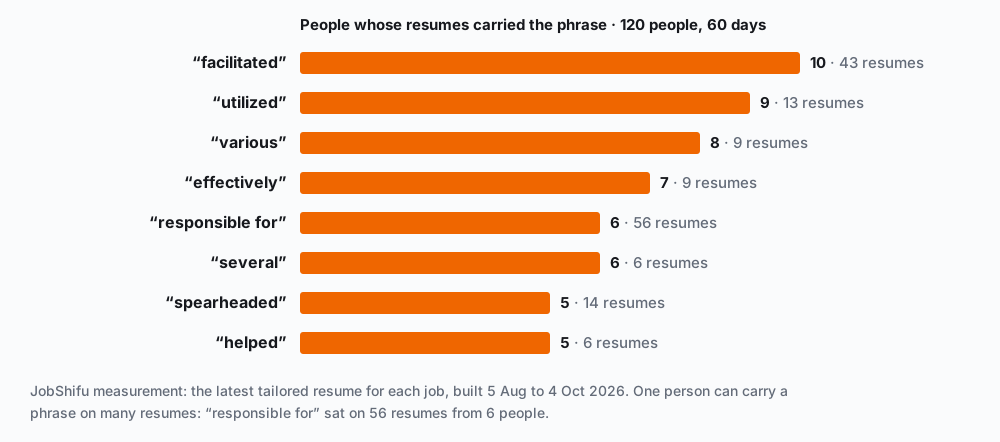
Two things this does not show. These lines were flagged and then shipped, because the check advises rather than blocks, so 2.7% is what was still on the page at each latest build, not a clean result. And a fixed list cannot see a line that is generic without using a listed word. A bullet can be dense, accurate and still unreadable to the recruiter it is written for, and no check in the list asks whether a person can tell what you did.
The second kind of line, the claim you cannot back up, is handled elsewhere in the engine and more strictly. Every line must cite a fact the user confirmed in their Vault, and a line citing nothing fails the build. A separate check fails a line that carries a term from the job posting that appears nowhere in the Vault or the uploaded resume [7]. Those two are the ones that block, which is the reverse of how most people rank the risks: the style tell is the one people worry about, and the unsupported claim is the one that costs the interview.
Using AI on a resume without the tells
The fixes follow from the two failure kinds, and none of them depends on which model you use.
- Write from what you did, not from the posting. Give the model a full record of your work and ask it to select and reorder, not to invent. A model given only the posting has nothing of yours to write from. Using Claude to tailor a resume covers the setup, including keeping a master document in context.
- Delete the filler list. Search your draft for the phrases above. Replace "responsible for" with the thing you did, and "facilitated" with what happened as a result.
- Check every number. If you could not explain where a figure came from in two sentences, cut it or replace it with one you can.
- Read each line aloud and ask whether you could talk about it for two minutes. It is the only check that runs against you rather than against the document.
- Use the posting's vocabulary only where your evidence supports it. Matching the wording of a requirement you meet is good tailoring. Borrowing the wording of one you do not meet is the overclaim in a different form.
JobShifu builds that discipline into the tailoring itself: changes are proposed from facts you confirmed, shown with their sources before they land, and checked before export. The resume tailoring page describes the flow, and CV tailoring covers the same for UK, Irish and New Zealand applications. The prompt-by-prompt version runs a similar set of checks by hand in a chat window, for free.
Common questions
Is it cheating to use AI on a resume?
Just over half the hiring managers TopResume asked do not treat assistance as cheating: 52% accept AI for proofreading or drafting support [5]. What they object to is a document that no longer describes the person, and that standard applies whatever wrote the draft.
Should I say I used AI on my application?
Expectations vary. In the Resume Genius report, 79% of hiring managers said candidates should disclose AI assistance in application materials [4]. If an application or interviewer asks directly, answer plainly. Either way, every line should be one you can defend without mentioning the tool.
Can an AI detector clear my resume before I send it?
Not reliably. OpenAI withdrew its own classifier for low accuracy [2], and detectors have been shown to flag non-native English writing as AI-generated [3]. A passing score tells you little about how a recruiter will read the page. Rereading for filler and for claims you cannot explain tells you more.
Sources
- Greenhouse Support, "Auto-Reject application rules overview": support.greenhouse.io/hc/en-us/articles/203105595. Updated 2 March 2026, read 3 October 2026.
- MediaPost, "OpenAI Text Classifier Shuttered Based On Low Accuracy Rate", quoting OpenAI's note on its AI classifier announcement: mediapost.com/publications/article/387580. Published 26 July 2023.
- Liang, Yuksekgonul, Mao, Wu and Zou, "GPT detectors are biased against non-native English writers": arxiv.org/abs/2304.02819. Submitted 6 April 2023, revised 10 July 2023.
- Resume Genius, 2026 Hiring Insights Report, survey of 1,000 US hiring managers via Pollfish: resumegenius.com/blog/job-hunting/hiring-insights-report. Published 24 March 2026, read 3 October 2026.
- TopResume, "Where Employers Draw the Line on the Use of AI in Hiring", survey of 600 hiring managers via Pollfish, 15 to 16 May 2025: topresume.com/career-advice/ai-in-hiring-survey. Published 3 June 2025.
- JobShifu, Resume tailoring tools benchmark, August 2026: /blog/resume-tailoring-tools-benchmark, data file tailor-benchmark-2026-08-27.json, CC BY 4.0. Published 27 August 2026.
- JobShifu, the Calibration Engine: /calibration. Read 3 October 2026.