Yes. An employer can configure some application questions to reject an application automatically. That does not mean every employer uses these rules, or that a fast rejection proves your resume failed an AI test.
Greenhouse documents automatic rejection based on employer-configured answers to custom questions. Workable documents automatic disqualification when a candidate answers No to a configured yes/no question. These are specific form rules, not a universal judgment of your resume. [1] [2]
The practical response is to check the requirements and review your answers. Choosing an inaccurate answer to get through the form can create a problem later.
Four things that can happen to an application
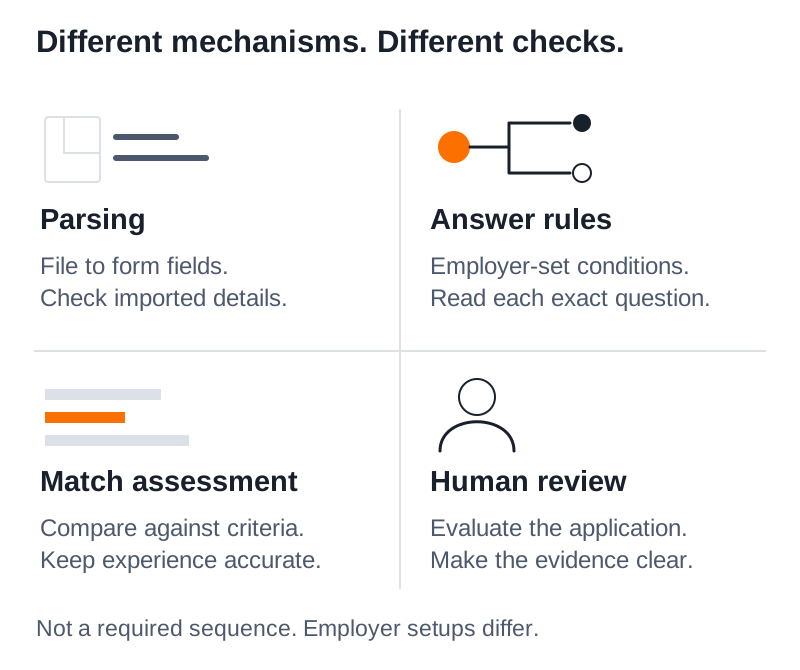
People often use "the ATS" to mean everything between Submit and an interview. Separate the steps.
| Process | What it does | What to check |
|---|---|---|
| Resume parsing | Extracts information from a document into fields | Names, dates, employers and other imported details |
| Application screening rule | Applies an employer's configured condition to an answer | Exact question wording and your selected response |
| Matching or scoring | Compares information with criteria to support evaluation | Whether relevant experience is recorded accurately |
| Human review | A person evaluates the application | Clear examples, context and readable writing |
These processes do not necessarily happen in this order. An employer may use some and not others.
Greenhouse's candidate FAQ makes an especially useful distinction: its Talent Matching feature provides an assistive match score and does not itself automatically advance or reject candidates. That can coexist with the separate answer-based rejection rules described above. [3]
Read the whole question before choosing an answer
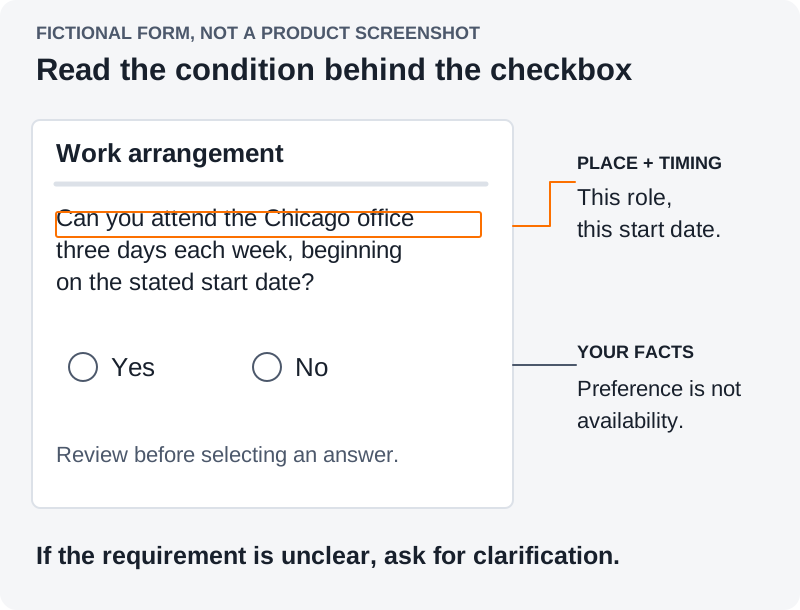
Consider this fictional example. A job description says "hybrid" and the application asks whether you can work at its Chicago office three days each week, beginning on the stated start date.
You currently live elsewhere and would consider relocating. A saved answer saying you are open to hybrid work does not resolve that specific question. Your answer needs to reflect whether you can meet this role's arrangement and timing.
If you can, answer accordingly. If you cannot, do not treat a resume rewrite as the solution. If the timing or location is unclear, look for clarification in the posting or ask a published recruiting contact before submitting, where possible.
Separate what you meet now, what you can meet by a stated date, and what remains uncertain.
Review these fields after autofill
Autofill can reduce repeated typing. It still needs a review against the current form. Greenhouse's candidate guidance advises checking imported information and correcting parsing mistakes before submitting. [3]
Start with these areas:
- Eligibility and availability. Read every condition attached to a yes/no answer. A question about today may differ from one about your possible start date.
- Dates and credentials. Check employment dates, graduation information and the status of required qualifications against your records.
- Numbers with units. Confirm that salary expectations, travel percentages and notice periods use the unit the form asks for.
- The attached resume. Open or preview the file where the form allows it. Confirm that it is the version intended for this role.
- Free-text examples. Make sure the answer addresses the question and describes work you actually did. Remove placeholders and unsupported details.
For ambiguous eligibility questions, seek clarification from the employer or an appropriately qualified adviser. Guessing which answer the system prefers is not a reliable way to establish eligibility.
A confirmation email is not a review decision
Workable says an automatically disqualified candidate still receives an application confirmation and may not know that disqualification occurred. A receipt therefore confirms submission, not necessarily that the application passed a screening rule. [2]
The reverse inference is also unsafe: a quick rejection does not identify the rule, score or person responsible. Unless the employer provides a reason, the mechanism remains unknown. Avoid repeatedly changing keywords to address an unconfirmed cause.
Save the answer and its context
Build a small record of reusable facts: the answer, when you last checked it, and any condition that changes it. Keep role-specific answers alongside the application they belong to.
JobShifu's Chrome extension supports application autofill and saved answers on supported forms. The user reviews and submits. In the web app, confirmed experience can also be saved in the Vault, a reusable master resume, for future tailoring. These features support preparation; they do not override employer rules or guarantee an interview.
For an older vacancy, first check whether the employer is still accepting applications. Then spend the final review on the actual questions as well as the resume.
Common questions
Should I change an answer after a rejection?
Correct a factual mistake through the employer's supported process if one exists. Do not change an accurate answer simply because you suspect it triggered a rule.
Does answering every required question mean I passed screening?
It means you completed those fields. A completed form and an application receipt do not reveal every subsequent screening decision.
Sources
- Greenhouse, Auto-reject, updated January 30, 2026; accessed September 15, 2026 (UTC).
- Workable, Auto-disqualify candidates using application form questions, accessed September 15, 2026 (UTC).
- Greenhouse, MyGreenhouse FAQ for Candidates, accessed September 15, 2026 (UTC).