The next application asks for a difficult project, a time you worked across teams, and why you want this role. You have answered similar questions before.
Keep the underlying experience, not just the finished paragraph. A useful application answer bank separates facts you can reuse, examples you can adapt, and decisions that belong to one employer.
Download the application answer bank to start with a spreadsheet. Use the worked example below to decide what belongs in it.
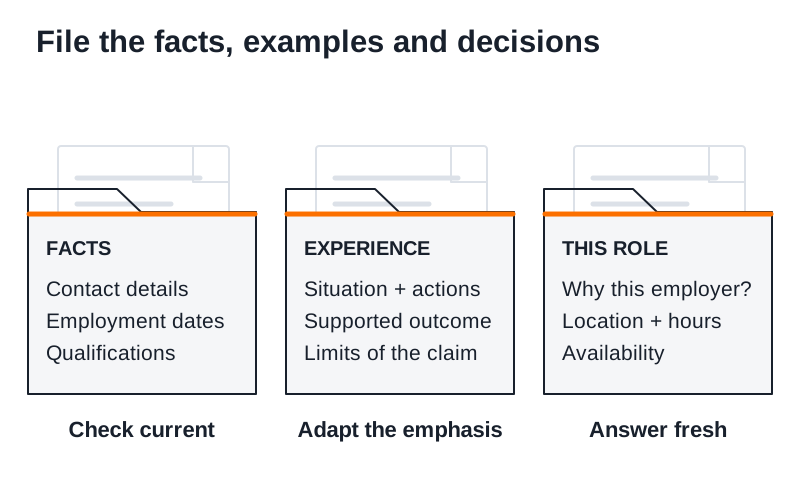
Sort your answers into three groups
| Group | Examples | Before reusing |
|---|---|---|
| Reusable facts | Contact details, employment history, completed qualifications | Check that the information is still current and fits the question |
| Adaptable evidence | A project, a difficult decision, a collaboration example | Select the relevant part and keep your contribution accurate |
| Fresh decisions | Why this employer, availability for this schedule, interest in this role | Read the current posting and answer for this application |
Do not make a single yes/no answer your permanent response to a family of similar questions. "Can you travel?" and "Can you travel internationally during the first month?" ask different things.
Save an evidence card before writing the paragraph
An evidence card records what happened. In your spreadsheet, include:
- Situation: the task or problem, with enough context to understand it.
- Your responsibility: what you owned, and where someone else was responsible.
- Actions: the concrete things you did.
- Result: what changed and how you know. A documented outcome does not have to be a percentage.
- Boundaries: claims the example does not support.
- Useful questions: the themes this example could help answer.
Keep sensitive company information out of a general application bank. Describe the work at an appropriate level and use only material you are allowed to share.
The boundaries field is particularly useful when using AI to draft. It tells you what to reject if a rewrite turns participation into leadership or adds a result you never measured.
One experience, two accurate answers
This is a fictional example created to demonstrate the method, not a customer story.
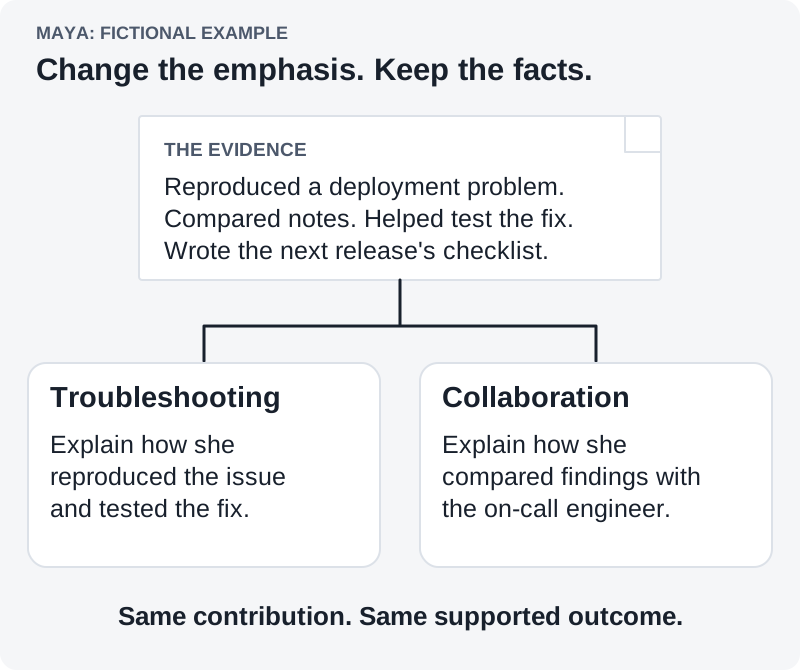
Evidence card: Maya was an engineer on a release that failed during deployment. She reproduced the configuration problem, compared notes with the on-call engineer, and helped test the correction. Afterward, she wrote a pre-release checklist that the team used on its next release. She did not lead the incident response and did not measure a reduction in failures.
For "Tell us about a technical problem you solved," Maya could write:
"During a failed deployment, I reproduced a configuration problem and worked with the on-call engineer to test the correction. I then documented the checks in a pre-release checklist, which the team used on its next release."
For "Tell us about working with another team member," she could write:
"During a deployment failure, I compared my reproduction steps with the on-call engineer's findings so that the correction addressed the same problem. I helped test the fix and wrote a checklist the team could use before the next release."
The emphasis changes. The responsibility and outcome do not. Neither answer needs an invented failure-rate improvement or a promotion to incident commander.
Keep the submitted version with the application
An evidence bank is your source material. An application record preserves what you actually sent. Keep both, because later edits to a reusable answer should not erase the version an interviewer may have read.
Record the employer, role, submission date, resume filename and final answer. If the form allows a review page or download, save the relevant record. Otherwise, keep your own copy before submitting.
Reusable candidate profiles can already handle parts of this work. For example, Greenhouse's QuickApply guidance describes reusing profile information and editing autofilled fields before submission. Its candidate FAQ also explains that the latest resume is the default and that the profile does not store multiple resume versions. That makes checking the intended attachment a concrete task, even when the profile details look right. [1]
Review rather than rewrite
Before pasting a saved answer, ask:
- Does it answer this exact question?
- Are the facts still current?
- Does it distinguish my contribution from the team's?
- Is there a role-specific condition or length limit?
- Can I explain every sentence in an interview?
If the answer clears those checks, there may be no reason to rewrite it.
JobShifu supports saved answers and autofill on supported forms. Its web app also compares job requirements with saved experience, prompts users to confirm relevant experience missing from their resume, and keeps confirmed material available in the Vault, a reusable master resume. You still review the current answer and submit the application yourself.
Start with one experience you have already explained well. Save the facts behind it, the final answer and the role where you used it. The next application can build on that work.
Common questions
Can I use the same example for several employers?
Yes, if it is accurate and answers each question. Change the relevant emphasis and employer-specific context rather than inventing another experience.
What if the form asks a yes/no question?
Read every condition before reusing a response. Some employers configure screening rules around application answers, so a saved answer deserves the same factual review as a new one.
Sources
- Greenhouse, MyGreenhouse FAQ for Candidates, accessed September 15, 2026 (UTC).