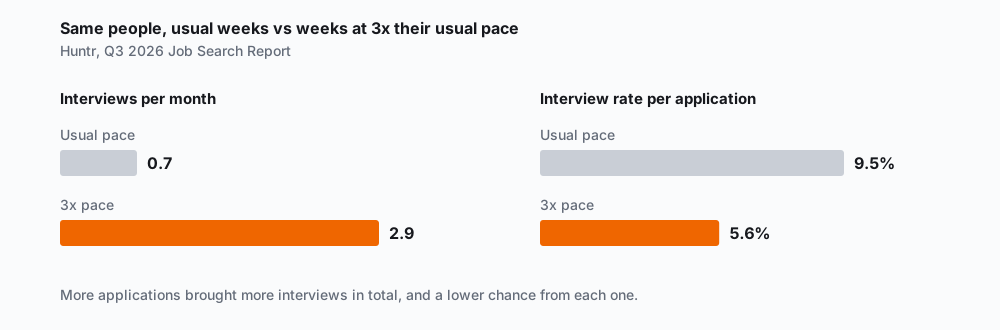
Yes, apply to several jobs at once. Waiting on one employer before trying the next is how a search stretches into months. But the evidence says the way you batch matters more than the number. In Huntr's tracker data for Q3 2026, the same people's weeks at three or more times their usual pace brought more interviews per month, 2.9 against 0.7, while each application's interview rate fell from 9.5% to 5.6% [1]. Volume works. It also makes every application worse, unless you change how each one gets made.
This guide is published by JobShifu, which crawls employer career pages directly and makes job search tools. The community numbers below are what posters reported about their own searches, labelled as such. The form and posting figures are JobShifu's own measurements, dated, with the method at the end.
Key findings
- 2.9 interviews a month against 0.7 in people's high-volume weeks, but a 5.6% interview rate per application against 9.5% at their usual pace (Huntr, Q3 2026, same people compared with themselves) [1].
- 68 of 329 surveyed job seekers had used a tool that sends applications for them. 40 had stopped. 6 got more interviews than when they applied themselves; 17 got fewer [1].
- About 14% against under 3%: one job seeker's log of 163 applications got replies to postings under 3 days old at about 14%, and to postings over 2 weeks old at under 3% [2].
- 6.2% against 4.9%: applications sent through employer career sites got interviews more often than those sent through job boards, for the same 5,855 people [1].
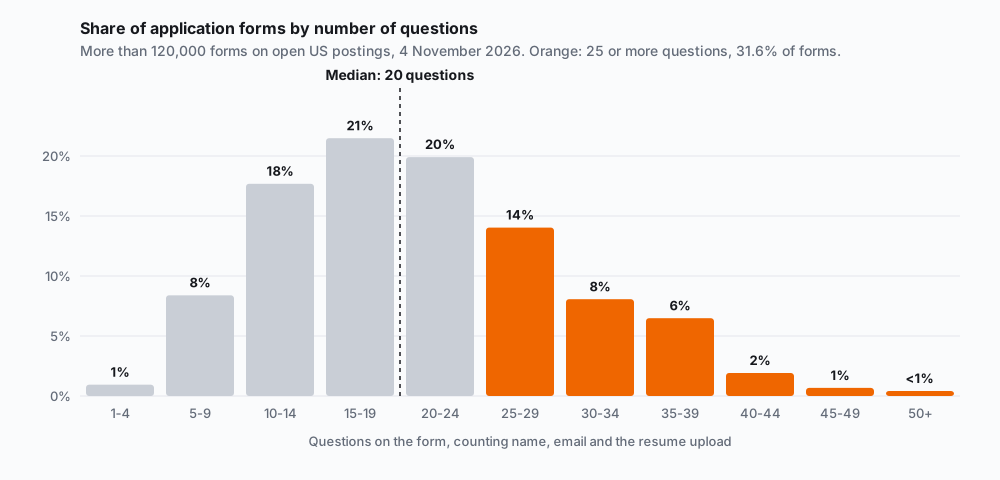
- 20 questions on the median application form, across 121,509 forms on open US postings at 7,285 employers, counting name, email and resume upload. 31.6% ask 25 or more (JobShifu, 4 November 2026).
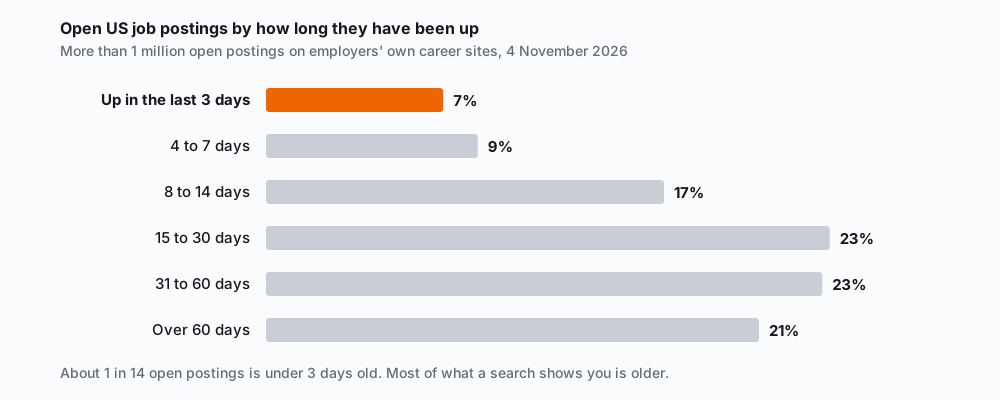
- 7.3% of 1,039,228 open US postings had gone up in the last 3 days (JobShifu, 4 November 2026). A fresh batch is a small batch.
Does applying to more jobs get you more interviews?
In raw count, yes. Per application, no. Huntr's same-person comparison is the cleanest version of the trade: more applications in a week produced more interviews that month, and each one was less likely to turn into anything [1]. Students asking whether 800 applications would bring more interviews are right about the count. They are ignoring the rate.
The two most-upvoted personal datasets on r/jobsearchhacks this autumn both describe getting out of that trade, not leaning into it. One poster, laid off from an operations role in May, logged 163 applications over four months: company, source, how old the posting was, whether anyone replied. Their reply rate was about 3% in the first month, sending 20 applications on Sunday nights. It was about 13% in the last month, sending 3 or 4 a day on weekday mornings, to fresh postings only, with the rest of the time spent messaging people at those companies. Four interviews followed in three weeks [2]. A UK public health researcher reported the other one: 50 applications and no interviews, then 30 applications and 6 interviews, after capping themselves at a few strong-fit roles a week [3].
At the far end sits the story that ran through r/recruitinghell in October: a Princeton chemical engineering PhD who had applied to 2,300 jobs, food preparation roles included, and was still being ghosted [4]. Two thousand applications did not fix a problem of fit and framing. Volume cannot.
The loop is easy to fall into. Silence makes people spray, and spraying produces more silence. Under a seven-year recruiter's widely shared Threads checklist for choosing roles carefully, the most-liked reply said, in effect, that their well-matched applications got no calls either, so now they apply to everything [5]. That reply is the loop in one sentence.
What "at once" should mean: a batch you can keep up
The way out is not fewer applications. It is a parallel batch you can sustain: several roles in flight at the same time, each one chosen and tailored, each one sent by you. Several posters in recent Threads discussion, some passing on career agents' advice, suggest running five to ten applications in parallel rather than one after another, so that decisions arrive close together [5].
What stops people is the cost per application. The method that worked in the UK thread took 2 to 4 hours per application [3]. Some of that is thinking: reading the posting, deciding whether you fit, choosing which of your experience to lead with. A lot of it is retyping.
JobShifu read the application forms behind open US postings on six applicant tracking systems. The median form asks 20 questions, counting name, email and the resume upload, and 73% ask 15 or more. By system, the median is 20 on Greenhouse, 22 on Workable, 17 on Lever and 11 on Ashby. A typical form asks for the same things the last one did: work authorization, sponsorship, willingness to relocate, how you heard about the role, links, sometimes credentials and the states you hold them in. Then come one or two questions written for this job.
That split is the useful part. The repeated questions are where the hours leak, and they need the same answer every time. The job-specific ones deserve the time. If an answer you wrote last week can fill this week's form, even when the question is worded differently, the batch gets cheaper without getting worse. Saving and reusing application answers covers how to build that bank.
The other leak is accounts. Workday hosts 58.3% of the open US postings in JobShifu's crawl, and many Workday employers ask you to create an account on their own career site before the form opens. That step is where a lot of people give up, which matters for the next section.
Sort the batch by freshness
The 163-application log is one person's data, and the poster said so: a small sample, one industry. But the gap they found is large. Postings under 3 days old drew replies at about 14%, and postings over 2 weeks old at under 3% [2].
A fresh pool is smaller than it looks. Of 1,039,228 open US postings on 4 November 2026, 7.3% had gone up in the last 3 days, and 32.8% in the last 14. Most of what any search shows you is older. Sorting by posted date first, then filtering for fit, puts the scarce part of the pool at the top.
Older does not mean dead. In JobShifu's lifespan data, 79% to 89% of postings were still listed on the employer's own site 10 days after they first appeared [6]. A two-week-old posting can still be worth a strong application, and is a three-week-old job worth applying to? has the checks to run first. Freshness is a way to order the batch, not a rule for excluding most of it.
On timing within the week, the community and the data disagree a little. The tracker found weekday mornings replied best. Across 1,131,492 new US postings, no single weekday reliably led, and two thirds went up between 10 AM and 6 PM Eastern [7]. The safe reading: check every weekday, and apply in the morning.
Don't let the applicant counter shrink your batch
"Over 200 applicants" on a posting a few hours old scares people off good roles. A 1.5K-upvote r/jobsearchhacks thread argued that the counter counts clicks on Apply, not finished applications. The poster's evidence was one dashboard: a role their employer's LinkedIn listing showed at 450 applicants had 22 completed applications in the company's Greenhouse, and about half of those failed basic requirements [8].
Treat that as an anecdote, and keep the pushback in view. Commenters pointed out that some portals save your details and refill them, that remote roles paying over $100,000 really can draw 300 to 400 resumes, and that remote entry-level postings are the ones that drown hiring managers [8]. A hiring-side commenter from Australia described one role: about 120 applications, and 3 suitable candidates once sponsorship, work rights and basic qualifications were applied [8].
The defensible version: the counter overstates your real competition, most of all where the form is long and the role is not remote entry level. You compete with the people who finish the form and fit the job.
Spend the time you saved on people
Both datasets put the saved hours in the same place. In the 163-application log, only 9 applications came through referrals, and 6 of those became real conversations [2]. The UK researcher had emailed the hiring manager before applying in half of their interviews, and in 21% of their rejections [3].
The broader numbers keep this in proportion. In Huntr's survey, 58% of people who had interviewed got their most recent interview by applying online, 13% through a referral and 11% through networking [1]. Applying still does most of the work. A message to one person per application is the multiplier, and applying again to a former employer roughly doubled the interview rate for the same people, 17.6% against 8.6% [1].
Keep every line checkable
A batch only works if each resume survives a ten-second read. The most-commented resume critique on r/jobsearchhacks in October had 353 comments, and its sharpest point was not formatting. Nearly every bullet followed the same formula, a strong verb plus a percentage gain from a named algorithm, and commenters stopped believing the page because none of it could be checked [9].
That pattern often comes from AI. In Huntr's survey, 187 of 297 people who use AI on their resume said it had added something untrue, such as a skill, a number or a result [1]. Even the UK researcher's winning method had an AI draft the CV before they edited it [3]. If you tailor with AI to keep the batch moving, hold it to one rule: every line has to point back to something you actually did, and a line that cannot is deleted. Fast and untrue is worse than slow.
A weekly routine for applying to several jobs at once
- Keep five to ten applications in flight. Add new ones as old ones close, rather than in Sunday bursts.
- Each weekday morning, check new postings in your field. Shortlist the ones under a few days old that you clearly fit. The UK researcher's scoring works: 1 point per essential requirement you meet, half a point per desirable one [3].
- Apply on the employer's own site where you can [1].
- Reuse what repeats, rewrite what doesn't. Keep a master resume and a bank of answers, and spend your minutes on the summary, the first bullet and the job-specific questions. The twenty-minute tailoring method is the manual version.
- Message one person per application, at the company, before or just after you apply.
- Log every application: the date, the posting link, and the exact resume version you sent. That row is what makes a follow-up possible. What to do when you hear nothing back picks up from here.
- Review the log once a week. Drop the channels that never answer. The UK researcher stopped applying to the employers that never once interviewed them [3].
The steps a tool can take off your hands are the repeated ones: filling the same questions, carrying your answers to the next form, keeping the log. The choices are still yours, and so is the Submit button.
Common questions
Can you apply for multiple jobs at once?
Yes, and running several applications in parallel is normal practice. What hurts is sending many generic ones: in Huntr's Q3 2026 data, people's weeks at three times their usual pace brought more interviews in total but a lower interview rate per application, 5.6% against 9.5% [1]. Keep five to ten applications in flight, each one tailored.
How many jobs should I apply to per week?
There is no right number for everyone, and Huntr says so about its own data [1]. The routines that worked in this autumn's most-upvoted threads ran from 2 or 3 strong-fit applications a week to 3 or 4 a weekday, fresh postings only, with time left over to contact people at each company [2] [3]. Pick the pace at which you can still tailor every one.
Do auto-apply tools work?
For most people who tried them, not well. Of 68 job seekers in Huntr's survey who had used a tool that sends applications for them, 40 had stopped; 6 got more interviews than when they applied themselves, 33 about the same and 17 fewer [1]. Tools that fill the form and leave the decision to you are a different thing from tools that send applications unattended.
Should I skip a job that already has hundreds of applicants?
Usually not, if you fit it well. The number on a job board can count clicks on Apply rather than finished applications, and in one reported case 450 shown became 22 completed in the employer's system [8]. Remote entry-level roles really are crowded. Specialist, onsite and long-form applications see much bigger drop-off.
How this was measured
- Application forms. JobShifu captures the application form behind postings on Greenhouse, Lever, Ashby, Workable, Recruitee and Rippling. The figures cover 121,509 forms attached to open US postings at 7,285 employers, read on 4 November 2026; forms were captured from 24 September 2026 (Workable from 9 October). A question is one field the form asks you to fill, including name, email and resume upload; answer options are not counted separately. Workday forms sit behind a per-employer account and are not in this count.
- Freshness and source mix. All 1,039,228 open US postings in JobShifu's crawl of employer career pages on 4 November 2026. "Gone up in the last 3 days" uses the time JobShifu first saw the posting, which tracks the posting date closely for most boards.
- Still listed at day 10. The Kaplan-Meier estimates from how long job postings stay open, for postings first seen 1 July to 15 August 2026; the range spans the three source tiers that report publishes.
- Community figures are what posters reported about their own searches, with counts as displayed on 3 November 2026. They are single people's logs, not samples, and are labelled that way above.
- Aggregates only. No form text, employer name or individual listing is published.
Sources
- Huntr, "Job Search Trends, Q3 2026": tracker data from 84,753 applications and a survey of 329 job seekers, 13 to 26 October 2026. Huntr Q3 2026 report. Read 4 November 2026.
- r/jobsearchhacks, "I tracked every single job application in a spreadsheet for 4 months and the data showed me exactly when people actually reply", 12 October 2026, 2.2K upvotes. Thread.
- r/jobsearchhacks, "I went from 50 applications/0 interviews to 30 applications/6 interviews", 26 October 2026, 498 upvotes. Thread.
- r/recruitinghell, "A Princeton Ph.D. Applied to 2,300 Jobs. He Still Can't Get One", 17 October 2026, 2.1K upvotes, sharing a Wall Street Journal article. Thread.
- Threads: a seven-year recruiter's checklist for choosing roles, 1 November 2026, 39.3K views (post); on running five to ten applications in parallel, 30 October 2026 (post).
- JobShifu, how long job postings stay open, measured to 15 September 2026, CC BY 4.0.
- JobShifu, what day are most jobs posted?, US postings from 3 August to 25 October 2026, CC BY 4.0.
- r/jobsearchhacks, "Stop letting the 'Over 200 applicants' number scare you away from applying", 18 September 2026, 1.5K upvotes. Thread.
- r/jobsearchhacks, "Rate my resume - 100+ applications no interview", 25 October 2026, 353 comments. Thread.