If you have heard nothing back, check that the posting is still up, then follow up once, about a week after applying, by email to a named person. If two weeks pass with no answer, plan as if that one is closed and keep applying. Hospitals and clinics are the exception: there, silence at day 40 is ordinary and waits of several months are reported, so judge by the posting, not the calendar.
This guide is published by JobShifu, which crawls employer career pages directly and makes job search tools. The community numbers below are what posters reported about their own searches, labelled as such. The posting figures are JobShifu's own measurements, dated, with the method at the end.
Key findings
- 71% of rejections in one job seeker's log of 163 applications arrived within 48 hours, and an application with no word by day 10 almost never turned into anything [1].
- 79% to 89% of postings were still listed on the employer's own site 10 days after they first appeared, and 71% to 84% at day 14 (JobShifu, postings first seen July to August 2026) [2]. Silence at day 10 rarely means the job is gone.
- 52 days to a first interview and 102 days to a first offer, at the median, for job seekers using Huntr's tracker in Q3 2026 [3].
- 135 of 272 job seekers answering an open survey question asked employers to respond or explain a rejection; 43% asked for any response at all, even a no [3].
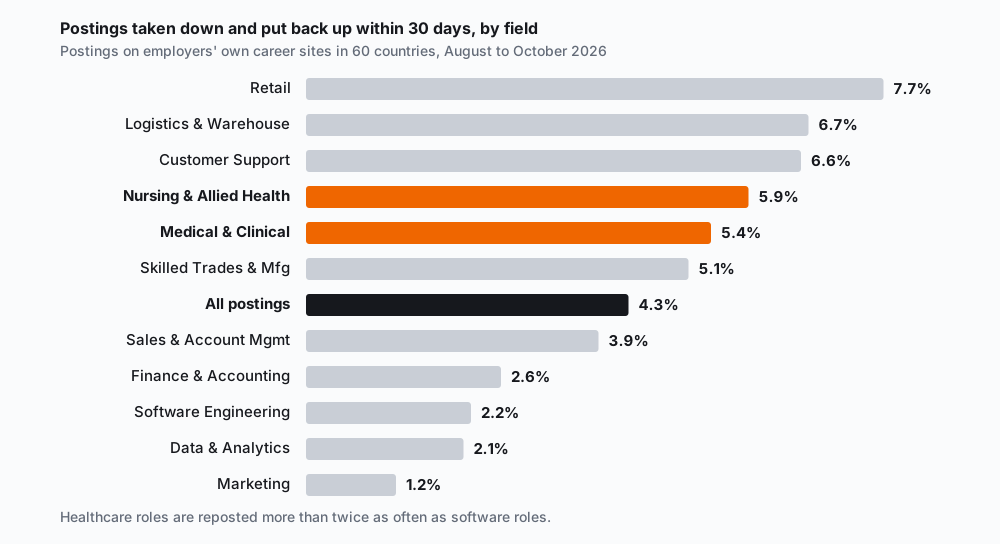
- 5.9% of nursing and allied health postings were taken down and put back up within 30 days, against 2.2% in software engineering (JobShifu, October 2026) [4].
How long should you wait to hear back after applying?
There are two clocks, and most advice only gives one.
The general clock. The most-upvoted application log on r/jobsearchhacks this autumn covered 163 applications over four months. Most rejections came fast: 71% within 48 hours, one of them four minutes after submitting. Replies after day 10 were so rare that the poster stopped checking email hourly at that point [1]. In a r/careerguidance thread asking exactly this question, the fullest answer put the follow-up at a week or so, two weeks as the usual sweet spot, and any timeline in the posting ahead of both. A second commenter was bleaker: at three to four weeks with no word, treat it as a dead end and move on [5]. Both can be true.
Keep one counterexample in mind. Under the 163-application log, a commenter reported an application from six months earlier that had just moved to the next stage [1]. Day 10 is a planning rule, not a law.
The healthcare clock. A medical assistant with two years of experience posted on day 40 of silence after 10 to 12 hospital applications, every portal still reading "Application Received". The replies were unanimous that this is normal: one commenter waited 6 to 7 months for one hospital role and 3 months for another, another's record was five months, and a third said timelines inside a single company ran from 2 weeks to 8 months [6]. If you work in hospitals, clinics or allied health, the general clock will tell you to give up on applications that are still alive.
Why silence at day 10 doesn't mean the job is gone
Here is the part the threads cannot see. In JobShifu's daily recheck of employers' own career pages, 79% to 89% of postings were still listed 10 days after they first appeared, and 56% to 69% were still listed after 27 days [2]. So the typical picture at day 10 is a job still open, an employer still collecting applications, and yours sitting unread somewhere in the pile.
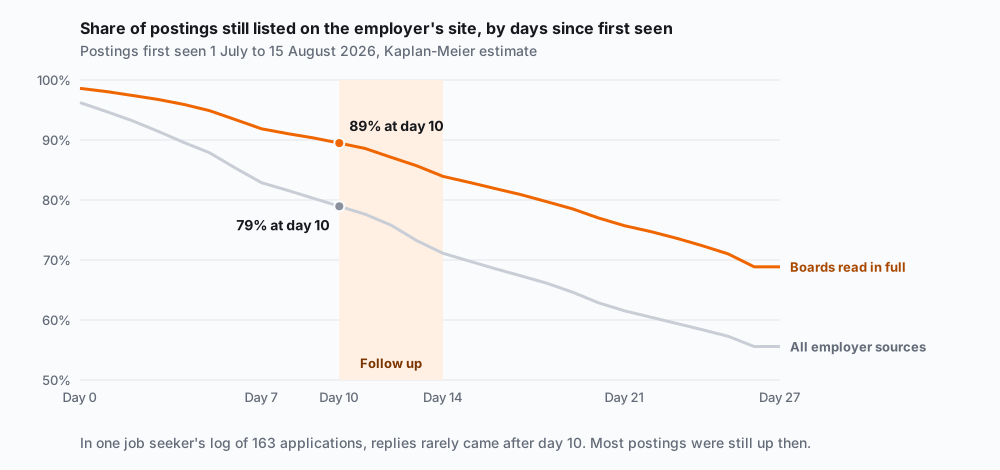
That changes what day 10 is for. It is not the day to give up. It is the day to act: a quiet application to a live posting is exactly the case where a short note to a person can move it, and Huntr's numbers explain why patience alone is a poor plan. Their tracker users waited a median of 52 days for a first interview and 102 for a first offer [3]. A search that waits on each employer in turn will not survive those timelines.
Check the posting before you follow up
Before you write to anyone, look the posting up on the employer's own careers page.
- Gone from the employer's site: don't follow up. Spend the time on a live role.
- Still listed: follow up. A note on a live role reads as interest, not anxiety.
- Taken down and put back up: read it as a posting the employer keeps refilling. Reposting is more common in healthcare: in JobShifu's October data, 5.9% of nursing and allied health postings and 5.4% of medical and clinical postings came down and went back up within 30 days, against 2.2% in software engineering and 4.3% overall [4]. A reposted listing is not a fake one, but it often means a pipeline that runs on its own schedule, so a named person matters more than the portal.
Long-open listings are common everywhere, not only in hospitals: on 4 November 2026, 23.6% of open US nursing and allied health postings in JobShifu's crawl had been listed for 60 days or more, against 27.2% in software engineering. Age alone does not tell you a job is dead. Whether it is still on the employer's own site does. The job posting checker shows when a posting first appeared, whether it is still listed and whether it was posted before.
Status text tells you less than you think
"Application Received" unchanged for 40 days feels like an answer. It is not one. In the medical assistant thread, the best-informed reply said it probably does not mean rejection yet, and also does not mean you are still being considered [6]. Portal statuses change when someone updates them, and many employers never do.
The checks that carry information are three: whether the posting is still up on the employer's site, whether the status has ever actually changed, and whether there is a human you can write to.
How to follow up after applying, once, to a person
- Respect any timeline in the posting. If it says you will hear within three weeks, wait three weeks.
- Otherwise, write about a week after applying. The most practical advice in a r/jobs thread about 98 applications without a single reply was a direct note to the hiring manager a week after applying [7].
- Email a person, not the portal. In a r/jobsearchhacks turnaround story, a researcher had emailed the hiring manager before applying for half of their eventual interviews, and for 21% of their rejections [8].
- Keep it to four lines. The role and the date you applied. One sentence on the most relevant thing you have done. One question you actually want answered, such as the timeline. Your name.
- Send one final note, then close it. A Threads post from someone who followed up for over a month, read every time and never answered, ends with the protocol worth copying: one last polite message, ask for brief feedback without demanding it, then treat it as finished [9].
- Keep applying while you wait. The threads above agree on this one, whatever else they disagree on.
A short example:
Hi Dana, I applied for the Patient Access Coordinator role on 3 November. I spent the last two years scheduling for a 12-provider specialty clinic, so the front-desk and insurance-verification parts of this role are work I do every day. Is the team still reviewing applications for it? Thank you, Sam Rivera
No response in healthcare and allied health
The healthcare threads point to a few things that general advice skips.
- Expect months, and say so to yourself in advance. A three-to-eight-month hospital timeline is normal in the threads above [6]. Specialty offices and private practices were suggested as faster.
- The silence often sits after the interview, or behind a credential. A phlebotomy graduate four months out was getting interviews that went nowhere, and held a course certificate but no certification, which some employers require even for entry-level roles [10]. A nursing student rejected from almost 20 patient care technician roles heard that hospitals often prefer certified nursing assistants for those jobs [11].
- Warm routes did the hiring. The people who got hired in those threads got there through an externship site that called back when a role opened, a friend's referral, or nurse managers on units where they had done clinicals [10] [11]. Labs, blood and plasma centers, night shifts, float pools and smaller facilities came up as places with less competition.
When the silence is about the application
Sometimes the employer is slow. Sometimes the application is not landing. A r/GetEmployed poster whose resume had been reviewed three times, and was fine, found the gap was elsewhere: no clear story for why they wanted the role, because their search covered too many kinds of job. The advice was to narrow to a few role types, with a few strong resume versions [12].
The channel matters too. In Huntr's data, applications sent through employer career sites got interviews more often than those sent through job boards, 6.2% against 4.9% for the same people [3]. On Threads, job seekers in Southeast Asia compared two job sites and found the one with visible progress and a chat with HR produced far less silence than the one that went quiet until a "vacancy closed" email [9]. If one channel never answers you, the fix may be the channel. How to apply for multiple jobs at once covers choosing where to send and how many.
Make the follow-up a two-minute task: track it
Every useful step above needs three facts: the date you applied, the posting link, and the exact resume you sent. Without them, a day-7 follow-up is a memory test, and you cannot tell a recruiter which version they are holding. The most-upvoted thread in this whole topic is a spreadsheet for a reason [1].
A tracker that keeps those three things for every application, the resume version included, turns a follow-up into a short email and a weekly review into ten minutes. That is most of what separates managing silence from waiting in it.
Common questions
How long does it take to hear back after applying for a job?
Rejections often come fast: in one job seeker's log of 163 applications, 71% arrived within 48 hours, and silence past day 10 rarely turned into anything [1]. Interviews take longer. Huntr's tracker users waited a median of 52 days for a first interview in Q3 2026 [3]. Hospital and allied health hiring often takes months.
Should I follow up if I haven't heard back?
Yes, once, if the posting is still listed. Write about a week after applying, or after any timeline the posting gives, to a named person rather than the portal. In JobShifu's data, 79% to 89% of postings were still up on the employer's site at day 10, so a follow-up usually reaches a job that is still open [2].
Does "application received" mean I was rejected?
No, and it does not mean you are still in the running either. Many employers never update portal statuses. Check whether the posting is still listed on the employer's own site, and whether the status has ever changed. Those two facts tell you more than the status text.
How long do hospitals take to respond to job applications?
Often months. Healthcare workers in a 2026 medical assistant thread described waits of 3 to 8 months for hospital roles, sometimes inside a single health system [6]. Hospital and allied health postings are also taken down and reposted more often than average, 5.9% within 30 days for nursing and allied health against 4.3% overall [4].
How this was measured
- Still listed at day 10. Kaplan-Meier estimates from how long job postings stay open, for postings first seen on employers' own career pages from 1 July to 15 August 2026 and rechecked daily to 15 September. The 79% to 89% range spans the three source tiers that report publishes; Workday's listing view under-reads older postings, which pulls the lowest tier down.
- Reposting. From how often job postings are reposted, edition of 25 October 2026: postings that came down and reappeared within 30 days, by JobShifu's function tags, across 1,344,995 open roles.
- Listed 60 days or more. Open US postings in JobShifu's crawl on 4 November 2026: 84,198 in nursing and allied health and 49,258 in software engineering, counted from the date JobShifu first saw each posting.
- Community figures are what posters reported about their own searches, with counts as displayed on 3 November 2026. Healthcare threads are small; they are used for what they describe, not as statistics. The follow-up email is an illustration, not a quote.
- Aggregates only. No employer name or individual listing is published.
Sources
- r/jobsearchhacks, "I tracked every single job application in a spreadsheet for 4 months and the data showed me exactly when people actually reply", 12 October 2026, 2.2K upvotes. Thread.
- JobShifu, how long job postings stay open, measured to 15 September 2026, CC BY 4.0.
- Huntr, "Job Search Trends, Q3 2026": tracker data from 84,753 applications and a survey of 329 job seekers, 13 to 26 October 2026. Huntr Q3 2026 report. Read 4 November 2026.
- JobShifu, how often job postings are reposted, edition of 25 October 2026, CC BY 4.0.
- r/careerguidance, "How long should you wait to follow up on an application?", 3 June 2026. Thread.
- r/MedicalAssistant, "Going on 40 days of total radio silence after applying... is hospital HR always this ridiculously slow?", 6 October 2026. Thread.
- r/jobs, "never hearing back from any job applications?", 17 September 2026. Thread.
- r/jobsearchhacks, "I went from 50 applications/0 interviews to 30 applications/6 interviews", 26 October 2026, 498 upvotes. Thread.
- Threads: on closing out a follow-up, 24 October 2026 (post); on silence by job site, 1 November 2026, 8.9K views (post).
- r/phlebotomy, "Almost 4 months post grad and still no job", 18 August 2026. Thread.
- r/StudentNurse, "Rejected from almost 20 PCT applications as a nursing student and feeling frustrated", 3 October 2026. Thread.
- r/GetEmployed, "Applying to jobs I'm qualified for and hearing nothing. Starting to think the problem isn't my resume", 7 May 2026, 143 upvotes. Thread.