"Is using Claude to tailor a new resume for every different job a good idea?" That question, near enough word for word, is one people put to the resume subreddits [1], and it is a better question than it looks. Both halves of it carry weight. Tailoring per job is not the part in doubt. What is in doubt is what a chat window has to tailor from.
This guide is published by JobShifu, which sells a resume tailoring product and runs it on Anthropic's Claude. Every number below comes from JobShifu's own published posts and pages, each linked and dated in the Sources list.
Is using Claude to tailor a new resume for every job a good idea?
Per job, yes, and the loop is not a secret. JobShifu publishes it in full: nine steps and fourteen prompts, from building a master document you never send, through decoding the posting, a gap analysis and a go or no go decision, to the rewrite itself [2]. Six of the fourteen prompts produce a draft. The other eight check it. Claude handles all fourteen; the guide itself says any current frontier model does [2].
Two things break, and neither of them is about the quality of the writing.
The first is memory. Your master document has to be in context for every prompt. Lean on the conversation instead of pasting it again and by prompt nine the model is working from a summary of a summary. In a long session it also starts carrying the last job's language into this one, and the drift is invisible because the output stays fluent [2].
The second is what happens at a gap. A model asked to make a document match a posting, holding nothing of yours that answers that posting, does not stop and report the absence. It continues, from the only material it has, which is the posting.
That failure mode has a measured example. JobShifu's benchmark ran one control resume through four tailoring products on 27 August 2026. The resume contained the word Kafka twice, Spark five times and Iceberg three times, and the words Apache and Flink zero times. A bullet generator asked for Apache Flink produced three bullets asserting Flink experience, one of them carrying an unfilled placeholder, "over X million events daily". Saving one of them moved the match score from 9 percent to 15 percent and Hard Skills from 3 out of 30 to 5 out of 30, and Flink became the only keyword the screen marked as present, while Kafka, Spark and Iceberg, all three genuinely in the document, stayed marked missing [3].
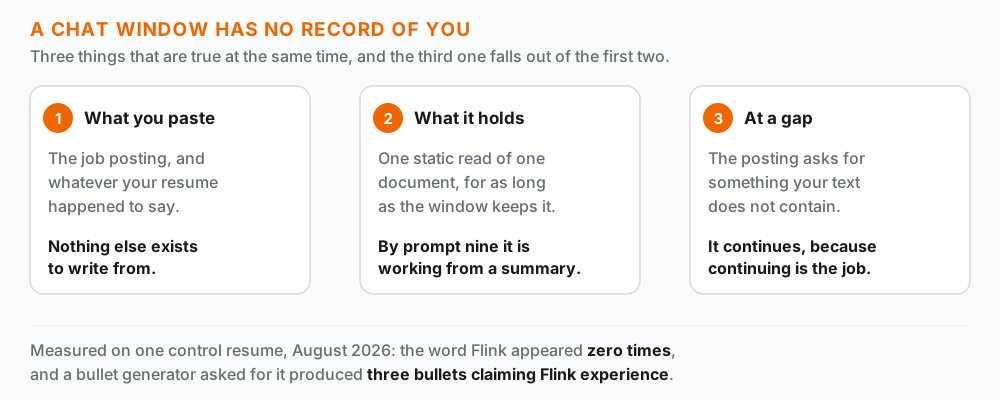
That run was not Claude, and the point is not that it was. The mechanism has nothing to do with which model sits behind the button: a generator writing from the posting, checked by a score reading the same posting, shares a ruler with its own checker.
So: per job, yes. Per chat window, it depends on what you keep giving it, and per line on whether you run the checking half.
Is ChatGPT or Claude better for a resume?
JobShifu has not benchmarked the two models head to head. Nothing it has published compares them, so this page cannot tell you which one writes a better bullet, and a page that answers that without showing a protocol is guessing.
What can be said is that the failure above is not specific to a model. In a bare chat window either one is handed two instructions that quietly conflict, match this job and stay true to this person, with no way to know which is the important one when both cannot be satisfied [4]. Both continue at the gap. JobShifu's own prompts guide arrives at the same place from the other end: any current frontier model handles the fourteen prompts, and model choice matters far less than whether you run the verification half [2].
The variable worth changing is not the model. It is what the model is allowed to write from.
Which Claude is best for a resume?
JobShifu answers this for its own product, and the answer transfers better than a model number would. Resume tailoring runs on Anthropic's top Claude model, not the cheap tier. Smaller Claude models handle the lighter jobs, like reading a posting into structured fields, because a larger model does not read a job posting any better [5]. Claude is Anthropic's, and Anthropic publishes the family [6].
Read across to your own use: spend the strongest model you have on the tailoring pass and on the eight checks, because those are the judgement shaped steps. Pulling a posting apart into must haves, nice to haves and house language is extraction, and extraction is not where a bigger model pays.
The same answer carries the caveat that matters more than the choice. A better model makes the writing better. It does not make the writing true, which is why every generated line is checked against your confirmed record before it can reach a document [5].
Is Claude good at reviewing resumes?
Reviewing is where a chat model earns its place, and it is eight prompts rather than one. A tailored draft fails in eight distinct ways, and they have different causes and different fixes [2]:
- Provenance. A line with no basis anywhere in your master document.
- Scope. Real work described at a size it was not.
- Entailment. A tool or outcome in the line and in none of your evidence.
- Jagged metrics. A number that exists nowhere in your source, or a timeframe contradicting your dates.
- Role integrity. A true bullet filed under the wrong employer.
- AI tells. Language that reads as generated rather than as yours.
- Title seniority. A headline a level above what your evidence supports.
- Positioning. The right evidence, sitting below the part anyone reads.
Each is its own prompt for a reason. Ask one prompt to find all eight and it finds the most obvious failure, usually the buzzwords, announces that the resume is now strong, and stops [2]. One check per prompt is slower and it is the only version that works.
Run the checks against the draft and the change log from the rewrite step, so the model compares text against text rather than against your memory.
Is Claude Pro worth it for resume writing?
No price for a Claude plan appears here, because none was read off Anthropic's own page while this was written. What can be described is the trade.
A paid chat tier buys more use of the strongest model and longer sessions, and this loop is hungry for exactly that: fourteen prompts per application, a master document that has to stay in context, and eight checks that each want their own pass. If a free limit is what stops you finishing the checking half, a paid tier removes it.
What a paid chat tier does not buy is a record of what you have actually done, or anything that refuses to write a line. Those are not tiers of a chat product.
For comparison, once: JobShifu's Pro is $239.99 a year, which is about $20 a month; there is also $74.99 every 3 months, or $29.99 month to month [7]. The free tier needs no card and includes two fully tailored resumes every day [7].
The same loop, with a Vault behind the model
Powered by Anthropic's Claude, JobShifu runs those same nine steps with two things a chat window does not have.
The first is the material. Career facts live in a Vault, added one at a time and confirmed with a source and a date, and the product states the contract on its first screen: "The Vault holds everything true about you. Tailoring picks what matches this job, and nothing lands on a resume that is not in here." Every proposed change names the confirmed units it draws from, and proposals citing anything unconfirmed are dropped before they reach you [4].
The second is where the check sits. Run through prompts, the eight checks are advice: the model reports that a line has no source, and you decide. In JobShifu nine checks run on every build and two block. Provenance is ordinary code reading the citations on each line, and a line citing nothing fails the build, so there is no document on the other side of it. Job-posting echo is ordinary code too, and it fails a line carrying a term from the posting that appears nowhere in your Vault or uploaded resume. Two of the seven that only report are model backed and fail open, which is why the page describing them declines to call them guarantees [4].
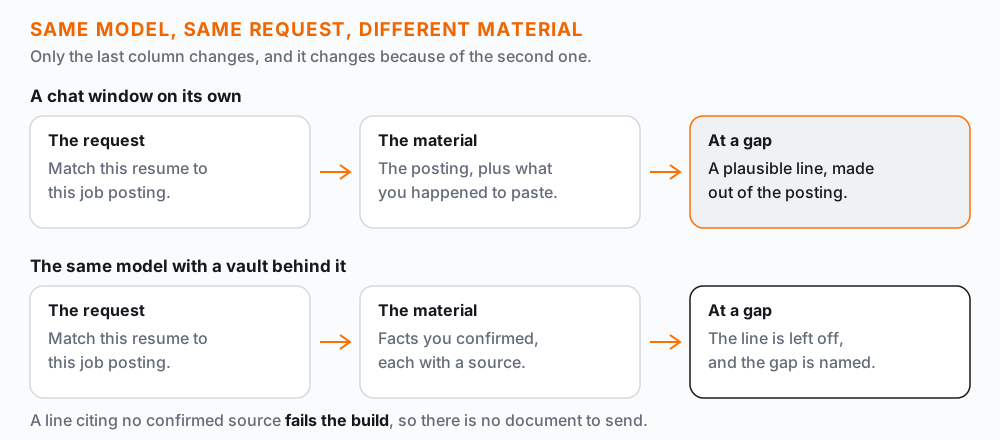
A third difference makes per job tailoring compound instead of reset: reading a posting closely surfaces work you did and never wrote down, and confirming it makes it citable for every resume after [4], stamped with the job that surfaced it [2].
What that looked like on a real run, from the same benchmark: keyword coverage moved from 6 out of 15 to 10 out of 15, entirely from facts already confirmed in the Vault, Fit came out at 80 percent, and Readiness moved from 51 to 76. One line that had been in the baseline resume did not make it onto the tailored document, with a notice saying why: "1 baseline line(s) had no confirmed evidence behind them and were left off. Confirm the fact in your Vault to bring them back." [3]
The cost sits in the same sentence. The Vault has to be filled in before the tailoring is any good, and a notice about a dropped line is a chore no chat window will ever hand you [3].
Common questions
Can Claude write a resume from scratch?
It can produce a document that looks like one, which is the problem rather than the achievement. With nothing of yours in front of it, every specific came from the posting or from the general shape of a resume. The useful version is the other way round: build a master document first, then ask the model to select and reorder rather than write [2].
Do I have to paste my whole resume into every prompt?
Effectively yes, and that is the tax on running this by hand. Skip it and by the ninth prompt the model is answering from a summary of a summary, which is also when the previous job's language starts appearing in this one [2]. Two things help: a fresh conversation for each job, and the master document at the head of the checking prompts as well as the writing ones.
Is tailoring per job worth the time on a weak fit?
Often not, and the loop has a step for deciding before the expensive part. Steps 3 to 6 are cheap and tell you whether the rewrite is worth doing at all, so on a weak fit the move is to run the gap analysis, write anything new back into your master document, and stop [2].
Sources
- r/ResumeCoverLetterTips, "Is using Claude to tailor a new resume for every different job a good idea?": reddit.com/r/ResumeCoverLetterTips/comments/1uwz0n5. Seen in Google results for "claude ai resume", 4 September 2026.
- JobShifu, "ChatGPT prompts to tailor a resume to a job description, free": /blog/tailor-resume-to-job-description-with-ai-free. Published 20 August 2026.
- JobShifu, Resume tailoring tools benchmark, August 2026: /blog/resume-tailoring-tools-benchmark, data file tailor-benchmark-2026-08-27.json, CC BY 4.0. Published 27 August 2026.
- JobShifu, the Calibration Engine: /calibration. Updated 17 August 2026.
- JobShifu, "Which AI model does JobShifu use?": /faq. Read 4 September 2026.
- Anthropic, Claude product overview: claude.com/product/overview. Read 4 September 2026.
- JobShifu pricing: /pricing. Updated 20 August 2026.