Yes, some can. Jobright's agent is described by Jobright as finding roles, customizing your resume, filling the form and applying on your behalf. ChatGPT agent and Meta Muse can fill web forms in a browser of their own, but neither company documents a workflow built for job applications. LinkedIn and Indeed use AI to find roles and prepare materials, and leave the application to you. What separates them is which of the five steps each one takes, and where it stops to ask you.
This comparison is published by JobShifu, which is building an assistant of its own, called Shifu, described at the end. Every competitor claim below comes from that company's own pages or from dated press coverage, linked in the Sources section. Nothing here comes from signing in to a competitor's product for this article.
Who does which step
| Agent | Finds jobs | Tailors | Fills forms | Submits | Asks before submitting | Outside the US |
|---|---|---|---|---|---|---|
| Meta Muse | General web browsing; no job matching documented | Not documented | Yes, any web form | Not documented for jobs | Approval before sensitive actions; job submits not specified | Canada since September 2026 |
| ChatGPT agent | General web browsing | Writes documents on request | Yes, in its own browser | Can, when you ask | Asks before actions of consequence | Yes, on paid plans |
| Yes, LinkedIn listings, natural-language search | AI writing help | Not an AI feature | No; you click Apply | Not applicable | Global, five languages | |
| Indeed Career Scout | Yes, Indeed listings | Customizes resumes | Pre-fills applications | Not stated | Not stated | Australia since July 2026 |
| Jobright Agent | Yes, postings from across the web | Customizes resume, writes cover letter | Yes | Yes | Not described in its launch posts | US roles at launch |
| JobShifu Shifu (early access) | Yes, live postings only | From your Vault; unsourced lines dropped | Yes, on supported application pages | No | You click Submit | Early access only |
Each cell is sourced in the sections below and in the Sources list. "Not documented" means the company's published material does not describe it, which is not the same as the product lacking it.
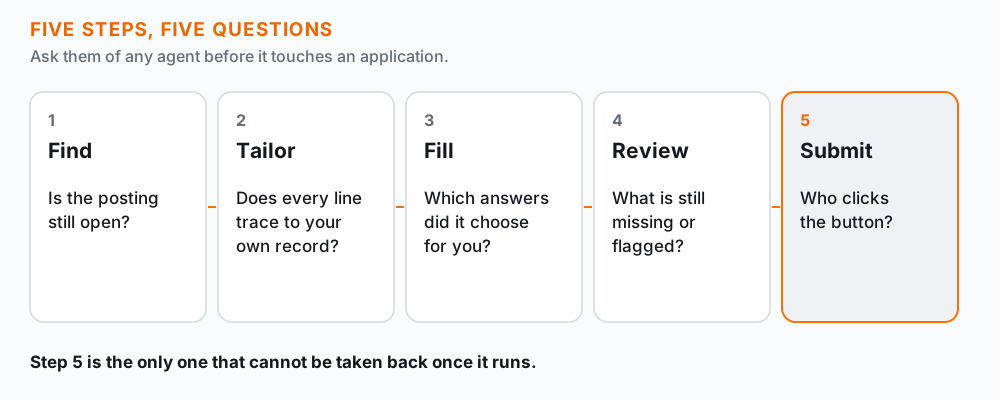
Finding jobs: listings versus the open web
The agents split into two groups here. LinkedIn and Indeed search their own listings. LinkedIn's AI job search takes a description of the role in plain language and was rolled out globally in January 2026 in English, Spanish, German, French and Portuguese [1]. Indeed's Career Scout, introduced in September 2025, offers job recommendations inside the Indeed app [2].
Jobright scans "over 400,000 new job postings from across the web" each day, by its own description [3]. ChatGPT agent and Meta Muse are general-purpose agents: they can browse job sites when asked, but neither OpenAI's launch post nor coverage of Meta's launch describes a job-matching system [4] [5].
None of these sources says whether the agent checks that a posting is still accepting applications before it acts. That check matters more as agents get faster, because a fast agent can fill a form for a role that closed last week. JobShifu publishes a free checker for whether a posting is still open for exactly that step [6].
Tailoring: who writes the resume
Jobright's agent "customizes your resume, writes a cover letter, fills forms, and applies," in Jobright's words [3]. Indeed says Career Scout customizes resumes and pre-fills applications [2]. LinkedIn has offered generative AI tools that draft application materials and cover letters since 2024 [7].
Meta has not documented a resume workflow for Muse. HRLens's job-search guide for Muse, published on September 29, 2026, notes that it "attaches the same file to every application" unless you change it yourself [8]. That is a reason to keep the tailoring step outside the agent, or at least to check which file it uploads.
Whoever writes the resume, the question to ask is the one in the figure above: can every line be traced back to something you have done? An agent that writes from the job posting rather than from your record will produce lines that read well and cannot be defended in an interview.
Filling and submitting: where each one stops
Filling is where general agents are strongest. Meta says Muse can open a browser and fill out forms, and that it keeps working on longer tasks after you close the app [9] [10]. OpenAI's ChatGPT agent navigates websites, fills forms and "requests permission before taking actions of consequence," and you can interrupt it, take over the browser or stop the task at any point [4].
Muse's permission layer is a separate component Meta calls Sentinel, which evaluates proposed internet actions and can block them or ask the user, with sending an email and completing a purchase given as examples [11]. Meta's material does not say whether submitting a job application counts as one of those actions. ArgoLand's review of Muse puts it plainly: Meta "has not publicly documented a dedicated job-application workflow" [5].
Jobright is the one product here built to submit. Its launch post describes an agent that "submits applications on behalf of job seekers" [12], and The Register's launch coverage reported that it was limited at the time to tech, education and government roles in the US [13]. Its launch posts do not describe a review step before each submission; check Jobright's current settings if that matters to you.
LinkedIn does not offer an AI that applies for you. Its help center also says it does not permit third-party software, including bots and browser extensions, that automates activity on LinkedIn's website, and that accounts using them can be restricted [14]. Sites can and do refuse agents: Amazon blocked Meta Muse from its store in September 2026, saying the agent did not identify itself as one [15]. An agent that can fill a form is only useful on the sites that let it in.
Where you can use them
Meta Muse launched in the US on September 8, 2026, for adults 18 and older [9] [11], and reached Canada less than two weeks later [10]. HRLens's guide, dated September 29, lists the UK among the places it is not yet available [8].
ChatGPT agent launched in July 2025 for Pro, Plus and Team subscribers [4]. LinkedIn's AI job search is global in five languages [1]. Indeed brought Career Scout to Australia in July 2026 [16]. Jobright's agent launched on US roles [13].
How Shifu handles the same steps
Shifu is JobShifu's assistant, currently in early access, which means a small group of invited accounts uses it and it is not open to everyone yet. It is described here by what the code does, step by step.
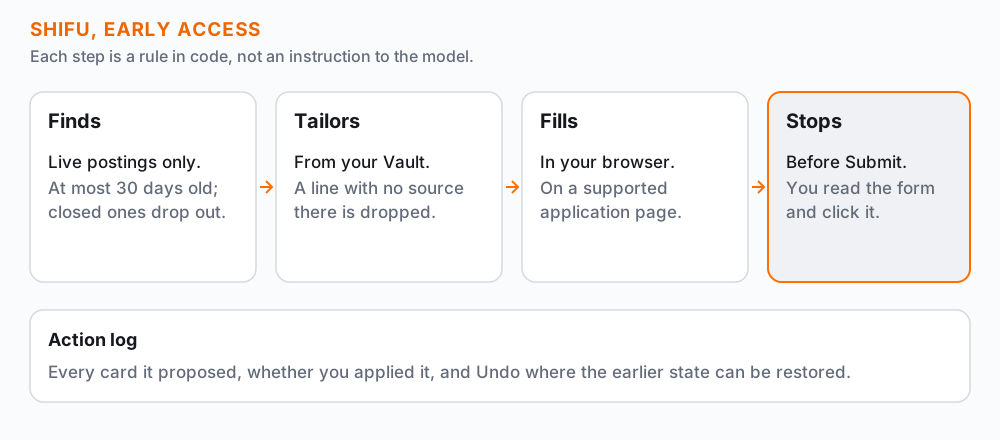
- Finds live jobs. Shifu searches JobShifu's own index of postings, where a card is at most 30 days old and a posting that has closed drops out.
- Tailors from your Vault, or drops the line. Your Vault is the store of experience you have confirmed. A claim Shifu writes without a citation to it is removed before you see it. The same rule runs the Calibration Engine that checks every tailored resume [17].
- Fills, then stops before Submit. For a saved job whose link is a supported application page (an application form on Greenhouse, Lever or Ashby), the JobShifu browser extension fills the form and reports what it filled and what it flagged. It never clicks Submit. You read the form and click it.
- Keeps an action log with Undo. Every card Shifu proposes is recorded, with whether you applied it. Where an action can be reversed, such as moving a job to a new stage, the log offers Undo.
Shifu does not apply to jobs while you sleep, and it is not built to. If volume is what you want, Jobright's agent is the product on this list built for it.
Which one fits your search
- You already live on LinkedIn or Indeed. Their AI search and writing tools sit inside the listings you browse, and you keep the Apply button. Career Scout is free in the Indeed app [16].
- You want an agent to send applications for you, in the US. Jobright's agent is designed for that, on the roles it covers.
- You want one agent for the rest of your life too. Muse and ChatGPT agent handle email, bookings and forms of every kind. For applications, upload the file you mean to send and read the form before anything is submitted.
- You want every line traceable to your own record, and the last click kept. That is what Shifu is built around, in early access today, and JobShifu's autofill works the same way on the form step now.
Common questions
Can Meta Muse apply for jobs?
Muse can fill out web forms, including application forms, and Meta says it asks for approval before sensitive actions. Meta has not published a job-application workflow, and it has not said whether a job submission triggers that approval. Read every form before anything is sent.
Is it safe to let an AI agent submit applications for me?
It depends on the step you hand over. Filling is easy to check because you can read the form. Submitting is the one step you cannot take back, and a sent application carries whatever the agent wrote and chose. Some sites, including LinkedIn, prohibit automation tools outright, and accounts using them can be restricted.
Do I need a different resume for every application?
A tailored resume puts the experience the posting asks for first. Muse, by HRLens's account, attaches the same file each time, so tailoring has to happen before the agent starts. Whichever tool does it, check that each line describes work you did.
Sources
- Social Samosa, "LinkedIn expands AI job search to multiple languages": socialsamosa.com. Published 8 January 2026.
- Indeed, "Indeed Introduces New Suite of Hiring Products: Career Scout, Talent Scout, Premium Sponsored Jobs and Indeed Connect": indeed.com. Published 10 September 2025.
- Jobright, "What Is the Jobright Agent? Automate Your Job Search": jobright.ai. Published 22 July 2025.
- OpenAI, "Introducing ChatGPT agent": openai.com. Published 17 July 2025.
- ArgoLand, "Can Meta Muse auto-apply to jobs?": argoland.ai. Published September 2026, read 3 October 2026.
- JobShifu, "Is this job still open?" checker: /is-this-job-still-open. Read 3 October 2026.
- TechCrunch, "LinkedIn leans on AI to do the work of job hunting": techcrunch.com. Published 13 June 2024.
- HRLens, "Meta Muse job search guide": hrlens.io. Published 29 September 2026.
- Fox Business, "Meta introduces Muse, a personal AI agent that can send emails, book travel": foxbusiness.com. Published 8 September 2026.
- iPhone in Canada, "Meta's Muse AI Agent Is Now Available in Canada": iphoneincanada.ca. Published September 2026.
- Let's Data Science, "Meta Launches Muse, a Personal AI Agent for Everyday Tasks", citing Meta's announcement: letsdatascience.com. Published 9 September 2026.
- Jobright, "Jobright Launches First AI Agent to Put Job Search on Autopilot": jobright.ai. Published 24 June 2025.
- The Register, coverage of the Jobright Agent launch: theregister.com. Published 24 June 2025.
- LinkedIn Help, "Prohibited software and extensions": linkedin.com/help. Read 3 October 2026.
- TechSpot, "Amazon blocked Meta's Muse agentic AI shopping service": techspot.com. Published 25 September 2026.
- IT Brief Australia, "Indeed launches AI Career Scout for Australian jobseekers": itbrief.com.au. Published 16 July 2026.
- JobShifu, the Calibration Engine: /calibration. Read 3 October 2026.