The first bullet under your most recent job should be the line that best proves the main thing this job needs, written as one specific result you could talk through in an interview. Not your biggest number, and not the posting's keywords repeated back.
If you change one thing on your resume this week, change that line. It is the last stop on the path a recruiter's eye takes in the first few seconds (title, company, dates, first line), and it is the one stop you fully control.
A recent r/jobsearchhacks thread on this got more than a thousand upvotes, and the replies filled up with people saying exactly that: they swapped one line and the calls started. Some of those replies also show the trap, which is the second half of this guide.
This guide is published by JobShifu, which sells a resume tailoring product. The ordering experiments described below are our own measurements on our own product.
Why does the first resume bullet matter most?
The first-pass screen takes seconds. Ladders' 2018 eye-tracking study put it at 7.4 on average, and found that the resumes that did best had bold job titles over bulleted accomplishments [1]. The recruiter who started the thread describes the same route: title, company, dates, then the first line of the latest role [2]. By the second bullet, most readers have already decided whether to keep going. We cover the whole path in where recruiters look on a resume. This guide is about the last stop.
Which bullet should go first on a resume?
Not the most impressive line. The line that best proves the main thing *this* job needs.
We learned that the hard way, by shipping two wrong answers before the current one. JobShifu orders the bullets inside each role in code, after the model has proposed its wording, and we have replayed that order against real tailored resumes each time it changed.
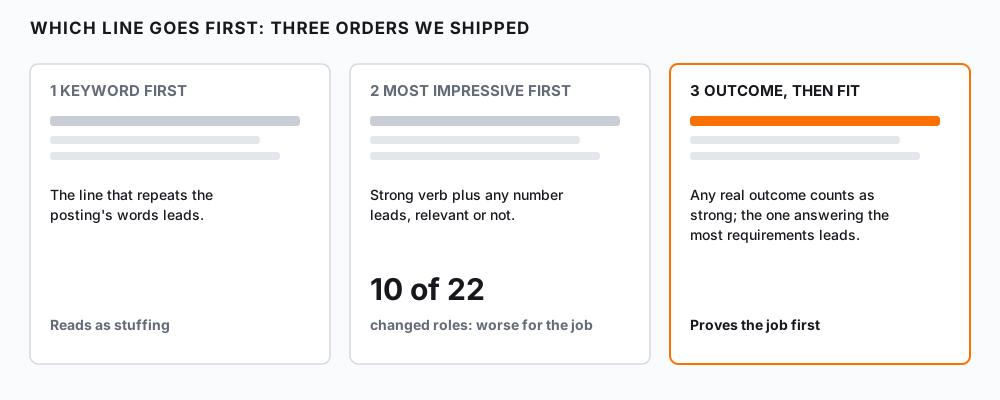
- Keyword first. The line that repeated the posting's words the most went to the top. It read like the posting talking back to itself, which a reader notices instantly.
- Most impressive first. The line with a strong verb and any number led. On replay, that made the first line a worse fit for the job in 10 of 22 roles where the order changed: a big number about the wrong thing beat a smaller one about the right thing.
- Strong line, then fit. Every line with a measurable result or a strong verb counts as strong, and among those, the one that answers the most of the job's requirements goes first. A later pass that also matched requirements by meaning, not only by shared words, and used that to break ties, changed the first line in 12 of 498 roles: 6 better, 1 worse, 5 neutral.
The rule you can use by hand: list the job's top three requirements, then pick the bullet that proves the first one with something you actually did. That is your first line.
How do you write a strong first bullet?
One sentence. Action, context, result, in that order.
| Before | After |
|---|---|
| Responsible for managing inventory | Moved our top 50 items to weekly cycle counts after repeated stock-outs |
| Responsible for reports | Rebuilt the weekly sales report to run from one query instead of four spreadsheets |
| Worked on customer onboarding | Rewrote the onboarding checklist that new accounts now follow in their first week |
Three things make these work:
- A verb you did, not a duty you had. "Responsible for", "worked on" and "assisted with" describe a job description, not a result.
- A noun only you would write. "Our top 50 items", "four spreadsheets", "new accounts". If the line could sit on a thousand strangers' resumes, it is not doing its job.
- A result, sized truthfully. A real number if you have one. If you do not, the change itself is the result.
What if you cannot measure the result?
Read the replies under any viral resume post and a template appears. In that thread, several separate commenters reported almost the same win: weekly reporting cut from a few hours to forty-five minutes. Maybe all of them did it. But a template is how a made-up number gets onto a resume, because it *sounds* like the kind of line that works.
An invented figure fails twice. A reader who has seen the template recognises it. And an interviewer will ask the obvious question: how did you measure that? A line you cannot talk through for thirty seconds is a liability on the page, however good it looks.
So:
- Use your exact figure. "Cut close time from 9 days to 6" beats a rounded "33%" you would have to reconstruct in the room.
- No number? Describe the change. "Moved our top 50 items to weekly cycle counts" needs no percentage to show judgement and ownership.
- Not sure of the number? Ask. Your old manager, the ticket history, your own notes. If you still cannot find it, leave it out.
JobShifu works the same way. The model is told to use the candidate's real metric when there is one and to write the bullet without a figure rather than invent one, and the Calibration Engine flags any number that does not match the confirmed fact the line cites. When an achievement in your profile has no number, the product asks you for the real figure, or a rough sense of scale, instead of guessing.
Common questions
Should the first bullet be my biggest achievement?
Only if it is also the most relevant one. The first line should prove the job's main requirement. A large number about unrelated work reads as off-target.
How many bullets should a role have?
Enough to prove the job's top requirements, usually three to five for a recent role. Older roles can shrink to one strong line.
Sources
- Ladders, "Ladders Updates Popular Recruiter Eye-Tracking Study With New Key Insights on How Job Seekers Can Improve Their Resumes", press release, 6 November 2018. The number of recruiters is not stated. prnewswire.com. Also reported by HR Dive, 8 November 2018: hrdive.com
- r/jobsearchhacks, "Your resume gets about 10 seconds. Here's where the reader actually looks", posted late September 2026, replies read 5 October 2026. reddit.com
- JobShifu, bullet-order replays on tailored resumes, 2026. Internal measurement of JobShifu's own product; counts are roles whose first line changed between orderings.