A job asks for incident response. Your resume says "maintained backend services." You start to mark incident response as a gap, then remember the on-call rotation, the failed deployment you investigated and the recovery notes you wrote.
You have not gained a new qualification. You have remembered work the resume does not show. Before rewriting a bullet, find the example behind it.
Separate missing evidence from missing experience
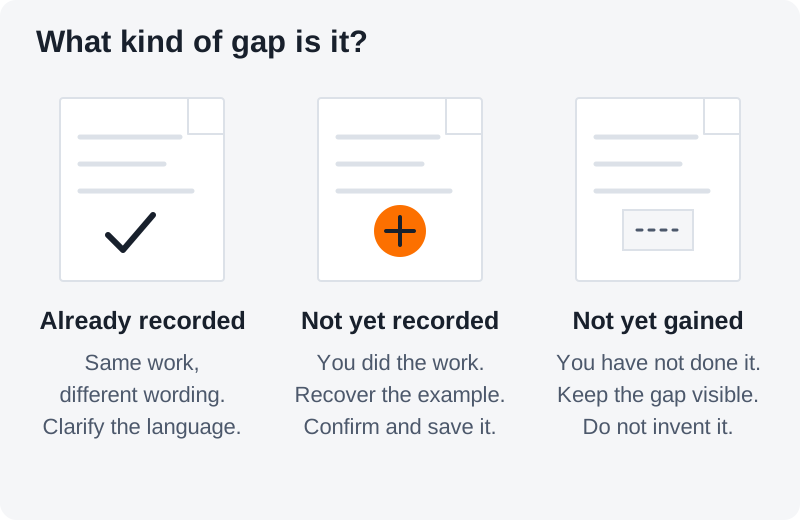
A job description can reveal three different situations. Treating all of them as a keyword problem is how an application becomes less accurate while sounding more impressive.
| What is missing? | What to do |
|---|---|
| The employer's wording, but the same work is already described | Use clearer, equivalent language without changing the scope. |
| A real example you have not included | Recover the details, confirm them and decide whether they belong in this application. |
| Experience or a required qualification you do not have | Leave the gap visible. Consider whether related experience is relevant or whether the role is a poor fit. |
For example, helping a colleague with a release is not the same as owning the release process. A course project is not production experience. Both can be worth describing, provided the label matches the work.
Use the requirement as a memory prompt
Choose one important responsibility from the posting. Ask these questions before asking an AI tool to rewrite anything:
- When have I done something like this? Consider paid work, internships, coursework and volunteering. Keep the context explicit.
- What did I personally do? Separate your contribution from the team's result.
- What tools or methods did I use? Name only those you used in that example.
- What happened afterward? Include a measured result if you have one. A concrete, non-numeric outcome is useful too.
- What can I check? Use permitted notes or records to refresh your memory. Do not copy confidential employer or customer information into an application or AI tool.
A title such as "support assistant" may hide training, documentation, scheduling or process improvement. The title is where the search starts; the work is what supplies the evidence.
One example, before and after
The following is an illustrative example, not a customer result or a screenshot of JobShifu. Suppose a developer confirms these facts: they participated in an on-call rotation, used service logs to investigate failed deployments and wrote recovery notes for teammates.
Job requirement: Investigate production incidents and document resolutions.
Current bullet: Maintained backend services.
Recovered example: Participated in an on-call rotation, investigated failed deployments using service logs, and documented recovery steps for teammates.
Proposed bullet: Investigated failed deployments during an on-call rotation and documented recovery steps for teammates.
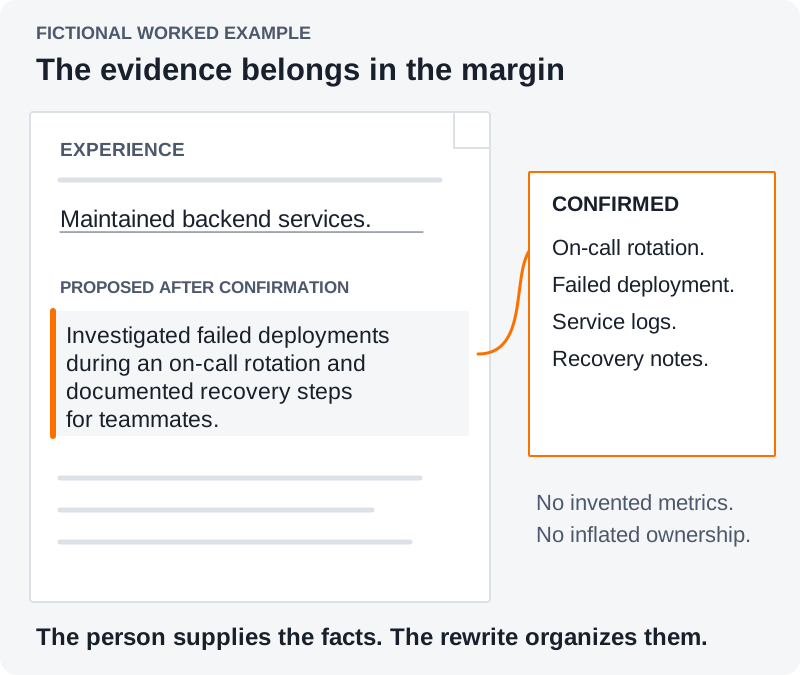
Nothing here supports "led incident response," "owned reliability" or "reduced downtime by 40%." Those would require additional facts. The proposed bullet also does not need every available detail: mention service logs if that detail matters for the role.
Read the sentence back and ask whether you could explain the incident, your contribution and the outcome in an interview. Correct anything that gives you more responsibility than you had.
Save the details, not just the polished sentence
Keep a master record that is longer than the resume you send. Yale's career office recommends building a master resume and selecting from it for a shorter, targeted version. [1]
The practical addition is to save the underlying example alongside the final wording:
- Context: role, project and approximate date.
- Contribution: what you did yourself.
- Tools and outcome: what you used and what happened, without guessed measurements.
- Limits: what you assisted with, did not own or cannot substantiate.
- Used for: the application where you included the example.
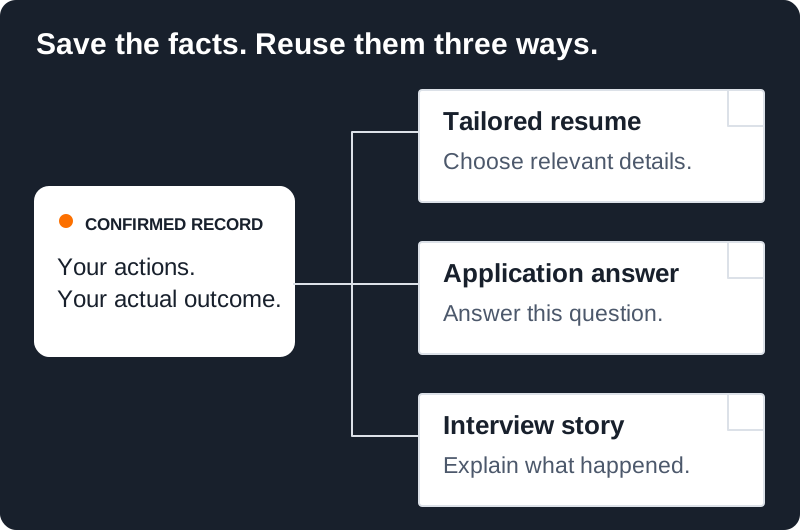
The same incident might support a reliability role's resume bullet, an application question about troubleshooting, or an interview story about troubleshooting a failed deployment. Those are different answers built from the same experience. Saving it once gives you a starting point next time.
Where an AI tool can help
An AI tool can compare the posting with your resume, ask about an apparent gap and help organize an answer. It cannot know an unrecorded project happened just because the job requires that skill.
Try this instruction with the requirement and a resume excerpt:
Compare this requirement with my resume. If relevant experience is missing, ask me for a specific example before proposing a bullet. Separate what I confirm from what remains unknown. Do not add responsibilities, tools or results I have not provided.
Review the output even with that instruction. A question is a prompt to recall evidence, not proof that you have it.
JobShifu connects this exercise to resume tailoring: compare the job with your profile, confirm relevant experience the resume leaves out, and review proposed additions. Confirmed experience can be saved in the Vault, your reusable master resume, for later applications. A qualification you do not have remains a gap. [2]
For the full editing process after this exercise, follow how to tailor a resume by hand. Start with one requirement and one example. You can decide what to cut after you know what is worth showing.
Common questions
What if I cannot remember a number?
Do not estimate a percentage to make the bullet sound stronger. Describe the action and a result you can support. Add a measurement later only if you can verify it.
Can I include coursework or volunteer work?
Yes, when it is relevant and labeled accurately. Name the context so a reader does not mistake a class assignment or volunteer project for paid professional experience.
Should everything I remember go into the resume?
No. Save the fuller record, then select what helps explain your fit for this role. Relevant details belong in the application; the rest can remain available for another one.
Sources
- Yale School of the Environment, Office of Career and Professional Development, A note about resume writing from CPD, August 1, 2024; consulted September 14, 2026.
- JobShifu, Resume tailoring, product description consulted September 14, 2026. This guide is published by JobShifu.