On a career change resume, keep your official job title, add the new field's term beside it in brackets only if it truly describes the work, put a one-line headline above everything naming where you are going, and make the first bullet of each role the one that transfers.
The reason is the first read. Recruiters check your latest job title first, and ask whether it looks close to the role. For anyone changing careers, that advice sounds like a closed door: the latest title is, by definition, the job you are leaving. It was the angriest reaction in a recent r/jobsearchhacks thread on the subject, and a fair one.
The door is not closed, but it is narrower than the one a same-field applicant walks through. You cannot change what your last job was called. You can change what the reader sees next to it, and in what order.
This guide is published by JobShifu, which sells a resume tailoring product. Skill figures come from our own measurement of 500,000 job postings, labelled in the Sources section.
Why is a career change resume harder to read?
The first pass is seconds long. Ladders' 2018 eye-tracking study put it at 7.4 seconds on average, and job titles were among the first things recruiters' eyes went to [1]. The title works as a category check. A recruiter filling a data analyst role sees "Operations Coordinator" and has to translate. One reply in the thread put it well: you are not out, you are making the reader do the translation, and in a skim that usually means a skip.
So the job is to do the translation for them, in the places the eye already lands.
How do you point your resume at a new field?
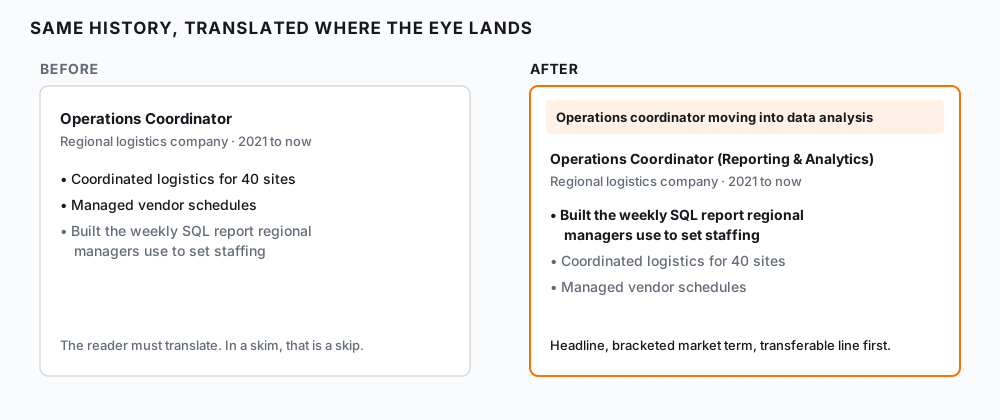
1. A one-line headline above everything. Not a paragraph. One line that names where you are going and the evidence you are bringing: "Operations coordinator moving into data analysis: SQL reporting for a 40-site network". It is true, and it gives the reader the category before the title has a chance to take it away.
2. Keep your title. Add the market's word beside it, if it is true. If your work was already analysis under another name, say so once: "Operations Coordinator (Reporting & Analytics)". Do not replace the title. Employers check titles in references and background screens, and one commenter in the same thread described a new employer questioning a title their old employer's HR records did not show.
3. Lead each role with the bullet that transfers. The first bullet under your latest job is the last stop of the first read. Make it the line that proves a skill the new job asks for, not your proudest moment in the old field. "Built the weekly SQL report the regional managers use to set staffing" beats "Coordinated logistics for 40 sites", even if the second was the bigger job.
4. Say it in the new field's words. Swap your old field's jargon for the capability it describes. "Ran the MRP cycle" means little outside manufacturing; "planned stock levels against forecast demand" travels.
5. Put the bridge where it can be seen. A course, a certificate or a project in the new field can sit near the top, labelled as exactly what it is. A class project is not production experience, and naming it accurately keeps it believable.
Which skills transfer between careers?
Some skills move between fields easily and some barely move at all. In our count of 500,000 job postings, SQL appeared across fields so widely that only 48.6% of the postings asking for it sat in its single biggest field. Business Development (45.0%) and Salesforce (46.4%) spread even wider. At the other end, 95.1% of postings asking for a Registered Nurse sat in one field, and Kubernetes sat 88.5% in one [2].
The practical read: lead with the skills on the portable end, because the new field already uses those words. Skills on the locked-in end still count, but they need the translation from move 4.
What a resume cannot do on its own
The thread was right about one thing: some of this is out of your hands. Two habits shift the odds more than any formatting.
- A cover letter, for once. A hiring manager in the thread said that of about 20 qualified applicants for one role, maybe 2 sent a cover letter, and those went to the top. For a career changer, it is the one place to explain the move in your own words.
- A person. A referral replaces the category check with a colleague's word, which is worth more to a career changer than to anyone else in the stack.
How JobShifu handles a career change
JobShifu's resume tailoring has a mode for exactly this, and its rules mirror the five moves:
- When you set a career-change target and a job matches it, the model is told to lead with the evidence most transferable to *this* job, and to use capability wording rather than the old field's labels.
- It may reorder and reweight. It may not add experience you do not have, and every line has to cite something in your profile.
- It never rewrites a past title. If you add a market title, the export prints it with your official title in brackets, never alone.
What it cannot do is the cover letter's job of explaining *why* you are moving. That reason is yours to write.
Common questions
Should I change my job title on my resume when changing careers?
No. Keep the official title so it matches reference and background checks. Add a market term beside it in brackets if it truly describes the work, and use a one-line headline to name the new field.
Should a career changer use a summary?
Use a single headline line instead of a paragraph. It sits where the eye lands first and names the target role before the old title does.
How do I show transferable skills on a resume?
Put them in the first bullet of each role, written in the new field's words, with a specific result. A skills list alone is a claim; a bullet with an outcome is evidence.
Sources
- Ladders, "Ladders Updates Popular Recruiter Eye-Tracking Study With New Key Insights on How Job Seekers Can Improve Their Resumes", press release, 6 November 2018. The number of recruiters is not stated. prnewswire.com. Also reported by HR Dive, 8 November 2018: hrdive.com
- JobShifu Posting Corpus, 500,000 live job postings measured 13 August 2026. Share of each skill's postings in its single largest field; JobShifu's own measurement. Method in the skills that pay, from 500,000 jobs.
- r/jobsearchhacks, "Your resume gets about 10 seconds. Here's where the reader actually looks", posted late September 2026, replies read 5 October 2026. reddit.com