The top reply under a recent thousand-upvote post on r/jobsearchhacks was not a tip. It was a complaint: people read conflicting advice every day, and it seems like nothing works. That is a fair reading of the subreddit. It is also fixable, because most of the conflict comes from mixing three kinds of advice that should never sit in the same list.
We read fourteen of the subreddit's heavier threads (between 13 and about 1,800 upvotes each, the busiest on finding fresh postings and on de-AI-ing a resume) and sorted every repeated tactic into three piles: holds up, depends on your situation, skip. This is that sort. The short version: apply early and on the employer's own site, make your first bullet specific, keep the layout plain, and use referrals. Skip invented numbers, mass auto-apply and timing tricks.
This guide is published by JobShifu, which sells job search and resume tailoring software. Upvote counts are a rough signal of what resonated, not proof that a tactic works, and we say where evidence is thin.
Why is Reddit's job search advice so contradictory?
Three mix-ups produce most of it.
- First read versus full read. "Recruiters skip summaries" and "a short summary helps" can both be true. The first pass takes seconds [1] and, by a recruiter's account, lands on titles, companies, dates and the first bullet [3]. The full read, before an interview, is where a summary or a skills section earns its space.
- One industry's tactic, stated as a law. Walking in with a paper resume worked in manufacturing and at a nonprofit. It does not get you past a badge reader at a bank.
- Evidence of one. "I changed one line and got calls the next week" may be exactly what happened. It is still one person, one market, one month.
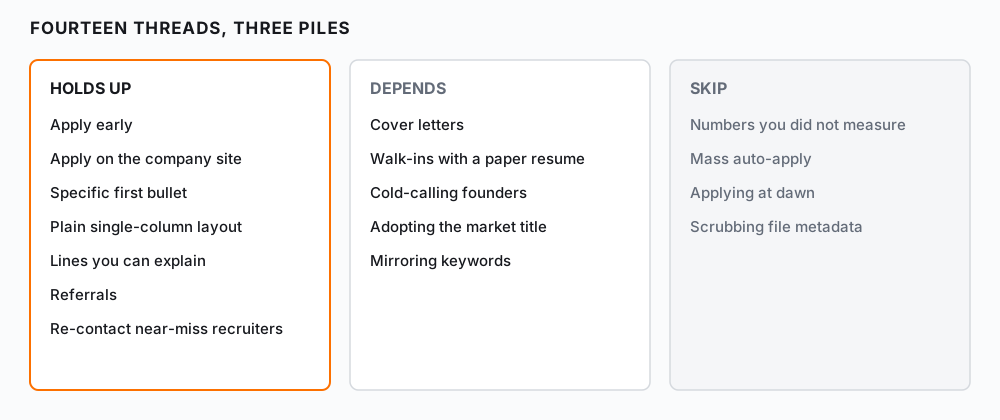
Which Reddit job search advice holds up?
These came up across several threads, from both applicants and people who hire, often with numbers attached.
Apply early. The single most repeated tactic, and the heaviest thread in our sample (about 1,800 upvotes) was a trick for filtering LinkedIn to postings minutes old. Our own first 48 hours guide puts numbers on why. Early is a strong advantage, not a cutoff: replies included interviews from postings several days old.
Apply on the company's own site. Aggregators trail company career pages, and an application through the employer's own system lands in the pipeline it actually reads.
Make the first bullet specific. One plain line about something you fixed, built or improved, under your latest title. It is the last stop of the first read. Our guide to rewriting your first resume bullet covers which line belongs there.
Keep the layout plain. Two-column templates scramble when parsed. The community's test: paste your PDF into a plain text editor and read what comes out. If it is garbage there, it is garbage to the system that stores it.
Every line has to survive a question. From the second-heaviest thread (about 580 upvotes): for every bullet, could you tell the real story behind it for thirty seconds? If a line could sit on a thousand strangers' resumes, rewrite it until it could only be yours.
Referrals and re-contact. The most upvoted reply in one tactics thread (about 150 upvotes) was to get back in touch with recruiters from interviews you nearly won when a new role opens, and a recruiter replied that they always prioritise people who made a good impression.
Which tactics depend on your situation?
None of these are wrong. They are wrong as general rules.
| Tactic | When it works |
|---|---|
| Cover letters | Contested in every thread. One hiring manager said about 2 of 20 qualified applicants sent one, and those went to the top. Worth it when you need to explain something: a career change, a gap, a move. |
| Walking in with a paper resume | Small employers, on-site work, and places where the decision-maker is in the building. |
| Cold-calling founders | Startups. One person reported 4 interviews from 15 calls. |
| Adopting the market's job title | Only when it truly describes your work, and next to your official title, never instead of it. We cover how in where recruiters look on a resume. |
| Mirroring posting keywords | In bullets that show the work, yes. Stacked in a skills list, it reads as a claim with nothing behind it. |
Which popular tactics should you skip?
Numbers you did not measure. Viral resume threads fill up with near-identical success stories ("cut weekly reporting from hours to forty-five minutes"), and a template is how an invented figure ends up on a resume. An interviewer will ask how you measured it.
Mass auto-apply. One member ran six paid auto-apply tools at once and reported roughly 700 applications, 3 interviews and no offers. One experiment, self-reported, but the failure modes (irrelevant roles, generic text, queues that wiped out the early-application edge) are the ones you would predict. The only tool that got near an offer was the one where a person still drove.
Timing your submission to the hour. Advice to apply at dawn rests on one comment. What matters is how fresh the posting is, not when you click submit.
Scrubbing file metadata to dodge AI detection. It treats the wrong problem. A resume reads as machine-written because of generic wording and claims you cannot back up, which our guide to whether recruiters know you used AI covers.
What we built from it
We started reading these threads to decide what to build, and most of the "holds up" pile is now product behaviour. JobShifu reads most postings from employers' own applicant tracking systems and shows how fresh each one is. Its resume tailoring puts the line that proves the job first in each role, exports one plain column, never changes your titles, and will not write a number you did not confirm. The Calibration Engine flags filler phrasing before you export.
None of that replaces the parts that are yours: the referral, the follow-up, and the story you tell in the room.
Common questions
Is it worth using auto-apply tools?
The most detailed account on r/jobsearchhacks reported about 700 applications, 3 interviews and no offers across six tools. Applying to fewer, fresher postings with a tailored resume is the better use of the same hours.
Do cover letters still matter?
Sometimes. Few applicants send one, so a specific letter can stand out, and it is the one place to explain a career change or a gap.
Sources
- Ladders, "Ladders Updates Popular Recruiter Eye-Tracking Study With New Key Insights on How Job Seekers Can Improve Their Resumes", press release, 6 November 2018. The number of recruiters is not stated. prnewswire.com. Also reported by HR Dive, 8 November 2018: hrdive.com
- JobShifu, review of 14 r/jobsearchhacks threads collected July to October 2026, scores read at collection. Thread titles and scores are kept in our research notes; individual posters are not named.
- r/jobsearchhacks, "Your resume gets about 10 seconds. Here's where the reader actually looks", posted late September 2026, replies read 5 October 2026. reddit.com