A role says remote. You spend the evening tailoring your resume, then reach a question asking whether you live in a state the employer hires in. You do not. Check where the job can be performed before deciding how well your experience fits it.
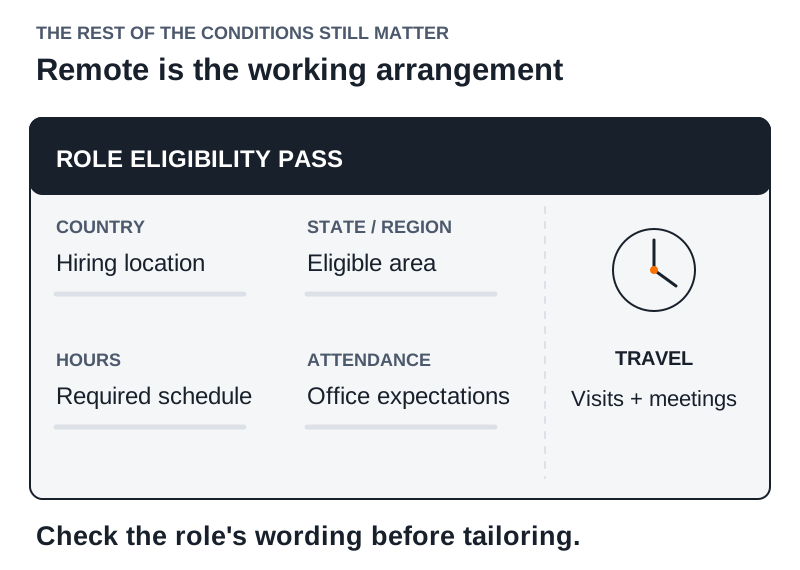
Remote describes a working arrangement. It does not, by itself, answer where an employer can hire you, which hours you must work or whether travel is required.
A remote company can still restrict a role's location
GitLab is a useful example because its working model is explicitly all-remote. Its candidate handbook still directs applicants to the individual listing to check whether their country is eligible. Its relocation policy also describes roles tied to particular countries, regions or time zones. Those are company-specific policies, not a rule for every remote employer. [1] [2]
For your application, the role's current wording matters more than a company's reputation for remote work. Read the location field, the responsibilities and requirements, and the application questions. If they disagree, ask which condition applies.
What a JobShifu corpus audit actually found
An audit of the JobShifu Posting Corpus found 8,693 of 11,973 remote-classified posting records had no extracted remote-region label, or 72.6%. The snapshot was taken on September 15, 2026 UTC. [3]
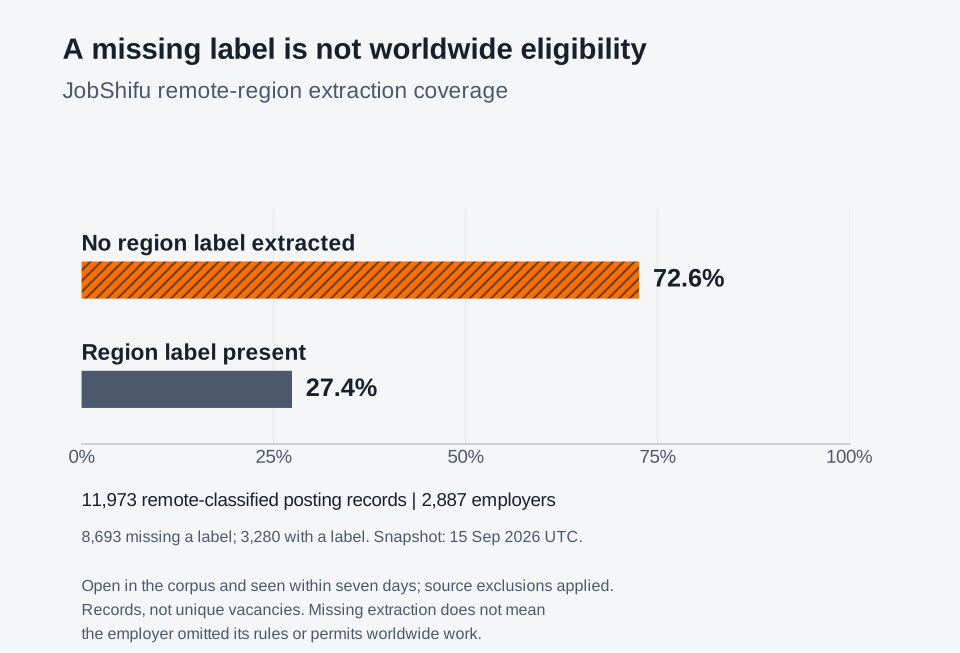
That is a measurement of JobShifu's data coverage, not the share of employers that leave location unclear. The missing label can reflect wording the extractor did not capture, incomplete source information or an unstated condition. The audit did not manually determine which explanation applied to each record.
| Extracted region field | Posting records | Employers represented |
|---|---|---|
| No region label extracted | 8,693 | 2,176 |
| A region label extracted | 3,280 | 1,197 |
| All included remote-classified records | 11,973 | 2,887 |
Employers can appear in both groups, so the employer counts do not add up. A populated label can identify a region or a worldwide label; it is not a count of restrictive policies. The audit deliberately does not label the missing group as worldwide jobs.
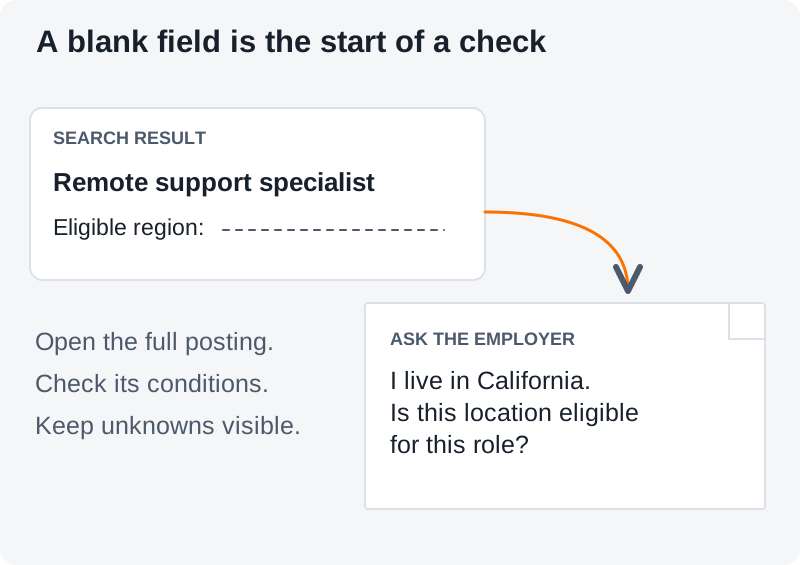
The practical lesson is small but consequential: an empty field is a reason to check, not permission to work anywhere. A search filter is a starting point. The employer's complete instructions still matter.
How the snapshot was measured
The read-only query included records classified as remote, marked open in the corpus and seen within the preceding seven days. It excluded blocked feed sources and company IDs. It included all countries, without weighting employers or markets. Being marked open is a crawler observation, not confirmation that an employer is actively interviewing.
The unit is a posting record. The records span 11,626 stored employer/requisition keys; different records can refer to the same vacancy, and those keys are not a validated vacancy count. The published table keeps the original record denominator. Both groups clear the research disclosure floor of 25 records and five employers.
This is a dated diagnostic snapshot. It does not estimate the global supply of remote jobs, track a market trend or establish why a particular application was rejected. The aggregate data and measurement notes are available to inspect.
Read a remote listing in five passes
Use this fictional example. It is a teaching example, not a quotation from an employer or a sampled corpus record:
Remote support specialist. Applicants must reside in Oregon or Washington. Working hours are 9 a.m. to 5 p.m. Pacific. Quarterly team meetings take place in Seattle.
| Check | What the example tells you | What it does not settle |
|---|---|---|
| Country | Two US states are named | Whether relocation before starting is accepted |
| State or region | Oregon or Washington | Whether nearby states qualify |
| Working hours | A Pacific-time workday | Whether the schedule is flexible |
| Office attendance | Quarterly meetings | Whether other visits are expected |
| Travel | Seattle meetings require attendance | Who pays and how much notice is given |
A reader in California should not interpret the Pacific-time schedule as permission to apply from California. A reader in Oregon who cannot travel should clarify the meetings before assuming the arrangement fits.
Ask a question the employer can answer
A useful clarification names your situation and the unresolved requirement:
I currently live in California. The posting lists Oregon and Washington. Is this role open to someone relocating to an eligible state before the start date?
Or, if the posting says remote but mentions regular office attendance:
Is office attendance required for this role? If so, how often and at which location?
Use an official recruiting contact when one is provided. Do not assume no response means permission, and do not choose an inaccurate application answer to get past a location question. Work authorization and sponsorship are separate conditions; confirm the applicable requirements rather than inferring them from the remote label.
Compare the conditions before tailoring
JobShifu brings job requirements into a consistent format and compares them with saved experience and preferences. Use that structure to identify what needs a closer look. Direct employer links let you check the current source; they do not guarantee the employer will accept your location.
For each promising role, record the allowed location, schedule, travel expectations and any unresolved question beside the application. Resolve a hard eligibility mismatch before spending time on a detailed rewrite. If the conditions fit, move on to finding the experience that demonstrates you can do the work.
Common questions
Does no location listed mean worldwide?
No. The location may be missing from the page you saw or from a tool's extracted fields. Look for explicit eligibility wording or ask the employer.
Can I work remotely while traveling abroad?
Do not infer that permission from the job's remote label. Ask the employer about the proposed destination and dates before making plans. A hiring location and a temporary travel arrangement are different questions.
Should I skip a role if the location is unclear?
An unanswered question is not automatically a rejection. Check the employer's page and seek clarification where practical. Keep it marked as unresolved instead of treating it as either permission or a confirmed restriction.
Sources
- GitLab, Candidate Handbook: where GitLab hires. Accessed September 15, 2026 UTC.
- GitLab, Relocation: location and time-zone considerations. Accessed September 15, 2026 UTC.
- JobShifu Posting Corpus, remote-region field coverage snapshot. Measured September 15, 2026 at 05:57 UTC. Posting-record coverage audit, not a labor-market estimate.