Your first week, in order
-
"We need this back by Friday" is often not the real deadline. In the US, if you are 40 or older, federal law gives you at least 21 days to consider a release of age discrimination claims (45 days in a group layoff) and 7 days to revoke it after signing (29 U.S.C. § 626(f)). Read the release of claims section closely. In a large layoff the cash usually follows a formula, but health coverage, equity vesting dates and a reference letter are worth asking about.
-
Unemployment eligibility depends on why your job ended. Make sure the separation documents say the position was eliminated or that it was a reduction in force, so the reason cannot be read later as performance or misconduct.
-
Each US state runs its own program. The Department of Labor's unemployment benefits finder links to yours. In the UK, start at gov.uk; elsewhere, your government's employment service.
-
Find out the day your employer coverage ends. Compare COBRA, which keeps your current plan at full price, with a marketplace plan: losing job-based coverage opens a special enrollment period, usually 60 days.
-
Your performance reviews, praise you were sent, your project results and the numbers you can stand behind. Keep only what is yours to keep, never confidential company material. This folder does two jobs: it is your leverage if you negotiate, and it is the raw material of your next resume.
-
A US nonimmigrant worker whose job ends may have a grace period of up to 60 days to change status or move to a new employer. Read USCIS's options after termination and talk to an immigration attorney early.
The deadlines, on one 60-day scale
This is general information, not legal advice. Rules differ by state and country, and a lawyer who knows yours can tell you what applies to you.
In a wave, your resume reads like a copy
A large layoff puts hundreds of near-identical resumes into the same applicant pools: same employer, same title, often the same project names. A recruiter reading them back to back sees one resume, many times. The one that gets read twice is the one only its owner could have written.
Translate, don't inflate
Big-company language does not travel. Internal levels, team codenames and in-house tools mean nothing to the next recruiter, and senior people often hear that their experience is not "relevant" when the real problem is that it is written in their old company's words. Restate each line in the terms the posting uses, from work you actually did.
Owned Falcon readiness for the org's L5+ partner teams via the internal health dash.
Led release readiness for the platform used by partner engineering teams, and built the service-health dashboard they reviewed each week.
An illustrative example, not a real resume line.
The pressure to stretch a title or a skill peaks right after a layoff, and it is the line that gets checked in an interview or a reference call. JobShifu's Calibration Engine builds each tailored resume only from experience you have confirmed, and removes any line it cannot trace back to it.
If you are on a visa
The clock starts on your last day, not when your search starts, so aim at employers who sponsor and are hiring now. In JobShifu's join of public USCIS records to a live crawl on 4 October 2026, about 1 in 10 open US jobs was at an employer with 100 or more H-1B approvals on record (which H-1B sponsors are hiring now).
Don't skip a posting because it is silent. Across the postings JobShifu examined, 93.7% say nothing about sponsorship either way (visa sponsorship research). Silence is not a no. You can look up an employer's H-1B history or search only past sponsors.
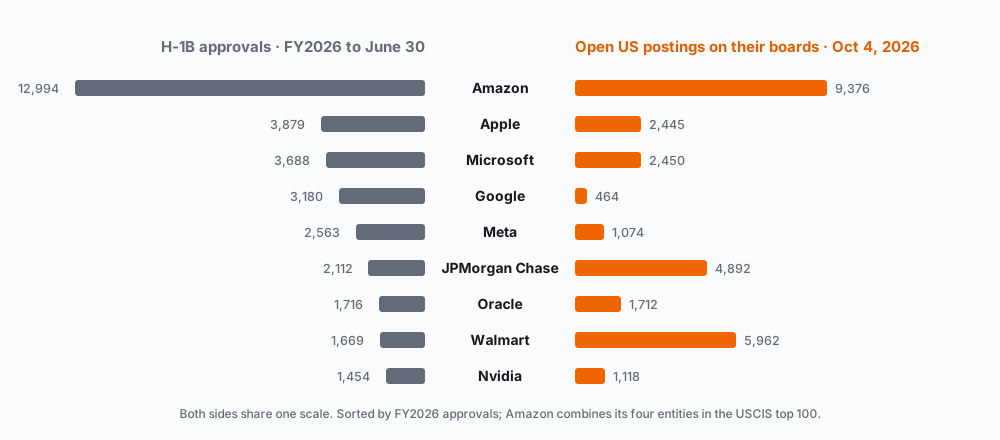
Where to spend your applications
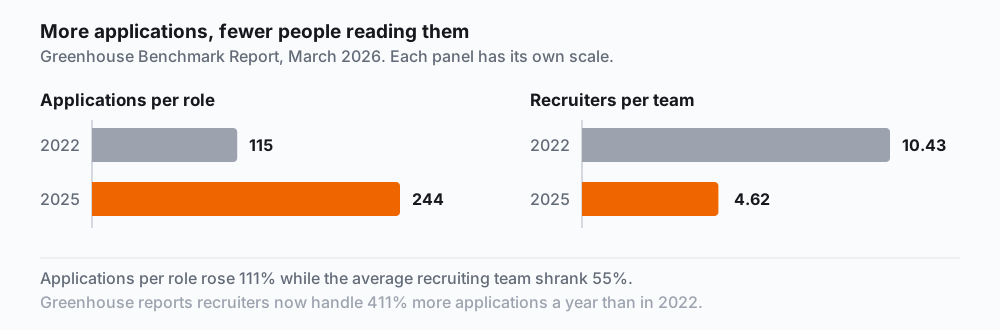
Apply early, even without a referral. Greenhouse's March 2026 Benchmark Report puts applications per open role at 244, and a recruiter works from the top of that queue. Referrals help, but they are not the only door: an application that arrives in a posting's first days is near the top of the list. More on why in why the first 48 hours matter.
Check a posting before you spend an evening on it. Postings stay up longer than most people think: in daily rechecks of employers' own career pages, 56% to 69% were still listed at day 27 (how long jobs stay open), and 4.3% came down and went back up within 7 to 30 days (relisting research). Still listed is not the same as still hiring. Paste a posting's link to see when it first appeared and whether it was reposted.
Search where the postings start. JobShifu's job search reads employers' own career pages and shows when each posting was first seen, so the newest ones are easy to find.
Leaving on a set date?
If you accepted a voluntary exit or were given notice with a future last day, you are still employed until that day. Your resume can show the role as current, and the search can start now rather than after you leave. This page has no view on whether to take an exit offer.
What JobShifu gives you while you search
JobShifu has a permanent free tier with no credit card. Pro is optional and covered on the pricing page.
- Postings from employers' own career pages, with the date each was first seen.
- A tailored resume for each job, built only from experience you confirm.
- A tracker that keeps every application with the resume you sent.
- Cover letters and interview prep from the same confirmed experience.
Common questions
Should I say I was laid off when I apply?
Say it plainly if you are asked. A layoff is not a firing, and after a large one most recruiters will already know. While you are still on the payroll during a notice period you are employed, so your resume can show the role as current until your last day.
Can I negotiate severance in a mass layoff?
The cash amount in a large layoff usually follows a formula, so it rarely moves. Terms around it sometimes do: health coverage, equity vesting dates, a reference letter and the wording of the reason for leaving. Asking costs nothing. If you think you have a legal claim, talk to an employment attorney in your state before you sign.
How long do job postings stay up?
Longer than most people assume. In JobShifu's daily rechecks of employers' own career pages in September 2026, 56% to 69% of postings were still listed 27 days after they first appeared. Still listed does not mean still hiring, which is why a posting's age and history are worth checking before you spend an evening on it.
Does JobShifu cost anything?
JobShifu has a permanent free tier with no credit card: job search, posting history checks, application tracking and autofill are unlimited, and tailored resumes come with a daily allowance. Pro is optional.
Sources
- Age Discrimination in Employment Act, 29 U.S.C. § 626(f), waiver requirements (Cornell Legal Information Institute).
- U.S. Department of Labor, CareerOneStop, Unemployment Benefits Finder.
- HealthCare.gov, Special Enrollment Period.
- USCIS, Options for Nonimmigrant Workers Following Termination of Employment.
- Greenhouse, Benchmark Report, March 2026, North America: applications per open role. Not JobShifu data.
- JobShifu, "Which H-1B sponsors are actually hiring right now?", USCIS records joined to a live crawl, 4 October 2026.
- JobShifu, visa sponsorship research, how long job postings stay open and relisting research, each published with its method and dataset.