A recruiter's first look at a resume lasts about seven seconds: Ladders' 2018 eye-tracking study measured 7.4 on average [1]. In that time the eye lands on four spots: your latest job title, the company, the dates, and the first line under your latest role. Everything else waits for a second read, which only happens if those four spots earn it.
A recent post on r/jobsearchhacks made the same point, said a resume gets about ten seconds, and listed where the reader looks [3]. It collected more than a thousand upvotes and a long thread of people furious that the number was true. The number is roughly right. The more useful part is the path, because once you know which four spots get read, you know where your best work has to sit.
This guide is published by JobShifu, which sells a resume tailoring product. Outside figures are linked and dated in the Sources section. Where we describe how JobShifu builds a resume, that is a description of our own product, not a study.
How long does a recruiter look at a resume?
The figure everyone quotes comes from Ladders, a US job site, which ran an eye-tracking study of recruiters in 2018 and reported an average of 7.4 seconds on the initial screen, up from 6 seconds in its 2012 version, which is where the "six second rule" comes from [1]. Treat it as an order of magnitude rather than a stopwatch: Ladders' own release does not say how many recruiters took part or which roles they were screening.
The arithmetic behind it is newer and better sourced. Greenhouse, from more than 640 million applications, found the average role drew 244 applications in 2025, up from 116 in 2022, while recruiters per organisation fell from 10.43 to 4.62 [2]. Nobody reads 244 resumes top to bottom. The first pass is a sort into "look again" and "no", and it takes seconds because it has to.
That pass is not the whole decision. A resume that survives it gets read properly, usually right before an interview. The first pass only decides whether that second read happens.
What do recruiters look at first on a resume?
Ladders reported that recruiters' eyes went to "superficial details such as layout, job titles, text flow, keywords", and that the resumes that did best had bold job titles over bulleted accomplishments [1]. The Reddit post, written from the recruiter's chair, turns that into a route with four stops [3].
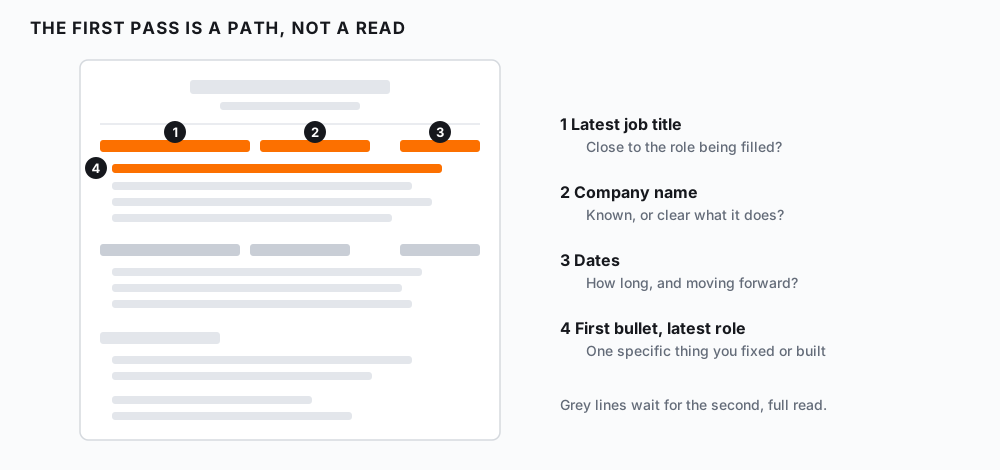
- Your latest job title. Does it look close to the job being filled? This is a category check, made in under a second.
- The company name. Does the reader know it, or can they tell in one glance what it does?
- The dates. How long you stayed, and whether the story moves forward.
- The first line under your latest job. This is where most resumes lose the reader, because it is where most resumes say the least. Rewriting your first resume bullet covers which line belongs there.
What makes a recruiter skip a resume?
Ladders' worst performers had "cluttered layouts characterized by long sentences, multiple columns, and very little white space" [1]. Past layout, three things come up in every version of this advice, and they all fail the same way: they use the reader's few seconds and give nothing back.
- Self-description in place of evidence. "Passionate, results-driven professional" describes how you would like to be seen. It cannot be checked, so it gets skipped.
- Duty lines. "Responsible for day-to-day operations" is the job description of the job you had. It says what you were supposed to do, not what you did.
- A dense paragraph at the top. A five-line summary sits exactly where the eye lands first and makes it work for the one fact it wanted.
What makes a recruiter keep reading?
The fix for all three is the same: one plain line about something you fixed, built or improved, written specifically enough that it could only be yours.
| Skipped | Kept |
|---|---|
| Responsible for managing inventory for the warehouse | Moved our top 50 items to weekly cycle counts after repeated stock-outs |
| Responsible for weekly reporting | Rebuilt the weekly sales report so it runs from one query instead of four spreadsheets |
| Passionate customer-focused professional | Took over the escalations queue and cleared a three-week backlog |
None of the right-hand lines needs a big number. A number helps when you have a real one. A specific line without one still beats a vague line with an invented one, because the second line is the one you will be asked about.
The read-aloud test. Say your first bullet out loud. If it sounds like something you would tell a friend about your week, keep it. If it sounds like a LinkedIn bio, rewrite it.
Fixing each spot, without making anything up
The thread's sharpest replies were not about recruiters. They were about the people the path seems to shut out: career changers, people with a vague job title, people from companies nobody has heard of. Each one has a fix that stays true.
A title that does not match the market. Do not change your title: it gets checked in reference and background checks. Add the market's name for the work beside it, once: "Client Relations Specialist (Customer Success)". The reader gets the category; the record stays accurate. If you are moving into a new field, the career change version adds a one-line headline above it.
A company nobody knows. Add a few words after the name: "Halden Systems, payroll software for clinics" (an invented example). It costs one line and answers the second spot's question before it is asked.
A first bullet that sells the wrong thing. Within each role, move the bullet that best proves *this* job's main requirement to the top. You have not written anything new; the evidence was already there, further down. Choosing which requirement that is takes a pass over the posting, which tailoring your resume by hand walks through in twenty minutes.
A long summary. Shorten it rather than reflexively deleting it: Ladders' best performers had a short overview at the top of page one [1]. Two sentences at most, and the first clause names the job and your strongest qualification. On a one-page resume where your latest role already says that, you can cut it and let the role do the work.
Typos. One hiring manager in the thread said they stopped reading at the first error. Run a spell check, then read the top third out loud, slowly. The eye skips what it expects to see; the voice does not.
How JobShifu builds the first read
We built JobShifu's resume tailoring around this slice, so it is worth saying exactly what it does and does not do.
- It reorders before it rewrites. Inside each role, the line that answers the job's requirements goes first. The instruction to the model is plain: the first bullet of a role gets read far more than later ones. The order is then re-checked in code: lines with a measurable result or a strong verb come first, and among those, the ones that answer more of the job's requirements lead.
- It never changes your title. Titles print from your profile, not from model text. If you add a market title, the export prints it with your official one beside it, as in "Backend Engineer (Technical Specialist III)". It never prints the market title alone.
- It drops the self-description. "Passionate", "results-driven", "proven track record" and "responsible for" are on the list of phrases the model is told not to write, and the Calibration Engine flags any that survive.
- It keeps the summary short, or leaves it out. A summary is written only when your page limit is two pages or your original resume already had one, and then it is two or three sentences.
- It will not invent a number. A bullet uses your exact figure or no figure. Every line has to cite something you confirmed, and a draft with a line that cites nothing fails the check and is never shown to you.
Two things are still on you: the few words that say what an unknown employer does, and the typo pass on your own lines.
Common questions
What is the six second rule for resumes?
It comes from Ladders' 2012 eye-tracking study, which measured about six seconds on a resume's first screen. The 2018 update measured 7.4 seconds. Neither is a rule: it is an average for the first pass, which decides whether the full read happens.
Do recruiters read the whole resume?
Not on the first pass. A resume that survives the first few seconds gets a full read later, usually before a phone screen or interview.
Should I remove my resume summary?
Shorten it before you remove it. Ladders' best-performing resumes had a short overview at the top. Keep it to two sentences, opening with the job you want and your strongest qualification, or cut it on a one-page resume where the latest role already says that.
Can I change my job title to match the posting?
No. Keep the official title and add the market's name for the work beside it in brackets. A changed title can fail a reference or background check.
Sources
- Ladders, "Ladders Updates Popular Recruiter Eye-Tracking Study With New Key Insights on How Job Seekers Can Improve Their Resumes", press release, 6 November 2018. The number of recruiters is not stated. prnewswire.com. Also reported by HR Dive, 8 November 2018: hrdive.com
- Greenhouse, Benchmark Report, March 2026, North America. Applications per open role and recruiting team size, 2022 to 2025, from more than 640 million applications across over 6,000 companies. greenhouse.com
- r/jobsearchhacks, "Your resume gets about 10 seconds. Here's where the reader actually looks", posted late September 2026, read 5 October 2026. reddit.com