JobShifu is worth trying if you want to find relevant jobs, bring forward experience your resume leaves out, and reuse it across applications. Start free. Pay for Pro when its additional AI capacity or deeper tailoring is useful to your search. If you only need job tracking and application autofill, the free tier may be enough.
The workflow is practical: compare a job's requirements with your saved experience, confirm relevant work you have not recorded, then review the suggested resume changes. Those confirmed facts stay in your Vault, your reusable master resume, for the next application. You review answers and submit applications yourself.
Updated September 15, 2026: refreshed JobShifu's plan guidance and job-search workflow. Competitor observations and the freshness measurements below retain their original dates; they have not been remeasured for this update.
This comparison is published by JobShifu, not an independent reviewer. It compares Jobright, Simplify, Teal and Huntr using dated sources, including the third-party pricing reports identified below. For product checks, see is JobShifu legit; for discovery, see JobShifu vs HiringCafe; for the detailed workflow comparison, see JobShifu vs Jobright.
The five tools, at a glance
Five products, the axis each one is built around, and the monthly price. Competitor entries describe the August 2026 research snapshot, not a fresh test of their current products. Check their current plans before buying.
| Product | Best for | Job index | Content checks described | Price |
|---|---|---|---|---|
| JobShifu | Relevant experience you can reuse | Own crawler, employer direct, dated latency measurements | Source checks plus your review | $29.99 |
| Jobright | Volume and speed | Aggregated feed, 8,000,000+ claimed | Not identified in reviewed sources | $39.99 |
| Simplify | Filling in forms | Own crawl, 50,000+ companies, matches daily | Review guidance, your responsibility | $39.99 |
| Teal | A master resume you control | Sourced from ATS, ingested almost hourly | Warns its AI may generate inaccurate metrics | $29 |
| Huntr | Keeping track | None, you clip jobs yourself | States it cannot invent, no mechanism described | $40 |
Every figure here is sourced in the pricing section and the Sources list, so the matrix itself stays uncluttered.
One vault, and what it is for
Everything JobShifu generates comes from one store of confirmed career facts: roles, accomplishments, skills, projects. Confirm a fact once and the tailor, the cover letter, the screener answers and interview prep all reuse it.
A store like that is not something JobShifu invented. Simplify calls the whole product "Your AI job search partner. Powered by one profile." on its homepage [1]. Teal's help center puts it closer still to how JobShifu describes it: "Your Teal resume is your complete work history in one place. Not the polished one-pager you send to employers, but the comprehensive source document you pull from." [2]
In JobShifu, saved experience also supplies the source references checked during tailoring. A reference tells you which fact a suggestion points to; it does not prove the wording is accurate. You still need to review whether the suggestion reflects what you did.
The second difference is that it grows while you use it, and that is the part to try before deciding anything.
Reading a posting in JobShifu produces a gap analysis: what this job asks for, against what your vault can currently evidence. Some of what it lists you have genuinely done and simply never wrote down, which is the ordinary condition of every resume ever written. Recognise one, say so, and it becomes a new confirmed fact stamped with the job you were reading when you added it. Assert something already recorded and it enriches that fact rather than stacking a near duplicate beside it. Two other moments do the same: a skill the posting wants that your evidence already backs, and a claim you affirm when a check flags a line for reaching too far.
As you confirm more relevant experience, later applications can draw on facts your original resume left out. Your dashboard keeps the count: how many of your facts arrived this way, surfaced while tailoring rather than typed in up front.
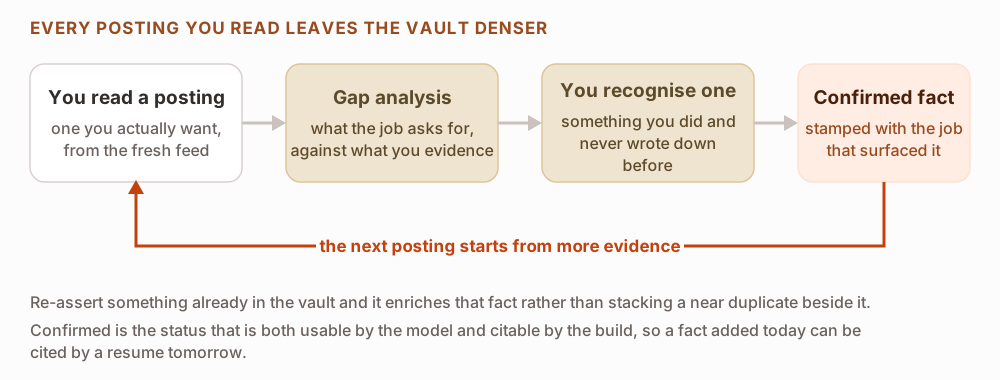
Write back of some kind is not unique either, and it is worth being exact about who does what. Simplify's help center says "edits made inside the Resume Builder sync back into your profile as well" [3]. Teal's says "Entirely new resume details (i.e., content that didn't exist in your Resume Builder prior to your current editing session) will be added to all resumes automatically" [4]. Both are real. What they move is resume prose, triggered by an edit you made to a document. What moves in JobShifu is a fact, triggered by you recognising a requirement while reading a job description, recorded with a source and a date so that a later build can cite it, and refused by the build if it cannot.
Getting there first
JobShifu crawls employer boards directly: 894,705 open postings in early August 2026, 786,923 distinct after its first dedup layer, across 10,783 employer boards carrying a live opening, roughly 98% of it employer direct rather than aggregator mirrored. Latency matters more than volume, so here is JobShifu's, with both halves. Across 222,573 postings in a rolling seven day window, read from JobShifu's own stats endpoint on 4 August 2026: the median from the timestamp the employer's board gives a posting to that posting being searchable in JobShifu is 1.9 minutes, and the 90th percentile is 1008 minutes, about 17 hours. The median is the flattering half; the tail is real, because quiet boards get crawled less often than boards that keep changing.
These are historical August measurements, not today's inventory or a guarantee of current speed. The comparison below sets them beside the competitors' dated descriptions of update cadence; those measure different things.
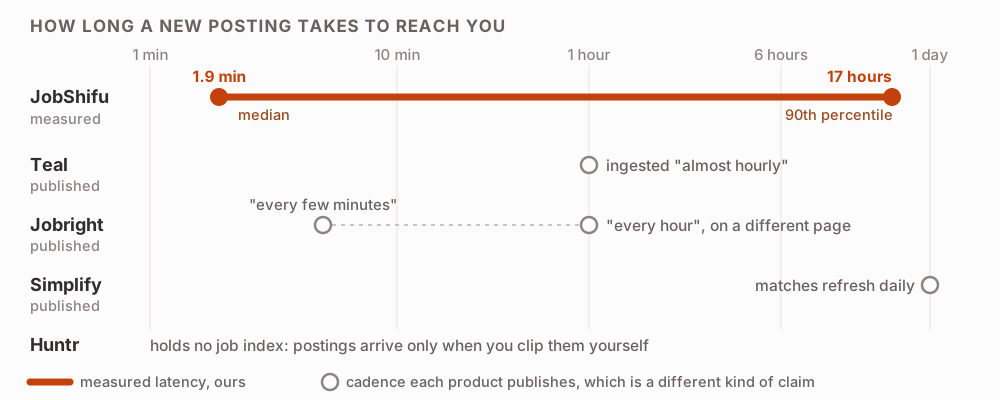
Teal's alerts fire "as soon as Teal finds a matching job (jobs are ingested almost hourly)" [5]. Jobright claims two rates on two surfaces, "every hour" for the dashboard [6] and "every few minutes" for the feed (App Store listing, 20 July 2026). Simplify's help center says "Job Matches refresh daily" [7]. Huntr holds no index, so jobs arrive by Chrome clipper or by hand.
JobShifu's Pro first hours alert lane runs every 30 minutes and the daily digest is on every plan. JobShifu does not call that instant or real time: 30 minutes is the crawl tier floor underneath it.
Reading the job posting properly
A posting is not a bag of words to JobShifu. Each is parsed into structured requirements: must haves, nice to haves, skills, seniority, work authorization, compensation. Matching runs on coverage of the parsed must haves rather than raw keyword overlap, and on domain experience compared through a synonym aware comparison rather than substring matching, which is what stops "AI" matching inside "retail". Deterministic tags from a curated dictionary make a skill search an exact filter, not a text search that mangles "C++". And the Fit score revises down when the evidence does not support it, and says that it did.
The products describe different scoring signals in the sources reviewed in August. Simplify advises aiming for "around 70% keyword coverage or higher before applying", adding, to their credit, that "A high score does not guarantee interviews, and not every keyword matters equally." [8] Teal's Match Score is keyword presence as colours: "Green = you have it. Yellow = toggle it on. Red = add it." [9] Huntr's is the most sophisticated of the four and deserves to be named as such: it weighs "four key elements ... Qualifications, Responsibilities, Keywords, and Job Title Match", with "qualifications and core responsibilities matter most" [10]
Tailoring, which is the centre of the product
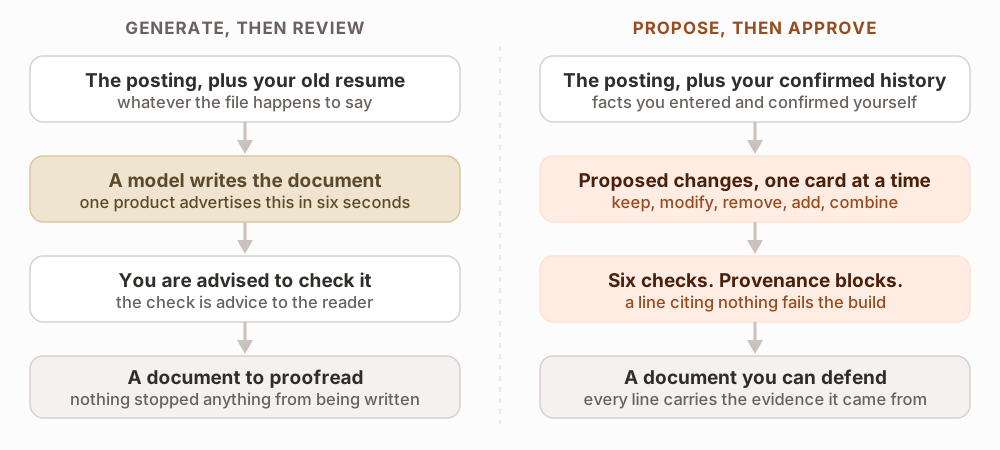
JobShifu never writes your resume from scratch. It reads your confirmed history against one posting and returns proposed changes in five kinds: keep a line, modify it, remove it, add one, or combine two. The units sent to the model are selected against that job description rather than the whole vault being dumped in, and proposals citing anything unconfirmed are dropped before they reach you.
You decide every card three ways: apply, decline, or cut. Declining reverts rather than deletes: decline a suggested removal and the line ships as it was, decline a merge and both originals ship, decline a rewrite and your wording ships. Cut is the only thing that deletes, and only you can press it.
The finished document is checked for source references and potential issues. Examples include:
- provenance (blocking): every line cites at least one confirmed piece of your experience. This verifies the reference, not whether every claim follows from it.
- job-posting echo (blocking): a term from the posting, such as a tool or a standard, that appears nowhere in your Vault or your uploaded resume.
- jagged metrics: a number has to appear in a source that line cites.
- ai-tells: buzzword and weasel word density.
- scope: the line claims more than its cited source supports.
- role integrity: a line sitting under the wrong employer.
- entailment: whether the cited sources support the line's content, not merely exist.
Some things a model is not allowed to do in JobShifu. The technical skills section is generated by code from your confirmed skills and spliced in as ordinary reviewable cards, so a skill you claimed cannot be dropped by a model that decided it did not fit. The page limit is enforced against the real PDF measurement, and the trim is placement aware: it will not machine cut the only bullet demonstrating a keyword the job asked for, and never touches a card you decided yourself. A keyword you merely list in a skills line is worth half one you demonstrate in an accomplishment, which is why the product pushes terms into the bullet whose evidence proves them.
Now the category, from their own pages. Jobright's tailoring pages describe a finished document to download, ending at "Get a brand new AI refined professional resume" and "Download your resume!" [11], advertised on their homepage as "in just 6 seconds" [12]. Simplify's AI will "rewrite an entire resume against a target job" and "regenerate bullets individually" [13], advising you to "always review edits before submitting" [14]. Teal's is mostly toggling: "toggle those bullets on ... zero rewriting required." [9] Huntr rewrites and then lets you approve, "Bulk Approve or Reject" across multiple suggestions [15]
So per change review is not unique to JobShifu. What differs is what happens to the document when a line has no evidence behind it.
The cost of that, plainly: a tool writing the whole resume in six seconds is genuinely faster, and on a night when you want volume, faster may be what you want.
What happens when a claim has no evidence
The August sources describe several approaches to accuracy. These are published descriptions, not a controlled test of the products.
Teal warns at the top of its help article on AI bullets that "our AI may generate metrics that aren't accurate to you", and asks you to read the generated statements and adjust anything that does not feel right [16]. That is candid, and they are right to say it. Any product generating resume content should be telling users exactly that. Teal goes further in the same help center: "If a job asks for 'Salesforce' and you've never used Salesforce, don't pretend you have." and, best of all, "A 75% match with real content beats a 95% match with fluff." [9] That last sentence is JobShifu's thesis, written by a competitor.
Simplify puts it in the refund policy [17]: AI outputs "may vary and are not guaranteed to meet any particular standard or expectation", and "The final output, and the decision to use, edit, or submit it, is your responsibility." Their help center backs that with genuinely good instructions: "Review the completed application, make any edits you want, and submit the application yourself" [18]
Huntr states a property rather than advice, in the FAQ on its resume tailor page: "Huntr's AI only suggests changes grounded in what you actually did. It can't invent titles, numbers, or skills." [19] That claim is not independently testable from outside the product, so take it as stated rather than verified. What is on the page is a stated property with no described mechanism and no stated failure mode. JobShifu's names both: every line cites a confirmed unit, and when that fails, the build fails.
The August 4 review did not identify a comparable source-check mechanism in the Jobright terms [20], privacy policy [21] and resume pages consulted. That does not establish that the product has no safeguards. The one accuracy obligation in their terms runs toward the user, section 32: "You must provide accurate and truthful profile, resume, and application information."
JobShifu combines source-reference checks with review prompts. A valid citation can still accompany an overstatement, so check the wording, numbers and scope yourself. The full mechanism and its limits are at Calibration Engine.
The market has already priced this problem in on the other side of the table. Jobright also sells a recruiter side product detecting "candidate risk signals related to work experience authenticity, profile safety, and over-packaged application materials", "Trusted By 10,000+ Recruiters And Hiring Teams" [22]. Inflated applications are a real enough problem that detection is a product recruiters buy. Source references help you review a claim; they do not guarantee an employer's assessment or an interview.
Autofill and answer memory
JobShifu's extension fills applications, including multi page Workday flows, and stops at the review screen. You press Submit. No auto apply, by decision.
Screener answers are saved and reused, and on Pro the matching is rewording aware, so a question you answered stays answered when it returns phrased differently. Simplify remembers answers too, but "The wording has to match exactly. Similar questions with slightly different phrasing are treated as separate questions." [23] Huntr's FAQ says you "can autofill the repetitive information, and manually answer questions". Teal says it does not submit applications on your behalf [24]. That statement alone does not establish whether it offers autofill.
The concession is on coverage, not mechanism: Simplify's extension lists 500,000 users on the Chrome Web Store (31 July 2026), against JobShifu's much smaller base, and covers "over 100 job boards and application portals" [25]
Tracking, and the growth part
Tracking is a Kanban board plus a list view, and each row carries which resume version went to that role. Unlimited on the free tier, and table stakes: Teal links resumes to roles through a Resume Attachments tab [26], and Huntr's Application Packets keep each one "linked to its job" (read 4 August 2026).
The differentiated piece sits next to it: Growth ranks your skill gaps by what the postings you target actually ask for, counted in JobShifu's own corpus rather than pulled from generic advice, and simulates what acquiring a skill would do to your match.
What it costs
JobShifu's current pricing, checked September 15, 2026, is $29.99 monthly, $74.99 every three months, or $239.99 yearly. The $14.99 Week Pass buys seven days of Pro and does not renew. Prices are in US dollars. The competitor rows below preserve the dated pricing snapshot described beneath the table.
| Product | Monthly | Cheapest longer plan | Shortest commitment |
|---|---|---|---|
| JobShifu Pro | $29.99 | $239.99 / year (about $20 a month) | $14.99 Week Pass, one time, never renews |
| Jobright Turbo | $39.99 | $89.99 / quarter (about $30 a month) | $17.99 / week, recurring (about $72 a month) |
| Simplify+ | $39.99 | $89.99 / 3 months (about $30 a month) | $19.99 / week, recurring (about $87 a month) |
| Huntr Pro | $40 | $160 / 6 months (billed $26.66 a month) | monthly, $40; no shorter plan |
| Teal+ | $29 / 30 days | $79 / 90 days (about $26 a month) | $13 / 7 days, recurring (about $56 a month) |
Sourcing, because a competitor number without a date is just a rumour. Jobright's prices, and their framing of the weekly plan as about $72 a month, were read off their in-app plan screen on 4 August 2026; jobright.ai/pricing 404ed on 3 August 2026, so they are visible only once you have an account. Huntr's were read on huntr.co/pricing, 3 August 2026. Simplify's come from a third party review, wobo.ai, updated July 2026 (simplify.jobs/pricing also 404ed). Teal's from resumly.ai, updated 13 June 2026 (tealhq.com/pricing returned 403 when checked). JobShifu's are at /pricing, which stays correct when this page goes stale.
Stated as fact rather than boast: three of the four sit at $39.99 to $40 a month, and one, Teal, sits at $29 alongside JobShifu. JobShifu is at the low end of the cluster and not alone there. The observation worth making is about the short option: every competitor here that sells a shorter commitment sells it as a plan that recurs weekly, and in each case that weekly plan is the most expensive way to buy the product. JobShifu's is a one time pass, and it cannot renew because there is no subscription behind it.
One number explains the shape of the list. A fully tailored application costs JobShifu about 34 cents of language model usage, by JobShifu's own measurement from its usage logs in a June 2026 sweep, on the most expensive model path, cover letter included. That is why the price cannot go to zero: thirty tailored applications is about $10 of model usage before anything else is paid for.

The free tier is two fully tailored resumes a day, plus three cover letters a month, five screener answers a week and one interview prep a month, with unlimited autofill, matching, tracking and saved answers, no card. Check which allowance you actually reach before paying; job search, tracking and autofill do not require an upgrade. For one heavy week, the $14.99 Week Pass is seven days of Pro with nothing to cancel; two of those cost a penny less than a month of Pro, so past a fortnight Monthly is cheaper for the same thing.
Which one fits which search
Each of these is the right buy for somebody, and the somebody is different in each case.
Jobright is volume and speed: an aggregated feed at 8,000,000+ claimed, and an agent that will apply for you. Buy it if you are applying at high volume and want breadth above all.
Simplify has the widest autofill coverage of the group, over 100 portals, 500,000 extension users, unlimited free applications. Buy it if your search hurts most at the form filling stage.
Teal is strongest at organising a master resume and toggling bullets per job, zero rewriting required, and free is uncapped on volume. Buy it if you want control and no model rewriting your lines.
Huntr is the tracker: a real Kanban with customisable stages, and packets that stay linked to a job. Buy it if your problem is keeping track rather than writing.
JobShifu is a shortlist pursued properly: evidence that compounds as you review postings, and a document you can defend line by line. Buy it if you tailor several a week and want to be early.
Where JobShifu is the wrong buy
- You want a machine to apply for you. JobShifu stops at the review screen on purpose. Jobright's AI Agent advertises "90% Job Search Automation" [27]; Simplify's Autopilot "applies on your behalf to roles that match your criteria" [28].
- You want the biggest aggregated feed. Jobright publishes "8,000,000+ total jobs" [12] and Simplify monitors "50,000+ companies" [1], both on their homepages. Both are larger than what JobShifu holds.
- Your target market has little coverage. Search your role and location in the public job search before committing. Employer coverage varies, and an open employer page does not prove active hiring or that a role is available everywhere.
- You want an uncapped free tier for tailored resumes. JobShifu's free tailoring is two a day, which is a real allowance and still an allowance. Teal's free plan is uncapped on volume.
- You want speed over deliberation. Tailoring in JobShifu is slower than a one button generate and asks you to decide every change.
- You want a long operating history. JobShifu is new and small. The product launched in 2026.
Common questions
Is JobShifu free, or do I need Pro?
Start with the free tier: two tailored resumes a day, five AI screener answers a week, three cover letters a month and one interview prep a month. Autofill, matching, tracking and saved answers are unlimited. Pro adds higher AI capacity and Mentor Mode; compare the current plan details with what you actually use.
Can I use JobShifu just to find jobs?
Yes. Start with public job search, follow the employer's application link, and check the role's location and requirements. Tailoring and tracking are available when you want to continue the application in JobShifu. If discovery is your main need, the HiringCafe comparison explains the different workflows.
Do I have to review every change myself?
Yes, and that is the design. Every proposed change is a card you apply, decline or cut, and declining reverts to your original rather than deleting anything. If you would rather approve in bulk, Huntr documents that.
What actually stops it inventing things?
The provenance check: every line on a built resume has to cite at least one confirmed unit in your vault, and a line citing nothing fails the build rather than warning you. Seven further checks warn about unsourced numbers, filler wording, overclaimed scope, misplaced lines, unsupported wording, an inflated title and evidence buried too far down the page. The long version is at /calibration.
Settle it in one sitting
Build your vault, tailor one application against a real posting you care about, and read the verdict at the end, which shows line by line which piece of your confirmed experience backs each claim. Two of those a day are free forever, no card, which is more than enough to find out whether the mechanism on this page does what it says. If it does, the volume question answers itself within a week. If it does not, you paid nothing and you know.
Sources
The competitor sources below were consulted on the dates shown. They are not all newly verified on the article's update date. Pricing exceptions and third-party sources are identified in the pricing section.
- Simplify homepage: simplify.jobs. Read 4 August 2026.
- Teal help center, "How to build your resume in Teal": help.tealhq.com/en/articles/14435724. Read 4 August 2026.
- Simplify help center, on Resume Builder edits syncing back to your profile: help.simplify.jobs/articles/8396475. Read 4 August 2026.
- Teal help center, on new resume details being added to all resumes: help.tealhq.com/en/articles/9457698. Read 4 August 2026.
- Teal help center, on job alerts and how often jobs are ingested: help.tealhq.com/en/articles/13456939. Read 4 August 2026.
- Jobright, AI job match page: jobright.ai/ai-job-match. Read 4 August 2026.
- Simplify help center, on how often job matches refresh: help.simplify.jobs/articles/2166608. Read 4 August 2026.
- Simplify help center, on keyword coverage and the resume score: help.simplify.jobs/articles/2175778. Read 4 August 2026.
- Teal help center, on tailoring a resume and the Match Score: help.tealhq.com/en/articles/14435726. Updated March 2026, read 4 August 2026.
- Huntr help center, on the Job Match Score and tailored resumes: help.huntr.co/en/articles/13005373. Read 4 August 2026.
- Jobright, resume tailor tool page: jobright.ai/tools/resume-tailor. Read 4 August 2026.
- Jobright homepage: jobright.ai. Read 3 August 2026 and 4 August 2026.
- Simplify help center, on the AI resume tailoring tools: help.simplify.jobs/articles/8040103. Read 4 August 2026.
- Simplify help center, on reviewing AI edits before using them: help.simplify.jobs/articles/0515607. Read 4 August 2026.
- Huntr homepage: huntr.co. Read 4 August 2026.
- Teal help center, on AI generated resume bullets: help.tealhq.com/en/articles/9519206. Read 4 August 2026.
- Simplify refund policy: simplify.jobs/refund-policy. Updated 26 May 2026.
- Simplify help center, on reviewing and submitting an application: help.simplify.jobs/articles/2415391. Read 4 August 2026.
- Huntr, resume tailor product page and its FAQ: huntr.co/product/resume-tailor. Read 4 August 2026.
- Jobright terms of service: jobright.ai/legal/service. Updated 29 July 2026.
- Jobright privacy policy: jobright.ai/legal/privacy. Updated 15 June 2026.
- Jobright, fake candidate detection page: jobright.ai/fake-candidate-detection. Read 4 August 2026.
- Simplify help center, on remembered answers to application questions: help.simplify.jobs/articles/7306766. Read 4 August 2026.
- Teal help center, on applying to jobs with a Teal resume: help.tealhq.com/en/articles/12601338. Read 4 August 2026.
- Simplify, Copilot page: simplify.jobs/copilot. Read 4 August 2026.
- Teal help center, on tracking which resume you used for each job: help.tealhq.com/en/articles/9525013. Read 4 August 2026.
- Jobright, AI Agent page: jobright.ai/ai-agent. Read 4 August 2026.
- Simplify, AI talent agent page: simplify.jobs/ai-talent-agent. Read 4 August 2026.