Updated September 15, 2026: clarified the review checks, their limits and the free plan.
Somebody typed "is JobShifu legit" into a search box and landed here. That is a fair question to ask before you hand a product your work history, and it deserves an answer without a sales pitch wrapped around it.
The short version: JobShifu is a real job search product, built by Chris Cheng and launched in 2026. This is the company's own account, not an independent review. You can browse employer-sourced jobs without an account and try resume tailoring on the free plan without a credit card. JobShifu proposes changes using your career record, shows you what needs review and leaves application submission to you.
The useful question is not whether a company sounds trustworthy. It is whether its claims are the kind you can check.
What JobShifu is
JobShifu is a job search mentor that helps you find relevant work, recognize experience missing from your resume and reuse it across applications. Your career record becomes a reusable master resume: you review suggested additions, save the facts and draw on them for later resumes, cover letters and screener answers. The Chrome extension fills supported application forms, including Workday flows, and the tracker keeps your applications together. Resume tailoring uses Anthropic's Claude.
Who is behind it
JobShifu is built by Chris Cheng, who is the founder and is named here on purpose: a company with a person's name attached to it can be looked up. You can reach the team at support@jobshifu.com for anything to do with your account, or hello@jobshifu.com for everything else. A person answers both.
Here is the part most companies leave out of a page like this: JobShifu is new and it is small. The product launched in 2026. There is no decade of operating history to point at, and no roster of household-name logos. On a page about whether JobShifu is legitimate, hiding that would be the exact behavior you came here to check for.
How the no-fabrication mechanism works
This is the load-bearing part, so it is worth being precise.
JobShifu never writes your resume from scratch. It proposes changes to your real resume, and you approve every single one. Nothing reaches a finished document without passing under your eyes as a specific, reviewable suggestion.
Source references and wording checks do different jobs. The provenance check blocks missing or invalid source references. Other checks look for issues such as unsupported posting terms, numbers, inflated scope and experience placed under the wrong employer. Some findings block the build; others ask you to review the wording.
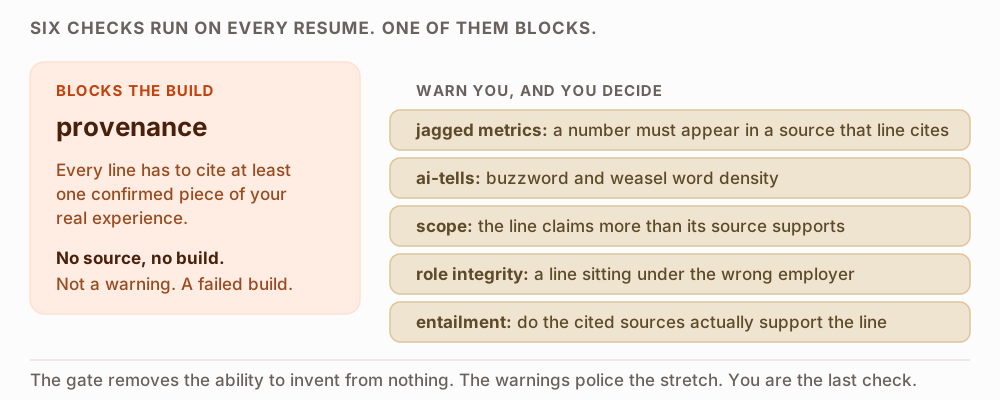
A citation cannot prove the sentence is true. A line can cite real experience and still overstate your contribution. Model-based checks can miss that. Compare the wording with the source and correct anything you could not explain in an interview.
Missing experience and missing qualifications are different. If you have relevant experience that your resume leaves out, add and confirm it. If you do not have the qualification, leave that gap visible. For example, helping onboard a colleague does not establish that you managed a team. This is an illustrative distinction, not a measured product result.
You review the proposed changes. Keep accurate numbers, responsibilities and your own voice. Save useful additions so the next application can draw on them.
The full explanation of the checks lives at /calibration.
Every bullet comes with its 30-second story, so the follow-up question is the easy part.
That last one is the real test of an honest resume. If a document can survive the interview it gets you, it was true. If it cannot, it was never an advantage.
What JobShifu does not do
JobShifu does not auto-apply. There is no button that fires a hundred applications at companies while you sleep. The browser extension fills in the application form, including the long multi-page ones, and then stops at the review screen. You read it, and you press Submit.
Applications often ask for details that a resume does not settle, such as availability, work authorization or a specific example. Review these answers yourself. Autofill reduces repeated typing; it does not decide what you should claim or guarantee an interview.
What happens to your data
- Your vault, meaning the career facts you have confirmed, is scoped to your account.
- One click erases all of it.
- Deleting your account is a real deletion, not a flag on a row.
- When you tailor a resume or draft an answer, the relevant parts of your vault and the job posting are sent to Anthropic's Claude API to do the work. That processing, and the terms it runs under, are set out in the privacy policy.
- JobShifu uses PostHog for product analytics. Also disclosed in the privacy policy, along with everything else it does with data.
This page deliberately does not sell you privacy as a virtue. Read /privacy and judge the policy, which is written to be read rather than to reassure.
What it costs
There is a free tier, forever, with no credit card: unlimited autofill, unlimited job matching and tracking, and two fully tailored resumes a day. The free plan also includes 5 AI screener answers a week, 3 cover letters a month and 1 interview prep a month. Pro adds higher AI usage allowances. The current numbers, plus what each plan includes, are on /pricing, which is the page that stays correct when this one goes stale.
Whether the paid tier is worth buying is a different question from whether JobShifu is real, and it has a different answer depending on how much you are applying. That one is worked through, by situation, in is JobShifu worth it, including who should stay on the free tier and not pay for it.
How to verify all this
You do not have to take any of the above on trust. Here is what is checkable from outside:
- The Chrome Web Store listing. The extension is published, reviewed, and versioned at the Chrome Web Store. Install counts, reviews, permissions, and update history are all visible there, and none of them are written by JobShifu.
- This site. /calibration explains the checks, /faq answers the specific questions, /privacy and /terms are the actual documents.
- Email a human. support@jobshifu.com. Ask anything before you sign up, including things on this page.
- Make the mechanism fail in front of you. This one needs a free account, which is a fair criticism of it, but it is also the only check that tests the actual claim. Build a tailored resume and open the verdict panel at the end. It shows you, line by line, the experience referenced by each claim. Compare each proposed claim with its cited source. Check that titles, numbers and responsibilities still describe your work, and review any reported gaps.
A claim you can falsify inside the product beats a testimonial you cannot.
Common questions
Is JobShifu free?
There is a free tier with no credit card and no expiry, covering unlimited autofill, matching and tracking plus a daily allowance of fully tailored resumes. The current numbers are on /pricing, which is the page kept in step with the product. Whether the paid tier is worth buying is a separate question from whether the product is real, and it is worked through by situation in is JobShifu worth it.
Does JobShifu apply to jobs for me?
No. The extension fills in the application form, including the long multi-page Workday flows, and then stops at the review screen. You read it, and you press Submit. That is a deliberate product decision rather than a missing feature, for the reasons set out above.
Can JobShifu invent experience I do not have?
AI wording can still overstate your experience. JobShifu checks source references and flags possible problems, but a valid citation does not prove the sentence it supports. Review the proposed changes against your actual work before exporting or submitting.
Who is behind JobShifu, and can I reach a person?
JobShifu is built by its founder, Chris Cheng, and this post was written by Chloe Lin on the JobShifu team. Either way you are reading the company's own account of itself, which is why the page ends with a list of things you can check from outside. support@jobshifu.com for anything to do with your account, hello@jobshifu.com for everything else. A person answers both.
One last thing about the name
A shifu is a master teacher. That is the whole gloss, and it is the whole intent: something that helps you get better at this rather than something that does it behind your back and hands you a number.
If any of that sounds worth twenty minutes, the free tier is genuinely free and does not ask for a card. Build the vault, tailor one application, and read the verdict panel. If the mechanism does not do what this page says it does, you will know in one sitting, which is exactly how it should be.
← All posts