Paste the job posting. Click once. Get back a resume perfectly tailored to it. Taken on its own terms, that is a genuinely appealing promise, and the appeal is not fake: the tedious part of applying really is the rewriting, and a machine really can rewrite faster than you can. But there is a question the button never answers, and it is the only question that decides whether the output is any good. Tailored from what? A tailor who has never met you can still cut cloth to a pattern. They just cannot cut it to you.
This post is published by JobShifu, which sells a resume tailoring product, and it leans throughout on JobShifu's own published benchmark of four tailoring tools. The benchmark is linked below, its protocol is written out, and its data file is open under CC BY 4.0, so the numbers here can be checked rather than taken on trust.
The ladder every tailoring tool sits on
There are only three rungs, and a tool's rung is decided by one thing: what it asks of you before it writes.
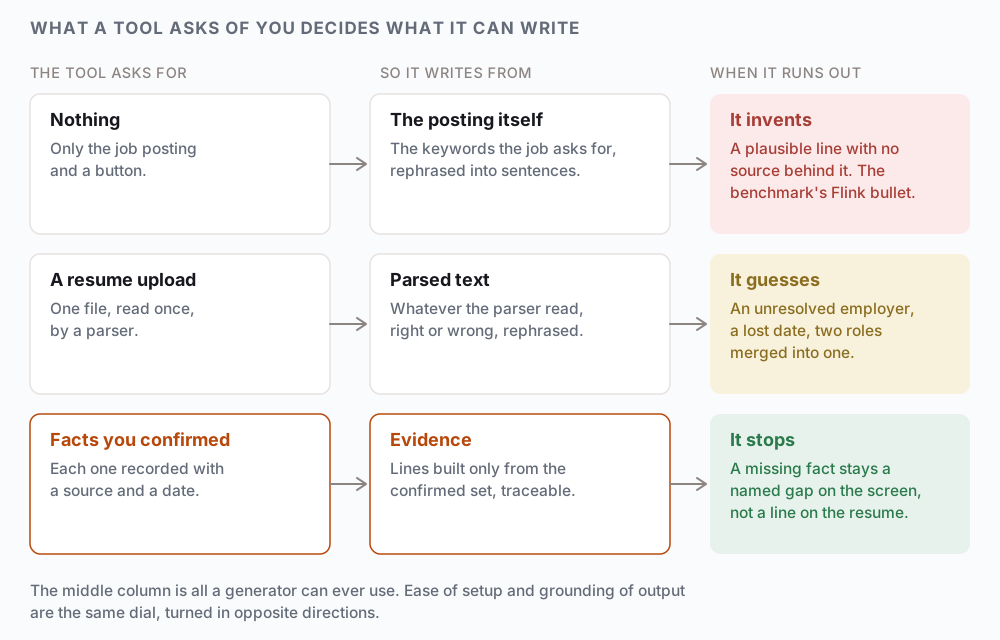
Rung one asks for nothing but the job posting. That is the whole one-click pitch, and it is stated plainly: paste a link, get a tailored line. The material available to the generator is the posting, plus whatever it can infer about the shape of a resume. When the posting demands a skill and the generator has nothing of yours that matches, the generator does not stop. It writes the line anyway, from the only source it has.
Rung two asks for an upload. That is real context, and it is a large step up: parsed roles, dates, employers, bullets. But an upload is one static read of one document, so the tool knows what your old resume happened to say and nothing else. Where the parse is thin or ambiguous, the tool has to fill in. The good version of filling in is asking you. The unremarkable version is guessing quietly.
Rung three asks for confirmed facts: individual claims you have affirmed, one at a time, each with a source and a date. That is much more work up front, and it is the only rung where the tool has material that is specifically yours and specifically checkable. It buys one behavior the other rungs structurally cannot offer: when the posting asks for something you have not confirmed, the tool can leave a labelled gap instead of writing a sentence.
Notice what is doing the work here. This is arithmetic, not ethics. Nobody at these companies wants to put false claims on your resume. A language model given a job posting and no material about you does not experience the absence as a problem to report. It continues, because continuing is what it does, using the material in front of it. The middle column of that figure is all any generator can ever use, and the fill in the gap behavior falls out of that constraint automatically. Ask for less, and the gap between what the posting demands and what the tool holds about you gets wider. Everything in that gap has to come from somewhere.
Rung one, watched closely
The benchmark ran the same job posting and the same control resume through four tools on 27 August 2026 [1]. The control resume was written so that the gap would be visible from outside. It contained the word Kafka twice, Spark five times, and Iceberg three times. It contained Flink zero times, and the string "Apache" zero times. Whatever a tool produced about Apache Flink, it did not get from the resume.
One tool offered a keyword picker: a list of terms from the posting, each with a button to generate a bullet containing it. Asking it for Apache Flink produced three generated bullets, all of them asserting Flink experience the resume never contained. One of the three carried a literal unfilled placeholder, "over X million events daily", which is the mechanism admitting itself out loud. The generator had a sentence template that wanted a throughput number, no throughput number about this candidate anywhere in its inputs, and no way to stop. So it emitted the variable name.
That placeholder is the most useful artifact in the whole benchmark, because it is the only invention that announces itself. Every other generated claim came out fluent. "Built streaming pipelines in Apache Flink" reads exactly like a true sentence. The placeholder version is the same machine failing loudly instead of quietly, and it is worth holding onto as an image of what the quiet failures look like underneath.
Then the score moved.
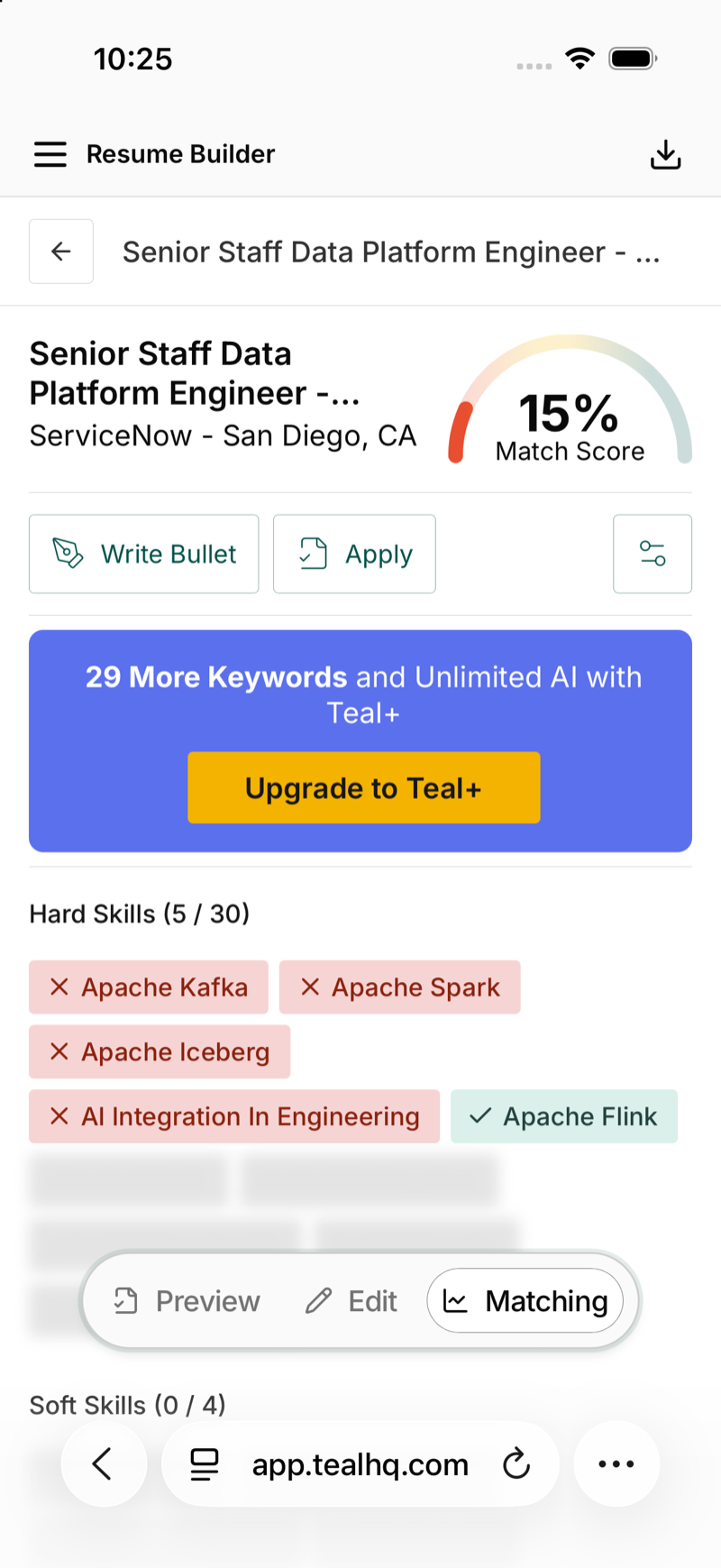
Before saving anything, the match score read 9 percent. After saving one generated Flink bullet, it read 15 percent. Hard Skills went from 3 of 30 to 5 of 30. And on the rendered score screen, Flink, the one skill the resume never contained at any point, appeared as the only present keyword. Nothing here malfunctioned. Every component did its job. The full protocol, the tool-by-tool detail and the raw capture data are in the benchmark [1].
Rung two, and what guessing looks like
An upload changes the arithmetic substantially. There is real material now. But a parse is an interpretation of a document, not a conversation with a person, and interpretations have edges.
Two observations from the same teardown day, both from JobShifu's own captures on 27 August 2026, show the two ways an edge gets handled.
The first: in one tool, the rendered resume dropped the dates on a sub-role. The parser had done its job and kept both roles. The rendering template lost the dates on the way to the page. The visible result was a document that overstated a Director tenure by 14 months. No generator invented anything. A layout decision made a factual claim, which is a reminder that the invention surface is wider than the writing step, and that the last thing to check is always the artifact you will actually send.
The second is the good version, and it is worth quoting because it is exactly right. When one tool's parser could not resolve an employer from the control resume, it stopped and asked: "We couldn't find an exact match for Meridian Analytics in our system. Please confirm or add by searching it below."
That is the whole thing in one sentence. The tool hit a gap in its context, said so, named what was missing, and handed the decision to the person who knows. Asking is what handling missing context looks like. Generating past it is what invention looks like. The same gap, two behaviors, and the difference is entirely in whether the product is willing to interrupt you.
Which is the uncomfortable part of the one-click promise. Interrupting you is the thing one-click sells itself on never doing.
Why the score will not catch it
The obvious objection is that all of this is fine because there is a number on the screen. If a generated line were bad, the match score would say so.
It cannot, and the reason is structural rather than a matter of tuning.
A keyword match score measures overlap between your resume and the posting. A generated line is written from the posting. So a line generated to cover a missing keyword scores perfectly on the metric, by construction, every time. That is not a bug in the scoring. It is what happens when the check and the generator read from the same source. They share a ruler, so one can never catch the other. The higher the score climbs on generated content, the more confidently it is measuring its own output.
The tools themselves are clear-eyed about this, which is worth saying plainly, because their help centers are more careful than the category's marketing.
Simplify's help center advises aiming for "around 70% keyword coverage or higher before applying", and in the same breath adds the caveat that matters: "A high score does not guarantee interviews, and not every keyword matters equally." [2] That is a correct description of what the number can and cannot do.
Teal's help center is blunter still, and puts the trade in one line:
A 75% match with real content beats a 95% match with fluff.
That is Teal's own help center, describing its own Match Score, and it also tells users directly: "If a job asks for 'Salesforce' and you've never used Salesforce, don't pretend you have." [3] Both companies know exactly where the ruler stops working. The documentation is right. The gap is between the documentation and the button, because the button is where the user actually is, and the button does not repeat the caveat.
So read every score as a wording check. It tells you whether your resume uses the posting's vocabulary. It cannot tell you whether the sentences are true, because it was never built to look at that.
The multiplier tell
Here is a pattern to notice, and then a way to use it.
When a category can easily show its mechanism, its marketing shows the mechanism. When it cannot, the marketing leads with a multiplier instead.
Here is what the category's own front doors said, captured in a single mobile session:
| Product | The claim |
|---|---|
| Teal | "Land 6X more Interviews" |
| Jobright | matches "in less than 1 min" |
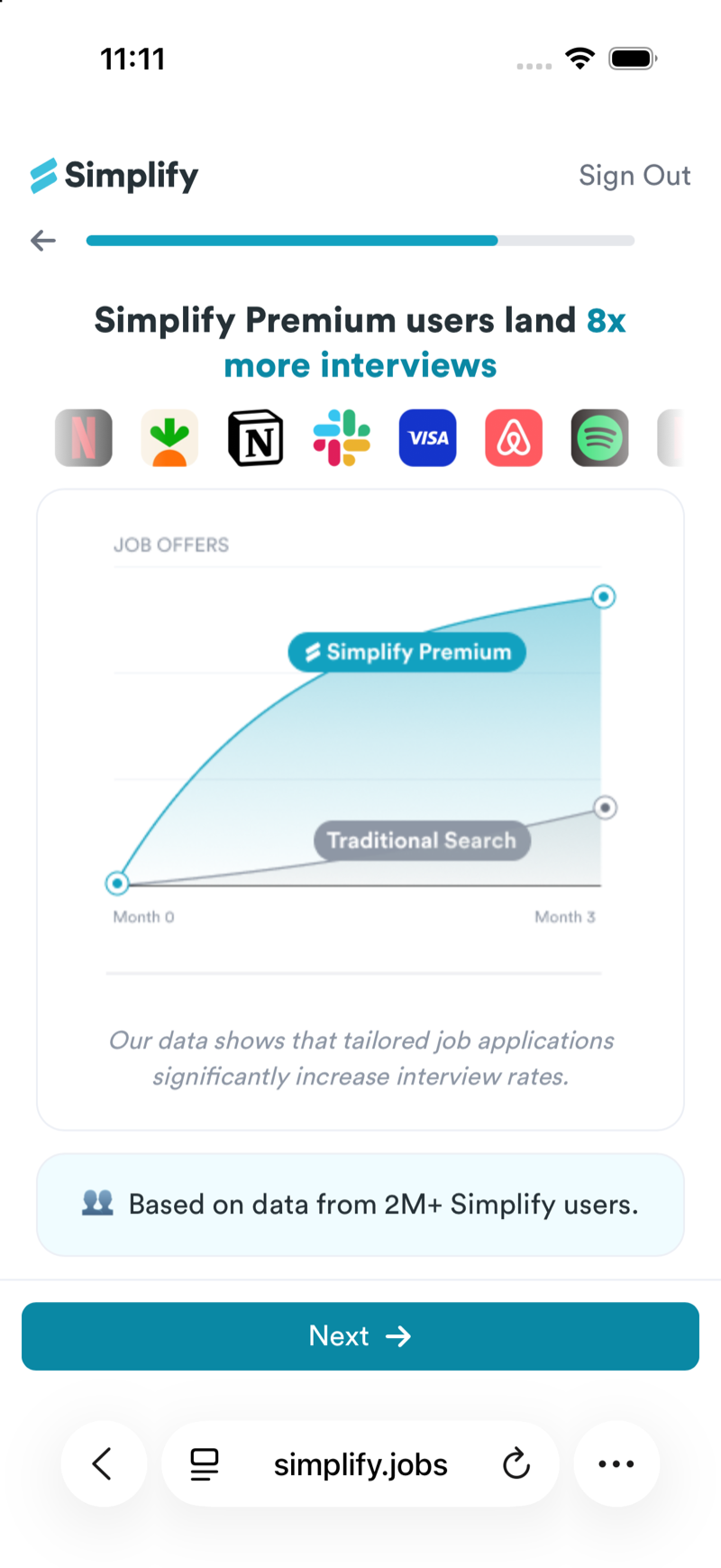
| Simplify | "5x faster", "5x job offer rate", "8x more interviews" (Premium), "hired a month sooner", "cut 5+ hours" per week |
All claims captured on 27 August 2026 from the tools' own hero and signup surfaces. See Sources for the benchmark protocol.
None of these was published with a methodology. The 8x interstitial sits over a chart with no values on its axis, captioned as based on "our data" from "2M+ Simplify users". The 5x and the 8x appear in the same signup flow minutes apart, measuring different things, and a reader moving through that flow at normal speed has no way to reconcile them, because nothing on either screen says what either number counted.
This is not an accusation. Nobody here is saying these numbers are false. The observation is narrower and it is about publication, not intent: as published, each of these claims is unsourced and unfalsifiable. There is no stated population, no comparison group, no time window, no definition of an interview. A reader cannot check them, and neither can a competitor. And every tool in the category leads with one, which is the actual finding. This is an industry-wide register, not one company's sin, and JobShifu writes in the same market and has to resist the same pull.
The tell is portable, and it works on any product in any category. A falsifiable claim names what was measured, over which population, in what window. An unfalsifiable one names only how much better your life will be. "Land 6X more interviews" is a statement about your future. "Kafka appeared twice in the control resume and Flink zero times" is a statement about an artifact somebody can go and open.
JobShifu publishes no interview multiplier, for a boring reason: it has not measured one. The claims it does make are of a different kind, like a crawl of 10,000 or more employer boards, which is a count of something that either happened or did not.
What asking for more context actually buys
Now the third rung, concretely, using the publisher's own product because that is the one whose internals can be described accurately here.
In JobShifu, the setup step is a vault of facts, and the step 1 copy states the contract up front: "The Vault holds everything true about you. Tailoring picks what matches this job, and nothing lands on a resume that is not in here."
Facts go in one at a time, each confirmed with a source and a date. Tailoring then selects only from the confirmed set. That single constraint is what changes the behavior at the gap, and the change is visible on screen. When a baseline line has no confirmed evidence under it, the line does not get written around. It gets left out, and the user is told:
"1 baseline line(s) had no confirmed evidence behind them and were left off. Confirm the fact in your Vault to bring them back."
That notice is the whole mechanism in one message. A gap was found, the tool declined to fill it, the gap was named, and the fix is handed to the person who can actually resolve it. Compare it to the placeholder from rung one: same situation, missing material for a line the posting wants, and two entirely different outputs. One writes "over X million events daily". The other says a line was left off and tells you why.
In the benchmark run, keyword coverage moved from 6 of 15 to 10 of 15 entirely from confirmed facts [1]. Not from generated ones. That is a smaller headline number than a bullet-generator can produce in a click, and it is made of different stuff.
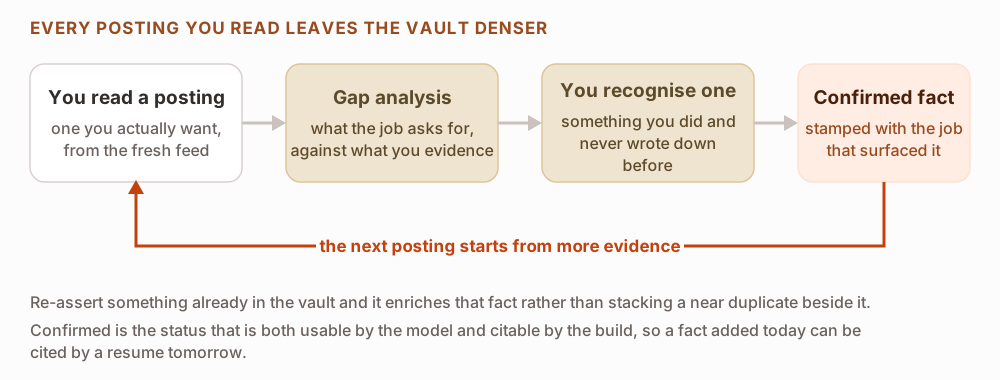
There is a second effect that only shows up after a few applications. Reading a posting closely surfaces things you have genuinely done and never wrote down. The posting asks about incident response, and you remember the on-call rotation you ran for eight months and never put on a resume because it did not feel like an accomplishment. That becomes a confirmed fact, stamped with the job that surfaced it. The next application starts from a denser vault than the last one, and the one after that starts denser still.
Now the cost, stated plainly, because the trade is the point of this post and not a footnote at the bottom of it.
This is slower to start. The first session is setup, not output. If what you want is a tailored resume in the next ninety seconds, a rung one tool will give you one and this will not. The bet is that the setup is paid once and the returns land on every application afterwards, and that a resume assembled from things you confirmed is one you can walk into a room and defend. That bet is wrong for somebody sending one application this year. It gets better every application after that.
What to do this week, whatever tool you use
None of this requires switching products. Three moves work on any rung.
Keep one master fact file. A plain document of what you have actually done, with the numbers, in your own words: systems, scale, dates, outcomes. It does not need to be formatted or pretty. Its job is to be material. Any tool you paste it into now starts from something of yours instead of from the posting, which moves that tool up a rung without changing anything about the tool. This is also the single highest-leverage hour in a job search, because everything downstream reads from it.
Never save a generated line you could not defend out loud. Not "could not prove" and not "is not literally false". The test is whether you could sit across from someone who does this work and talk about that line for two minutes without flinching. If not, cut it or rewrite it into something true before it gets saved, because once it is saved it is in the document, and the document is what gets sent. The failure mode is not a dramatic lie. It is a plausible sentence you never quite decided to keep.
Read every score as a wording check, never a verdict. A high match score means your vocabulary lines up with the posting's vocabulary, which is genuinely useful for getting past keyword filters. It says nothing about whether the resume is accurate, and it especially says nothing when the content was generated from the posting the score is measuring against. Teal's own help center already told you the trade: real content at 75 beats fluff at 95.
And if you want to know where a tool actually sits before trusting it with a document, the benchmark closes with a five minute test that classifies any tool's rung from the outside [1].
Common questions
Is an easier tool always a worse one?
No, and the distinction matters. Ease of interface is free. Ease of context is not.
A tool that autofills a job application form from answers you already gave is demanding nothing from you and inventing nothing, because it is moving stored values into fields. There is no generation step and no gap to fill. Same for one-click apply, keyboard shortcuts, better search, a cleaner editor. All pure win, no trade.
The trade only bites when the tool writes claims about you. At that moment, and only at that moment, the question of what it was given becomes the question of what it will produce. So the useful version of the question is not "is this tool easy" but "is this tool easy at the point where it writes".
Isn't all this setup just friction?
It is friction. That is a fair description and it should not be argued away.
The part worth weighing is that it is the same friction as the interview. Every claim you confirm during setup is a claim someone may ask you to expand on later, and doing that thinking at a desk with your notes open is easier than doing it live. A line you confirmed once is a line you can speak to forever.
And the cost profile is lopsided in a way a first session hides. Setup is paid once. It is then amortized across every application after it, while the resume-per-application cost of a rung one tool is paid every single time, along with the re-reading needed to make sure nothing crept in. Whether that trade is worth it depends entirely on how many applications you are going to send.
How do I tell which rung a tool is on?
Two questions, and you can answer both in a few minutes without paying for anything.
First: what does it ask for before it writes? A posting only, an upload, or individual confirmed facts. That alone sets the ceiling on how specific its output can be, because a tool cannot write from material it was never given.
Second, and this is the one that actually separates them: ask it for a skill you do not have. Pick something plausible for your field and absent from everything you gave it. Then read what comes back. Does it write you a bullet claiming that skill? Does it ask you a question? Does it tell you the material is missing and name what it needs? The tools sort themselves instantly, and the answer arrives in one click. The benchmark's five minute test is that procedure written out in full, including what to look for in the output [1].
Sources
- JobShifu, Resume tailoring tools benchmark, August 2026: /blog/resume-tailoring-tools-benchmark, data file tailor-benchmark-2026-08-27.json, CC BY 4.0. Published 27 August 2026.
- Simplify help center, on keyword coverage and the resume score: help.simplify.jobs/articles/2175778. Read 4 August 2026.
- Teal help center, on tailoring a resume and the Match Score: help.tealhq.com/en/articles/14435726. Updated March 2026, read 4 August 2026.