As of 3 October 2026, Ontario is the only one of the four places with a ghost job law in force. Since 1 January 2026, an Ontario employer with 25 or more employees must say in every public job posting whether it is for an existing vacancy [1]. New York's bill passed both houses on 2 June 2026 and has not been signed [2]. New Jersey's bills cleared committee in March and May 2026 [4]. California's has been stuck in committee since August 2025 [6].
So Ontario is the only place where you can check what a ghost job law does to postings. JobShifu crawls employer career boards directly, so it measured that: of 58,194 Ontario postings first seen between 26 June and 3 October 2026, 50.1% carry a statement on whether the vacancy exists, 61.3% state pay, and 35.6% do both. Nine months in, half of Ontario's postings say whether the job exists. The other half say nothing.
The tracker
Status as of 3 October 2026. "Vacancy statement" means the posting must say whether the job is open now. Pay-range laws are listed separately below, because they are a different rule.
| Jurisdiction | Rule | Status | Covers | Penalty |
|---|---|---|---|---|
| Ontario | Must say whether the posting is for an existing vacancy, plus pay, AI screening, no "Canadian experience" requirement, and a reply to interviewed applicants within 45 days | In force since 1 January 2026 | Employers with 25+ employees | ESA enforcement |
| New York (S8877 / A6292) | Must say whether the role will be filled within 90 days, later, or is collecting resumes for the future; take the posting down within 2 weeks of filling it | Passed both houses 2 June 2026; not yet signed | Employers with 100+ employees, and job sites | $2,500 per violation, rising if uncorrected |
| New Jersey (S2136 / A1161) | Must say whether the posting is for an existing vacancy; take it down within 2 weeks of filling it or 30 days after posting, whichever is later | In committee (Assembly Labor, March 2026; Senate Labor, 11 May 2026) | Employers and job posting companies | Up to $300 first offense, $600 after |
| California (AB 1251) | Must say whether the posting is for a vacancy | Held in Senate Appropriations since 29 August 2025 | Private employers | Civil penalties, as proposed |
Sources: Ontario [1], New York [2] [3], New Jersey [4] [5], California [6].
What Ontario's law requires
Ontario's rules sit in Part III.1 of the Employment Standards Act, added by the two Working for Workers Acts of 2024, with the details in O. Reg. 476/24 [1] [7]. For a publicly advertised posting from an employer with 25 or more employees, the posting must:
- State whether the posting is for an existing vacancy. The guide defines that as "a position that is imminently available" to a qualified candidate. A posting that is not for one has to say so.
- State the expected pay or a pay range, with the range no wider than $50,000 a year. Roles paying over $200,000 are exempt.
- Disclose whether AI is used to screen, assess or select applicants.
- Not require Canadian experience.
Employers also have to tell interviewed applicants within 45 days whether a decision has been made, and keep copies of postings for three years. General "we are always hiring" campaigns and internal-only postings are exempt [1].
What we measured in Ontario
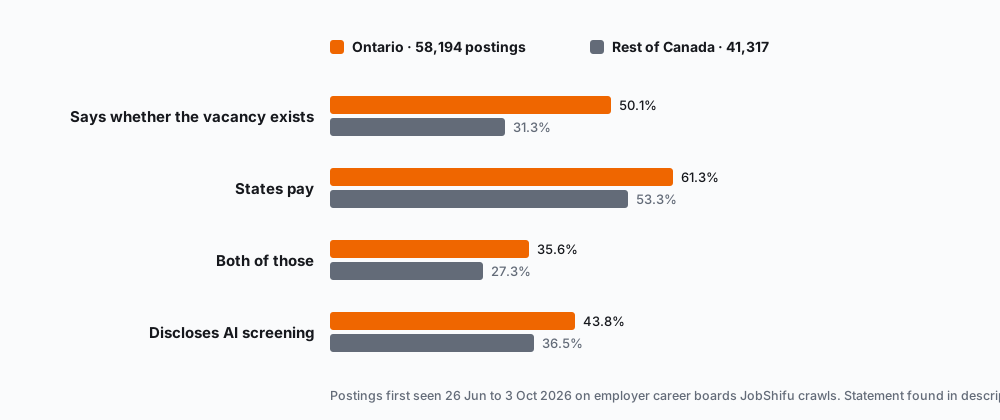
The window is every posting the crawl first saw in Ontario from 26 June (when the corpus history begins) to 3 October 2026: 58,194 postings from 1,400 employers. Counting only the 30,029 still open on 3 October gives the same picture: 49.3% carry a vacancy statement, 72.7% state pay, and 41.4% do both.
Three findings matter more than the average.
Ten employers carry the number. The ten largest employer accounts in the Ontario crawl hold 45.3% of the postings. Six of them put the statement on almost every posting, and four almost never do. Take them out and the remaining 31,833 postings, from 1,390 employers, carry a vacancy statement 33.4% of the time and both a statement and pay 21.6% of the time. Among the 515 employers with at least 10 Ontario postings, 170 put the statement on most of them and 273 never use it at all.
National templates leak across the border. Postings in the rest of Canada carry the statement 31.3% of the time, though no other province requires it. That is the large employers writing one disclosure block for the whole country. It also means the Ontario number is not only Ontario employers complying. It is partly a national habit the law started.
The statement almost always says yes. Only 1.3% of Ontario postings say the role is not an existing vacancy, or is for future or pooled openings. A law can make an employer say whether a job exists. It cannot make the answer informative.
On pay, Ontario sits below British Columbia, which has required pay in postings since November 2023 [8]: 77.0% of BC postings state pay against Ontario's 61.3%. Of the 35,667 Ontario postings with a two-ended pay range, 1,865 (5.2%) span more than $50,000 a year, though some of those may be exempt roles over $200,000.
What this means if you are applying in Ontario
- Read the statement, then check it. "This posting is for an existing vacancy" is a legal claim the employer made in writing. It is worth more than nothing. It is not proof the role is still open today.
- Treat silence as a question, not an answer. About half of postings carry no statement. Many of those come from employers under 25 people, who are exempt, or from boards that put the notice outside the job text. Silence is a reason to check, not a verdict.
- Check the employer's own board. A posting that is gone from the employer's careers site but still live on an aggregator is the most common ghost of all. The free checker does that lookup from a pasted link, and how long postings stay open tells you what "old" means in practice.
New York, New Jersey and California, in detail
New York. S8877, sponsored by Senator Michael Gianaris, passed the Senate on 28 April 2026 and the Assembly on 2 June 2026, substituting for A6292 [2]. It goes further than Ontario on timing: a covered posting has to say in bold capitals when the employer expects to fill the role, or that it is collecting resumes for future openings. It applies to employers with 100 or more employees and to third-party job sites, with fines of $2,500 per violation and more if a posting stays uncorrected [3]. It takes effect immediately if signed. It has not been signed as of 3 October 2026.
New Jersey. A1161 cleared the Assembly Labor Committee in March 2026 [5], and S2136, sponsored by Senator Paul Moriarty, cleared the Senate Labor Committee on 11 May 2026 [4]. Both require a posting to say whether it is for an existing vacancy, require removal within two weeks of filling it or 30 days after posting, whichever is later, and require employers to tell interviewed candidates where they stand. We found no record of a floor vote in either chamber as of 3 October 2026.
California. AB 1251, by Assemblymember Marc Berman, passed the Assembly in 2025 and has been held under submission in Senate Appropriations since 29 August 2025, with no action since [6].
Pay range laws are already in force
These do not require a vacancy statement, but they change what you can expect to see in a posting:
- New York: a pay range on postings from employers with 4 or more employees, since 17 September 2023 [9].
- California: a pay scale on postings from employers with 15 or more employees, since 1 January 2023 [10].
- New Jersey: wage or salary, or a range, plus a description of benefits, from employers with 10 or more employees, since 1 June 2025 [11].
- British Columbia: expected pay or a pay range on all public postings, since 1 November 2023 [8].
Common questions
Is it illegal to post a ghost job?
In Ontario, a covered employer must say whether a public posting is for an existing vacancy, so a posting that hides the answer breaks the Employment Standards Act. Nowhere else in this tracker has a ghost job law in force as of 3 October 2026. New York's bill passed both houses on 2 June 2026 and awaits the governor. New Jersey's bills are in committee, and California's has not moved since August 2025.
Do employers in Ontario actually include the vacancy statement?
About half do. Of 58,194 Ontario postings first seen from 26 June to 3 October 2026, 50.1% carried a statement on whether the vacancy exists, and 35.6% carried that statement and a pay figure. Without the ten largest posters, the vacancy statement falls to 33.4% of postings.
Does "this posting is for an existing vacancy" mean the job is real?
It means the employer stated in writing that the role is imminently available, which is a claim it can be held to. It does not tell you the role is still open today. Check whether the employer's own careers board still lists the posting before you spend an evening on the application.
What is New York's ghost job bill?
S8877 would require employers with 100 or more employees, and job sites, to state when they expect to fill a role, or that a posting is collecting resumes for the future. It also requires taking a posting down within two weeks of filling it. Fines start at $2,500 per violation. It passed both houses on 2 June 2026 and was not signed as of 3 October 2026.
Method
- Data. Postings on employer career boards that JobShifu crawls, located in Canada, first seen between 26 June and 3 October 2026, with more than 200 characters of description text. Ontario means the posting's resolved place is in Ontario, or it has no resolved place and its location names Ontario, Toronto, Ottawa or Mississauga. Employers are the crawl's company records, so a few large employers appear under two names.
- Vacancy statement. A pattern match on the posting text for a statement of vacancy status ("this posting is for an existing vacancy", "not for an existing vacancy", "reason for vacancy", "vacancy status", and their variants, with French equivalents). The full pattern is in the dataset. On a random sample of 773 Ontario postings, all 40 sampled matches were genuine statements, and the near misses we read were not.
- Pay. JobShifu's pay extractor found a figure or range in the posting.
- What this cannot see. Employer headcount, so exempt employers under 25 people are in the denominator. Text shown on a careers page outside the job description. Whether a statement is true. There is also no pre-law baseline, because the corpus history begins in late June 2026.
- Dataset. The aggregates are published under CC BY 4.0 as ontario-posting-disclosure-2026-10-03.json, with every province for comparison. Cite as: JobShifu, Ontario job posting disclosure rates, 2026, with a link to this post. No posting text is republished.
Sources
- Government of Ontario, Your guide to the Employment Standards Act: requirements related to publicly advertised job postings; consulted October 3, 2026.
- New York State Senate, Senate Bill S8877 (2025-2026), bill history; consulted October 3, 2026.
- Morgan Lewis, New York severance agreement and job posting bills await governor's signature, July 2026; consulted October 3, 2026.
- New Jersey Senate Democrats, Moriarty legislation cutting down on postings for "ghost jobs" clears committee, May 11, 2026; consulted October 3, 2026.
- New Jersey Assembly Democrats, Assembly Labor Committee passes bill to crack down on "ghost job" listings, March 16, 2026; consulted October 3, 2026.
- California Legislative Information, AB-1251 Job postings, bill status; consulted October 3, 2026.
- Government of Ontario, O. Reg. 476/24: Rules and exemptions re job postings; consulted October 3, 2026.
- Government of British Columbia, Guidance on wage or salary information on job postings; consulted October 3, 2026.
- New York State Department of Labor, Pay transparency; consulted October 3, 2026.
- California Legislative Information, Labor Code section 432.3; consulted October 3, 2026.
- New Jersey Department of Labor and Workforce Development, Pay transparency; consulted October 3, 2026.